Did Jesus Exist?
A Mountain of Proof Outside the Bible

John Di Giorgio
October 4, 2026
A Troubling Claim
In hidden-camera footage recorded by The Daily Wire at St. Andrew's Presbyterian Church in Austin, Texas, the church's pastor, Rev. Babs (Babsylon) Miller, pastor of the controversial James Dell Talarico, American politician, and Presbyterian seminarian, made a startling statement:
"We have no way of knowing if Jesus really existed."¹
She went on to say that Jesus was executed as a political dissident, and not as an atoning sacrifice for the sins of the world:
"Jesus didn't die to save us from our sins."¹
Understand this: Rev. Babsylon Miller is not an uneducated woman. She brings decades of graduate-level education, vocational training, and ministerial experience to her work. Her statements did not come from ignorance.
False Teachers Will Come
Now, Jesus Himself told us this day would come. In the Sermon on the Mount He warned: "Beware of false prophets, who come to you in sheep's clothing, but inwardly they are ravenous wolves. You will know them by their fruits" (Matthew 7:15–16). Later He added: "Many false prophets will rise up and deceive many" (Matthew 24:11), and "False christs and false prophets will rise and show great signs and wonders to deceive, if possible, even the elect" (Matthew 24:24).
Notice the words: they "will rise and deceive many." False teachers do not announce themselves. They rise from within, with credentials, with sincerity, and with the language of religion on their lips, and many are led astray because the deception looks so respectable.
Notice also the direction: they "come to you." You do not have to go looking for them. They arrive at the front door, and they come "in sheep's clothing." In other words, they look gentle and harmless. They wear the robes, hold the pulpit, and quote the Scriptures, but inwardly they are not just wolves, but ravenous - eager for gratification, with a strong desire to eat and satisfy their needs!
Peter adds that they "will secretly bring in destructive heresies, even denying the Lord who bought them" (2 Peter 2:1). Think about that: denying the Master who paid the price for them. Sounds a lot like Rev. Babs, doesn't it? And what is their ultimate motive? "They will exploit you in their greed with made-up stories" (2 Peter 2:3, CSBA). Jude says they "They turn the grace of our God into uncontrollable lust and deny our only Master and Lord, Jesus the Messiah (Jude 1:4). Rev. Babs is a lesbian "pastor." She has turned the grace of God into uncontrolable lust and denied our only Master and Lord, indeed!
But thank God, beloved, we are not defenseless. The Holy Spirit leads us into all truth, and Jesus gave us the test: "You will know them by their fruits" (Matthew 7:16). What are some of those fruits?
-
Lifestyle. Do they walk as Jesus walked? (1 John 2:6). You can know them by the way they conduct their lives.
-
Theology. Do they confess the divinity of Christ and the authority of Scripture? You will know them by what they say, teach, proclaim. And if it does not match Scriptures, run from them!
-
The Cross. Do they believe in the sacrificial atonement Christ made for us? That Christ, and Christ alone paid for all our sins in full with His perfect, sinless life, precious blood, death on the Cross and yes, resurrection from the dead!
Those who know these verses have seen this before. The same claims, in different clothing, have been leading people astray for centuries.
What the Bible Declares
Yet, the Bible is clear: Jesus Christ is God. Throughout the New Testament He stands not merely as a moral teacher or a prophet, but as the eternal Creator clothed in human flesh.
John 1:1 and 1:14 establish His divine pre-existence: "the Word was God", and that Word "became flesh and dwelt among us." Jehovah-Jesus became human! Jesus claimed His deity directly: "I and My Father are one" (John 10:30). He took to Himself the sacred covenant name of God: "Most assuredly, I say to you, before Abraham was, I AM" (John 8:58). Paul affirms that "in Him dwells all the fullness of the Godhead bodily" (Colossians 2:9) and calls Him "our great God and Savior Jesus Christ" (Titus 2:13). And God the Father Himself says to the Son, "Your throne, O God, is forever and ever" (Hebrews 1:8).
"Jesus didn't die to save us from our sins."
Really? Out of boundless love and perfect holiness, Jesus made full, substitutionary atonement on the cross, bridging the infinite divide that our sin had created. "Jesus died as a sacrifice to take the punishment for our sin. Then God could forgive us. Jesus did that not only for us. He did it for all people in the world, so that God could forgive them for their sins. (1 John 2:2, EASY). John the Baptist saw Him and cried, "Behold! The Lamb of God who takes away the sin of the world!" (John 1:29). On Calvary, Christ "Himself bore our sins in His own body on the tree" (1 Peter 2:24), satisfying divine justice and making saving grace available to every person (Titus 2:11). He is "not willing that any should perish but that all should come to repentance" (2 Peter 3:9), and He offers eternal life as a free gift to "whoever believes in Him" (John 3:16). I guess Rev. Babsylon never read these verses.
Are You Ready to Give an Answer?
But let me ask you, beloved: if a skeptical friend told you there is no evidence for Jesus, the Jesus of the New Testament, would you be able to reason with him or her from the pages of history? Could you build a case for Christ without using the Bible?
That is an important question. Our faith rests securely on the Word of God, but we are not asked to believe in a fictional character who appeared out of nowhere. Jesus stepped into human history. His life, death, followers, and teachings were witnessed and discussed far beyond the pages of the New Testament.
And the Bible tells us what to do: "Always be ready to give a defense to everyone who asks you a reason for the hope that is in you, with meekness and fear" (1 Peter 3:15).¹⁰ In other words, when someone asks you about your hope, be ready. How? Here is one way.
Five Voices from Outside the Faith
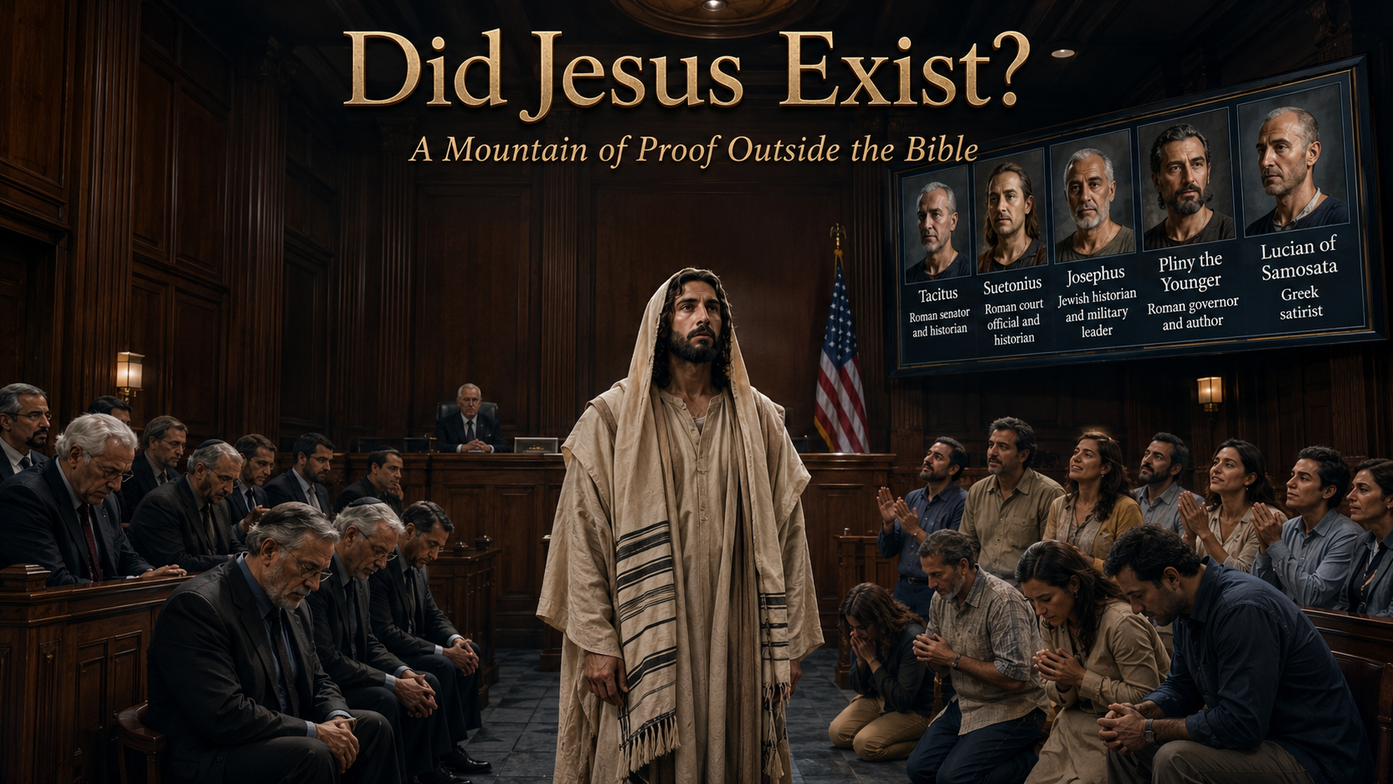
Believe it or not, we can find witnesses to the historicity of Christ outside the Bible. And for a brief moment, I want you to follow me as we examine just five witnesses (out of many). These were historians and writers with no Christian commitment, and in several cases they were openly hostile to Christ and His followers:
-
Tacitus, the Roman senator and historian
-
Suetonius, the Roman court official and historian
-
Josephus, the Jewish historian and military leader
-
Pliny the Younger, the Roman governor and author
-
Lucian of Samosata, the Greek satirist
Again, keep this in mind: these men were not trying to promote Christianity. They were reporting what they understood to be historical facts.
So when someone says, "We have no way of knowing if Jesus really existed," or "There's not a shred of evidence outside the Bible," we have a simple response:
Really? Let's take a moment to shred that theory to pieces?
The Historical Reality
For generations, critics have tried to make Jesus disappear from history. Yet the evidence is so substantial that the overwhelming consensus of serious scholarship, even among scholars highly critical of the New Testament, holds that Jesus lived and had an extraordinary impact on first-century Judea and the world beyond.
Even Skeptics Agree
Neil Carter, who had a seminary education and served as a church elder before becoming an atheist, wrote a defense of the historicity of Jesus:
"I can't believe I'm feeling the need to do this, but today I'd like to write a brief defense of the historicity of Jesus. When people in the skeptic community argue that Jesus never existed, they are dismissing a large body of work for which they have insufficient appreciation, most often due to the fact that they themselves have never formally studied the subject."²
Dr. Bart Ehrman, the respected historian and professed agnostic, put it even more plainly:
"There is no serious historian who doubts the existence of Jesus. There are a lot of people who want to write sensational books claiming that Jesus didn't exist, but I don't know any serious scholar who doubts the existence of Jesus."³
If those two voices were not enough, let's look at some the evidence itself.
1. Tacitus: The Roman Historian
Publius Cornelius Tacitus lived from about A.D. 56 to A.D. 120. He recorded how, after the great fire of Rome in A.D. 64, Nero shifted the blame onto the Christians:
"Nero fastened the guilt and inflicted the most exquisite tortures on a class hated for their abominations, called Christians by the populace. Christus, from whom the name had its origin, suffered the extreme penalty during the reign of Tiberius at the hands of one of our procurators, Pontius Pilatus, and a most mischievous superstition, thus checked for the moment, again broke out not only in Judea, the first source of the evil, but even in Rome."⁴
Look at what this hostile historian gives us: a group (Christians); a Person (Christus); a method of death (the "extreme penalty," that is, crucifixion); a time (the reign of Tiberius); a governor (Pontius Pilate); a place (Judea); and a movement that had spread all the way to Rome. This matches the basic outline of the Gospels. Tacitus does not argue that Jesus existed. He presupposes it.
2. Suetonius: The Court Historian
Suetonius served in the imperial court of Rome. He wrote of the emperor Claudius:
"As the Jews were making constant disturbances at the instigation of Chrestus [an alternate spelling associated with Christ], he [Claudius] expelled them from Rome."⁵
And of Nero:
"Punishment by Nero was inflicted on the Christians, a class of men given to a new and mischievous superstition."⁶
Luke records the same expulsion in Acts 18:1–2, where Paul meets Aquila and Priscilla, who had recently come from Italy "because Claudius had commanded all the Jews to depart from Rome." The picture is not built on one isolated sentence. It is strengthened by multiple, independent references to the early Christian movement.
3. Flavius Josephus: The Jewish Historian
Josephus, a Jewish historian and military leader, wrote a monumental history of his people for a Roman audience. In it he speaks of Jesus:
"Now there was about this time Jesus, a wise man, if indeed one ought to call him a man, for he was a doer of wonderful works, a teacher of such men as receive the truth with pleasure. He drew over to him both many of the Jews, and many of the Gentiles."⁷
"He was [purported to be] the Christ; and when Pilate, at the suggestion of the principal men amongst us, had condemned him to the cross, those who loved him at first did not forsake him; and the tribe of Christians, so named from him, are not extinct at this day."⁷
Listen to what Josephus records. He places Jesus in a specific time. He calls Him a teacher and a doer of wonderful works who drew both Jews and Gentiles. He connects Him with Pontius Pilate and the cross. And he observes that the Christians, named after Jesus, were still there in his own day.
That last line is striking: "the tribe of Christians … are not extinct at this day." The movement had survived, and Josephus could see it with his own eyes. Keep that in mind, beloved! We'll be coming back to that in a moment.
4. Pliny the Younger: The Roman Governor
Pliny wrote as a Roman official dealing with a religious movement in his province, around A.D. 112. This is not a Christian source. Pliny reports that the Christians:
"were in the habit of meeting on a certain fixed day before it was light, when they sang in alternate verse a hymn to Christ as to a god, and bound themselves to a solemn oath, not to do any wicked deeds, and never to deny a trust when they should be called upon to deliver it up."⁸
Here an outsider describes believers gathering, singing to Christ as God, and binding themselves to a moral life, just as we see in the New Testament.
5. Lucian of Samosata: The Mocking Satirist
Lucian was a gifted Greek writer and orator who mocked Christianity. Yet even in ridicule he confirms the historical claims:
"The man who was crucified in Palestine because he introduced this new cult into the world … Furthermore, their first lawgiver persuaded them that they were all brothers one of another after they have transgressed once for all by denying the Greek gods and by worshiping that crucified sophist himself and living under his laws."⁹
Despite his contempt, Lucian gives us a man, crucified in Palestine; a movement centered on his teaching; followers who called one another brothers; a rejection of the old gods; and a determination to live by his laws. Lucian did not believe the message, but even this hostile witness recognized Jesus as a real person around whom a real movement had formed.
No Way of Knowing If Jesus Really Existed?
There's a word for that in Italy: Bologna!
Not only is there evidence, there is a mountain of historical data about the existence of Christ, His teachings, His followers, His death, and the rapid spread of the movement that bears His name. Numerous non-Christian sources survive from within roughly 150 years of Jesus, and they support major features of His life, death, and ministry.
Fifteen Points from the Historical Record
Different witnesses. Different motives. The same Jesus.
OUTSIDE the Bible |
INSIDE the Bible |
|---|---|
1. Jesus lived in the time of Pontius Pilate and the reign of Tiberius Caesar (Tacitus). |
1. “In the fifteenth year of the reign of Tiberius Caesar, Pontius Pilate being governor of Judea…” (Luke 3:1; Matthew 27:2) |
2. Jesus lived a moral, upright life (Josephus). |
2. “He committed no sin, nor was deceit found in His mouth.” (1 Peter 2:22; Hebrews 4:15) |
3. Jesus was regarded as a wonder worker (Josephus). |
3. “Jesus of Nazareth, a Man attested by God to you by miracles, wonders, and signs…” (Acts 2:22; John 20:30) |
4. Jesus had a brother named James (Josephus; the James Ossuary inscription, though its authenticity is debated). |
4. “Is this not the carpenter’s son? Is not His mother called Mary? And His brothers James, Joses, Simon, and Judas?” (Matthew 13:55; Galatians 1:19) |
5. Jesus was acclaimed to be the Messiah (Josephus; Mara bar-Serapion). |
5. “You are the Christ, the Son of the living God.” (Matthew 16:16; John 4:25–26) |
6. Jesus was handed over by leaders of His own people (Josephus). |
6. “Your own nation and the chief priests have delivered You to me.” (John 18:35; Matthew 27:1–2) |
7. Jesus was brutally executed (Mara bar-Serapion; the Alexamenos Graffito). |
7. “He was wounded for our transgressions, He was bruised for our iniquities.” (Isaiah 53:5; Mark 15:15–20) |
8. Jesus was crucified under Pontius Pilate (Tacitus; Josephus; the Yehohanan ossuary, which shows the reality of Roman crucifixion). |
8. “…Christ Jesus who witnessed the good confession before Pontius Pilate.” (1 Timothy 6:13; Matthew 27:24–26) |
9. Jesus was crucified in Judea (Tacitus; Josephus). |
9. “And when they had come to the place called Calvary, there they crucified Him.” (Luke 23:33) |
10. Jesus was crucified around the time of Passover (the Babylonian Talmud). |
10. “Now it was the Preparation Day of the Passover.” (John 19:14; 1 Corinthians 5:7) |
11. Darkness and an earthquake were associated in later historical traditions with His death (Thallus; Phlegon; Julius Africanus). |
11. “Now from the sixth hour until the ninth hour there was darkness over all the land… and the earth quaked.” (Matthew 27:45, 51; Luke 23:44–45) |
12. Jesus’ disciples believed that He had risen from the dead (Josephus). |
12. “He is not here; for He is risen, as He said.” (Matthew 28:6; 1 Corinthians 15:3–8) |
13. Jesus’ disciples were persecuted for their faith (Tacitus; Suetonius; Pliny). |
13. “At that time a great persecution arose against the church which was at Jerusalem.” (Acts 8:1; John 15:20) |
14. Christianity spread rapidly, even as far as Rome (Tacitus). |
14. “You shall be witnesses to Me… to the end of the earth.” (Acts 1:8; Acts 28:14–16; Romans 1:8) |
15. Jesus’ disciples rejected the Roman gods and worshiped Jesus as God (Pliny the Younger; Lucian; the Megiddo church mosaic inscription). |
15. “You turned to God from idols to serve the living and true God.” (1 Thessalonians 1:9); “My Lord and my God!” (John 20:28) |
Do you see it, beloved? Those outside the Bible are confirming what is written inside the Bible! That, in itself, is a powerful testimony to the existence of Jesus of Nazareth!
The Greatest Evidence of All
But do you know what the greatest evidence for the existence of Jesus is today?
It's you!
Remembeer what Josephus observed? He said, "the tribe of Christians … are not extinct at this day." They were still thriving -- roughly 60 years after the death of Christ. And listen beloved: Nearly two thousand years later, we are still here, still ALIVE & thriving!
But ultimately, the question is not merely whether we can prove that Jesus existed. That has already been established: we can from a historical point of view! The deeper question is whether people can see that Jesus living inside of us -not the external, but internal evidence of Christ.
Yes, there is a mountain of evidence outside the Bible to help us explain the historical existence of Christ. But don't you want them to see Christ in you?
Our lives should become living evidence. Our love should point to Him. Our character should reflect Him. Our hope should testify to Him. And when the world asks why we believe, we should be able to give both a thoughtful answer and a transformed life. I mean, wouldn't it be wonderful to hear people speak of us 60 years from now saying, "the tribe of Christians … are not extinct at this day?" I know your answer. Of course you do.
Beloved, the goal is not simply to win an argument about whether Jesus existed. (We've alredy won that battle). The goal is to point people to the Jesus who is alive, who saves, who delivers, who transforms, who was raised from the dead, coming back again, and who is worthy of our praise and complete surrender.
Can I get an, Amen?
Endnotes
-
Rev. Babs Miller, St. Andrew's Presbyterian Church, Austin, Texas, in hidden-camera footage published by The Daily Wire (YouTube).
-
Neil Carter, "A Brief Defense of the Historicity of Jesus," Patheos, 2014.
-
Bart D. Ehrman, interview on Atheist Radio, December 30, 2011.
-
Tacitus, Annals 15.44.
-
Suetonius, Life of Claudius 25.4.
-
Suetonius, Lives of the Caesars: Nero 16.2.
-
Flavius Josephus, Antiquities of the Jews 18.3.3 (the Testimonium Flavianum), traditional English translation. The reference to James appears in Antiquities 20.9.1.
-
Pliny the Younger, Epistles 10.96.
-
Lucian of Samosata, The Passing of Peregrinus 11, 13.
-
1 Peter 3:15; see also Acts 18:1–2 for the expulsion of the Jews from Rome under Claudius.