LAHMI

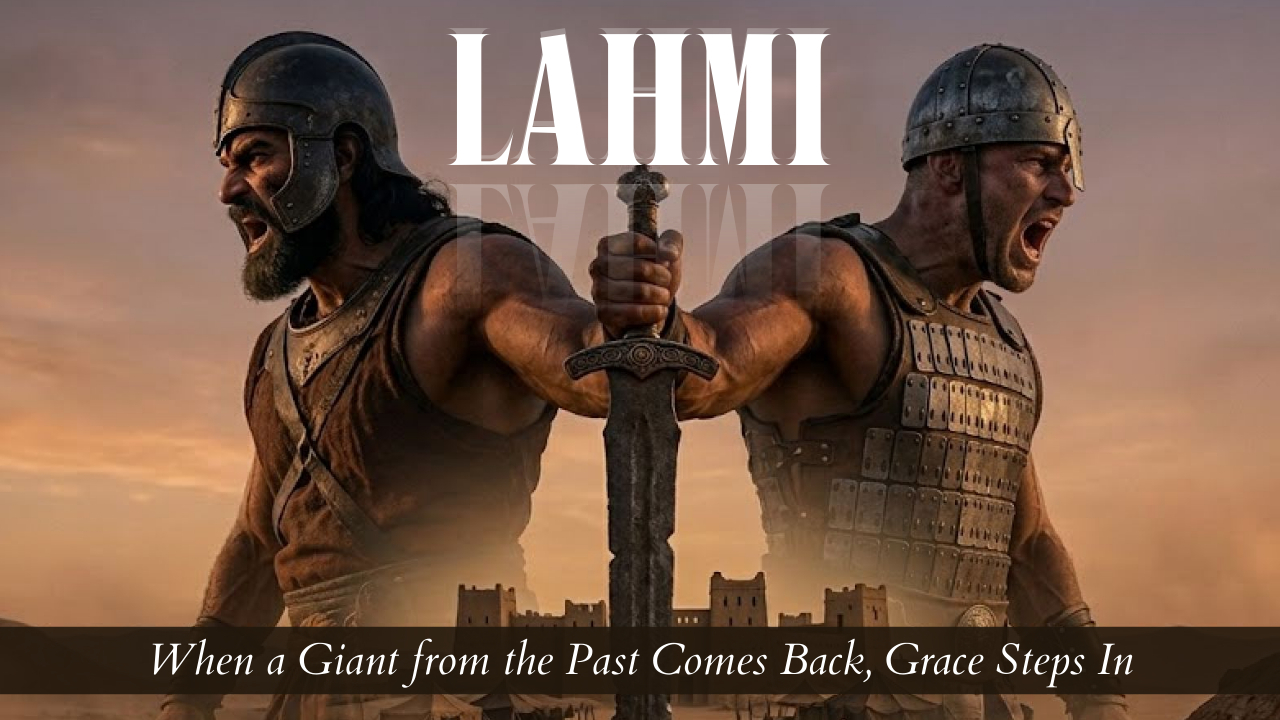
"For the GRACE of God has APPEARED, bringing salvation for all people…" — Titus 2:11
THE GIANT YOU THOUGHT WAS GONE
Most of us know the story of David and Goliath. We know about a shepherd boy, five smooth stones, and a giant who fell face-forward into the dust. It is one of the most beloved narratives in all of Scripture — a timeless reminder that with God, the underdog always has a fighting chance.
But 2 Samuel 21 introduces us to someone most people have never encountered in their Bible reading: a giant named Lahmi — the brother of Goliath.[3]
Yes, you heard right: Goliath of Gath had a brother! The text tells us that in the later years of David's life, as war broke out again between Israel and the Philistines,[2]
this towering figure emerged from the enemy's ranks bearing the same massive spear, the same terrifying stature, and the same murderous intent as his fallen brother!
Consider the scene. David is no longer the bright-eyed teenager who ran toward Goliath with a sling in his hand and a song in his heart. He is an older king now, worn by decades of warfare, grief, betrayal, and loss. And there, advancing toward him across the field of battle, is a figure who looks startlingly familiar — the same enormous frame, the same menacing spear, the same predatory gaze. The past, it seems, has sent a clone.
Have you ever experienced something like that? You fought a battle years ago and won. You thought a particular struggle — a destructive habit, a broken relationship, a season of fear or depression — was behind you for good. And then one day it reappears. The same spirit, wearing a slightly different face, yet strikingly familiar. Haunting you. Taunting you. Whispering: You thought you were free. But I'm back.
That is what David had encountered. Lahmi — Goliath's brother — staring him straight in the eyes. The name Lahmi tells us exactly what kind of spirit this is. Rooted in the Hebrew verb meaning both to eat bread and to wage war, Lahmi's name literally evokes the image of a consuming warrior — a maneater — one bent on devouring his enemy alive.[4]
His brother Goliath had wielded this same threatening language against David years before, promising to feed his flesh to the birds of the sky.[5]
Now Lahmi had come to finish what his brother had started — fueled by vengeance, hatred, and the ancient purpose of destroying God's anointed.
This is not merely ancient history. It is a portrait of how the enemy operates in your life and mine today. He does not simply want to inconvenience you or slow you down. He wants to consume you — to eat away at your peace, your faith, your sense of identity in Christ. He wants the unresolved wounds of your past to gnaw at you quietly, persistently, until there is nothing left. That is the spirit of Lahmi — a spirit fueled by the enemy whose sole goal is to steal, kill, destroy, and devour you. And it is as active today as it ever was.[1]
When the Warrior Grows Weary
Here is what makes this moment in 2 Samuel so remarkably honest — and so deeply relatable. The text does not present us with a heroic David who grits his teeth and charges forward. It tells us plainly that David had grown exhausted.[7]
This was not the sprinting shepherd boy wielding a smooth stone toward Goliath in the Elah Valley. This was a man who had been fighting for a very long time. His body was giving out. His resources were spent. And now, of all moments, a Goliath-sized enemy — a literal clone of the past — was bearing down on him.
If you have ever reached that place — that honest, bone-weary place where the battle feels endless and your strength feels gone — then you understand exactly where David stood. And you understand that at that precise moment, what you need is not more willpower. What you need is not a better strategy or a more determined effort. What you need is someone to step in and fight for you.
The young David had stood before Goliath with magnificent, God-given confidence and proclaimed:
"Today the LORD will help me defeat you… The LORD doesn't need swords or spears to save His people. The LORD always wins His battles, and He will help us defeat you."
That declaration was true when David was seventeen. And it is just as true when we are seventy — or when we simply feel seventy after a season that has drained us dry. The battle belongs to the Lord. It always has. And the seasons when we are weakest are often the seasons when He is most clearly seen.[6]
Elhanan: When Grace Has a Name
When David could fight no more, God did not abandon him on the field. He did not turn away from an exhausted soldier and look for someone more capable. He sent a man named Elhanan.
"There was war again with the Philistines, and Elhanan the son of Jair… struck down Lahmi the brother of Goliath the Gittite." — 2 Samuel 21:19
Elhanan. Take a moment and let that name settle over you. It is a compound Hebrew name: El (God) and chanan (to be gracious). Elhanan means, literally: God is gracious — or, The grace of God.[8]
Do you see how David gained the victory over the clone of the past? The Grace of God STRUCK DOWN LAHMI the brother of Goliath!
Hallelujah.
When David was exhausted, when the giant of the past was advancing toward him with a spear in hand, when there was simply nothing left in his aging body — God sent Grace to fight the battle. Grace stepped in. Grace killed Lahmi. Grace won the victory that David could not win on his own.
The Apostle Paul understood this principle at the deepest personal level. He was a man of remarkable gifts and staggering spiritual accomplishments — and yet he described a season in his own life when he felt buffeted and beaten by a messenger of Satan,[9]
pummeled from every side and unable to make it stop. He went to the Lord three times, asking for deliverance. And God's answer was not what Paul expected:
"My grace is sufficient for you, for my power is made perfect in weakness." — 2 Corinthians 12:9
The world insists that strength wins battles. God reveals that grace does. When we are strong, we are tempted to fight in our own power and take the credit. But when we are weak — truly, honestly, humbly weak — we become transparent vessels through which the grace and power of God flow without obstruction. People look at us and they do not see our resolve. They see His.
How to Face the Spirit of Lahmi
Perhaps as you have been reading, you have recognized Lahmi — not as a Philistine giant, but as something that has been quietly gnawing at your own life. A familiar spirit of condemnation. A voice that resurrects the failures of your past and whispers that you have gone too far, fallen too many times, or that God has simply run out of patience with you.
If that is where you are today, I want you to understand something before anything else: the answer to Lahmi was never David's sword. The answer was a name. Elhanan. The grace of God.
Grace Has Appeared
Paul wrote to young Titus with a declaration that should stop every weary believer in their tracks: "For the grace of God has appeared, bringing salvation for all people" (Titus 2:11). That word appeared — the Greek epephanē — is the same root from which we get "epiphany." It does not merely describe an idea arriving on the scene. It describes a blazing, luminous manifestation. An unveiling. A sunrise after a night that seemed it would never end.
Grace did not whisper its way into human history. Grace appeared — in a manger, in Galilee, on a cross, from an empty tomb. The Apostle John captured it with breathtaking precision: "And the Word became flesh and dwelt among us, and we have seen His glory, glory as of the only Son from the Father, full of grace and truth" (John 1:14). Jesus is not merely the messenger of grace. He is grace — walking, speaking, healing, weeping, bleeding, and rising.[10]
When Elhanan stepped onto that ancient battlefield and struck down Lahmi the brother of Goliath, it was a shadow, a foreshadowing, of something infinitely greater. It was a preview of the moment when Jesus Christ, the very embodiment of divine grace, would step onto the battlefield of human sin and death and strike down the ultimate enemy — once and for all, forever.
What Grace Actually Means
In the Hebrew of the Old Testament, the primary word for grace is חֵן — chen. It is a small word carrying enormous weight. Rooted in the idea of bending down, chen describes the posture of one who is greater stooping low toward one who is lesser — not out of obligation, but out of sheer delight. It is the image of a king who sees a beggar in the street and, rather than passing by, descends from his chariot, kneels in the dust, and lifts that beggar to his feet.[11]
Messianic pastor Jonathan Cahn writes that chen is "the undeserved kindness of the King — not earned, not merited, not demanded. It flows from His nature. To receive chen is to be seen by the Most High and to be favored — not because of who you are, but because of who He is."[12]
The New Testament word — charis in the Greek — carries the same resonance but adds a dimension of exuberant, overflowing generosity. Charis is not a transaction. It is not God settling a debt. It is God pouring out abundance where there was nothing, and then pouring out more. Charles Spurgeon declared: "Grace is the good pleasure of God that inclines Him to bestow benefits on the undeserving. It is not a response to anything in us. It is an expression of everything in Him."[13]
In Aramaic — the language Jesus Himself often spoke — the equivalent word is taybutha, which carries connotations of goodness, beauty, and benevolence all woven together. There is an aesthetic quality to grace in the Semitic mind: grace is not only powerful, it is beautiful. It does not simply rescue you — it adorns you. It does not simply pardon you — it glorifies you.[14]
Four Handles for the Battle
With that foundation beneath our feet, here are four tested, Scripture-grounded handles for standing against the spirit of Lahmi when he comes roaring back:
- Remember: Grace Is Not Your Reward — It Is His Gift. The enemy's most sophisticated weapon is not temptation. It is the lie that you must earn your way back into God's favor after you have fallen. But grace, by its very definition, cannot be earned. "For by grace you have been saved through faith. And this is not your own doing; it is the gift of God" (Ephesians 2:8). Dr. David Jeremiah writes: "You cannot add to what God has already given. The moment you try to supplement grace with performance, you have misunderstood both grace and God." When Lahmi whispers that you are too far gone, answer him with the simplest, most devastating truth in all of Scripture: it was never about you.[15]
- Let Weakness Be Your Pulpit. The world teaches that vulnerability is dangerous. God reveals that it is sacred. When Paul begged for his thorn to be removed, God did not remove the thorn. He redeemed it: "My power is made perfect in weakness" (2 Corinthians 12:9). The Greek word teleitai means to be brought to its designed completion. Your weakness is not a design flaw — it is the very space where grace was always meant to be most fully expressed. As Corrie ten Boom declared from the ruins of everything she had suffered: "There is no pit so deep that God's love is not deeper still." Lahmi feeds on your self-sufficiency. He starves in your surrender.[16]
- Call Grace by Name. David did not merely hope Lahmi would go away. Elhanan engaged the enemy directly. In your battle, this means naming the grace of God over every area where Lahmi has taken ground. Over the addiction: "The grace of God is sufficient." Over the broken marriage: "The grace of God can restore what the locust has eaten." Over the shame of your past: "There is therefore now no condemnation for those who are in Christ Jesus" (Romans 8:1). As Messianic teacher Ray Vander Laan has noted, the Hebrew practice of blessing — bracha — was never passive. It was a declaration, an active naming of God's goodness over the circumstances of life. Bless God loudly in the places where Lahmi has been loudest.[17]
- Live in the Tense of Grace. Grace is not only what saved you at conversion. It is what sustains you at this very moment. The writer of Hebrews gives us one of Scripture's most comforting invitations: "Let us therefore come boldly to the throne of grace, that we may obtain mercy and find grace to help in time of need" (Hebrews 4:16). The phrase "time of need" in the Greek — eukairon boētheian — means timely help: assistance that arrives precisely when it is needed most. God is never early, never late. As Max Lucado writes: "Grace is not a one-time gift unwrapped at salvation. It is the oxygen of the spiritual life — inhaled with every breath, every prayer, every stumbling step toward home."[18]
The Giant Has Already Lost
Here is the final word on Lahmi, on every giant of the past, on every consuming spirit that has risen against you with familiar menace and terrifying noise:
He is already defeated.
Not because you are stronger. Not because you have finally found the right combination of discipline and determination. But because two thousand years ago, on a hill outside Jerusalem, the Grace of God appeared in a crown of thorns — and absorbed every blow that Lahmi and all his kind could ever throw — and then rose from the dead on the third day in final, irreversible, eternal victory.
Colossians 2:15 says that on that cross, Christ "disarmed the powers and authorities" and "made a public spectacle of them, triumphing over them." The Greek word apekdusamenos means to strip off completely — as a warrior strips armor from a defeated enemy. Jesus did not merely wound your adversary. He stripped him. He humiliated him. He put him on public display as a conquered foe.[19]
Lahmi may still advance toward you. He may still carry a spear. But he carries it as a defeated enemy — and the Grace of God, who lives within you by the Holy Spirit, is greater than anything advancing against you (1 John 4:4).
Are you weary today? Good. Weariness is the threshold of grace. Are you out of strategies? Wonderful. Your emptiness is the very vessel He has been waiting to fill. Are you staring at a giant who looks exactly like the one you thought you had left behind forever? Then look past him — because standing just behind you, spear already raised, is Elhanan. The grace of God. And He never loses.
"And after you have suffered a little while, the God of all grace, who has called you to His eternal glory in Christ, will Himself restore, confirm, strengthen, and establish you." — 1 Peter 5:10
NOTES & SOURCES
[1] John 10:10 — "The thief comes only to steal and kill and destroy; I came that they may have life and have it abundantly." (ESV)
[2] 2 Samuel 21:15 — "There was war again between the Philistines and Israel, and David went down together with his servants, and they fought against the Philistines." (ESV)
[3] 2 Samuel 21:19 — "And there was again war with the Philistines at Gob, and Elhanan the son of Jaare-oregim, the Bethlehemite, struck down Goliath the Gittite, the shaft of whose spear was like a weaver's beam." See also 1 Chronicles 20:5. (ESV)
[4] Strong's Hebrew #3935 (Lahmi) and #3898 (lacham) — to fight, wage war, consume. The BDB Lexicon notes the dual connotation of bread/warfare in the root. See also Wilhelm Gesenius, Hebrew and Chaldee Lexicon to the Old Testament Scriptures (1847).
[5] 1 Samuel 17:44 — "Come to me, and I will give your flesh to the birds of the air and to the beasts of the field." (ESV)
[6] 1 Samuel 17:45–47 (CEV, adapted). The speech affirms that "the LORD always wins His battles" — a declaration of faith that remains eternally valid regardless of the believer's age or condition.
[7] 2 Samuel 21:15 — "David grew weary." The Hebrew wayyi'ap denotes exhaustion to the point of collapse. See Robert Alter, The David Story: A Translation with Commentary (W. W. Norton, 1999), 338.
[8] Strong's Hebrew #0445 — Elhanan: from El (God, #0410) and chanan (to be gracious, #2603). Francis Brown, S. R. Driver, and Charles Briggs, A Hebrew and English Lexicon of the Old Testament (Oxford: Clarendon, 1907), 337.
[9] 2 Corinthians 12:7–9 — "…a thorn was given me in the flesh, a messenger of Satan to harass me… Three times I pleaded with the Lord about this, that it should leave me. But He said to me, 'My grace is sufficient for you, for my power is made perfect in weakness.'" (ESV)
[10] John 1:14 — "And the Word became flesh and dwelt among us, and we have seen His glory, glory as of the only Son from the Father, full of grace and truth." (ESV). The Greek plērēs charitos kai alētheias is best rendered as saturated with grace and truth — not merely possessing them, but overflowing with them.
[11] Strong's Hebrew #2580 (chen) — grace, favor. Rooted in #2603 (chanan), to bend or stoop in kindness toward one who is lower. See Gesenius, Hebrew and Chaldee Lexicon, 265. The posture of bending is built into the root structure of the word.
[12] Jonathan Cahn, The Book of Mysteries (FrontLine, 2016), Day 121. Cahn is a Messianic Jewish rabbi and pastor known for Hebrew word studies applied to New Testament themes.
[13] Charles H. Spurgeon, Morning and Evening (1865), entry for "Evening, July 22." Spurgeon (1834–1892) was the pastor of the Metropolitan Tabernacle, London, and one of the most widely read evangelical preachers in history.
[14] Taybutha (Syriac/Aramaic: ܛܝܒܘܬܐ) — goodness, graciousness, benevolence. Used in the Peshitta (the Aramaic Bible) to render the Greek charis in key grace passages including John 1:14 and Titus 2:11. See J. Payne Smith, A Compendious Syriac Dictionary (Oxford: Clarendon, 1903), 195.
[15] Dr. David Jeremiah, What Are You Afraid Of? (Tyndale House, 2013), 214. Dr. Jeremiah is the founder and senior pastor of Shadow Mountain Community Church, El Cajon, CA, and host of Turning Point Radio.
[16] Corrie ten Boom, The Hiding Place (Chosen Books, 1971), 217. Corrie ten Boom (1892–1983) was a Dutch Christian who hid Jewish refugees during the Holocaust and survived Ravensbrück concentration camp. She became one of the twentieth century's most beloved voices on forgiveness and grace.
[17] Ray Vander Laan, That the World May Know film series, Vol. 6: "In the Dust of the Rabbi" (Focus on the Family, 1997). Vander Laan is a scholar of First-Century Jewish culture whose work has deeply influenced evangelical teaching on Hebrew context. The concept of bracha as active, declarative blessing is developed throughout his teaching series.
[18] Max Lucado, Grace: More Than We Deserve, Greater Than We Imagine (Thomas Nelson, 2012), 4. Lucado is the senior minister at Oak Hills Church, San Antonio, TX, and one of the best-selling Christian authors of the modern era.
[19] Colossians 2:15 — "He disarmed the rulers and authorities and put them to open shame, by triumphing over them in Him." (ESV). The Greek apekdusamenos (to strip completely, to divest) is a military term describing the stripping of armor from a defeated foe on the field of battle.
[20] Ephesians 1:7 — "In Him we have redemption through His blood, the forgiveness of our trespasses, according to the riches of His grace." (ESV). The Greek ploutos (riches) denotes an abundance that is inexhaustible in supply, not a fixed or finite amount.
[21] Ephesians 1:6 (KJV) — "…He hath made us accepted in the beloved." The Greek kecharitōmenos (accepted, highly favored) is a perfect passive participle, indicating a completed action with ongoing effect: you were accepted and remain accepted. For the Hebrew concept of kabbalat panim, see Zev Porat, Yeshua Discovered (Messianic Bible Society, 2018), ch. 7.
[22] Philippians 1:6 — "And I am sure of this, that He who began a good work in you will bring it to completion at the day of Jesus Christ." (ESV). The Greek epitelesei (to bring fully to completion) carries the sense of a master craftsman finishing his work — not abandoning it mid-project.