Renewed Day by Day
The Inside Job of our Gracious God

John Di Giorgio
August 19, 2026
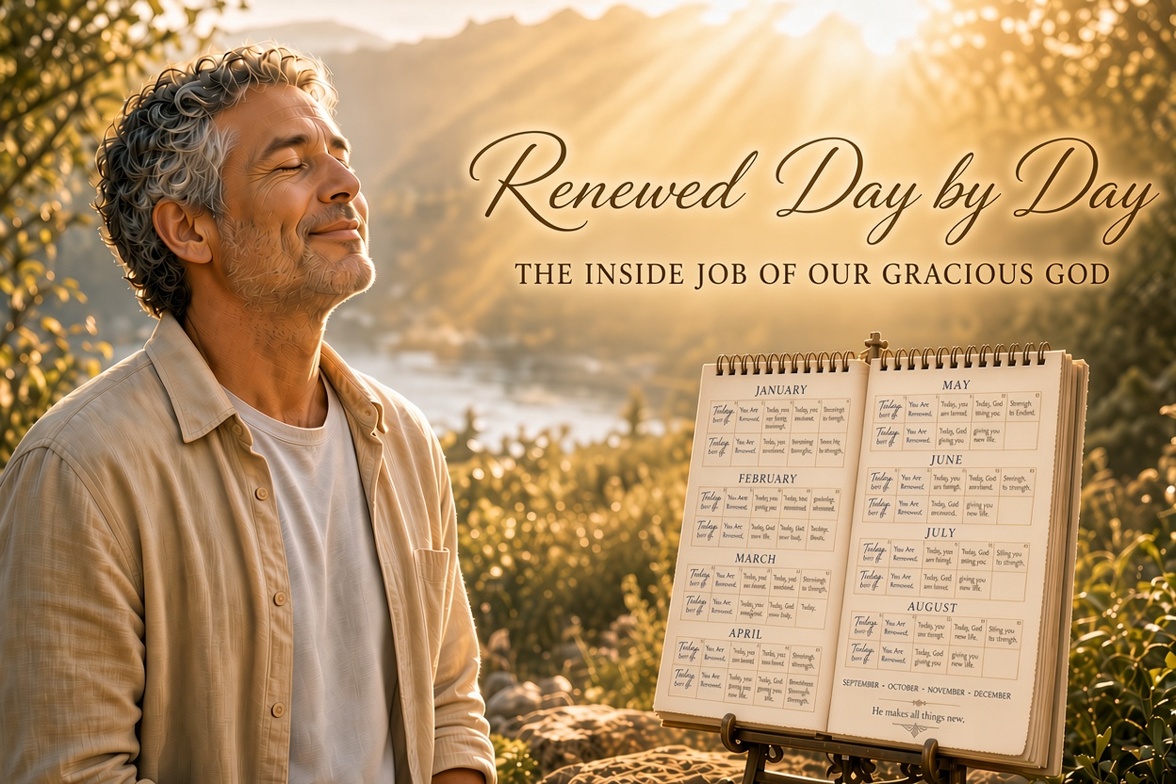
There is a war going on right now — and you are the battlefield.
Not a war of bombs and bullets, but a war between two people who live in the same body: the outward person, who is wasting away a little more with every sunrise, and the inward person, who is being built up, strengthened, and made new with every single one of those same sunrises. One is dying. One is being reborn. And both are happening to you — today.
This is not poetry. This is not wishful thinking scrawled to make hard times feel bearable. This is revelation — given by the Holy Spirit to a man who had absolutely nothing left to give.
The Desperate Flight from a Dangerous Fight
Picture the scene. The Apostle Paul has just fled Ephesus with his life, chased out by a riot so violent the whole city was in an uproar.¹ He crosses into Macedonia — not to rest, but to keep running. His body is battered. His nights are sleepless. His heart is heavy with news of a church in crisis and a betrayal that has cut him to the bone.
This is not Paul the invincible apostle of the stained-glass window. This is Paul the man — aching joints, trembling hands, a body he himself describes in Hebraic terms as adamah, dust of the ground, formed and fragile.² He does not deny his weakness. He names it. He calls his own body exactly what it is:
a jar of clay.
And it is from this place — not from a mountaintop, not from a place of strength, but from the valley floor of exhaustion — that heaven opens and Paul writes down one of the most powerful sentences in all of Scripture:
*"Therefore we do not lose heart. Even though our outward man is perishing, yet the inward man is being renewed day by day."*³
Beloved, if you are reading this from a hospital bed, from a grief you cannot outrun, from a diagnosis that has rearranged your whole world — this word was written for you. Not written by a man who had it all together, but by a man who had nothing together except the promise of God.
The Divine Word That Alters Your World
Now let us go where the English cannot take us. Let us go into the Greek, because in the Greek, the ceiling opens.
The word Paul chooses for "renewed" is anakainóō (ἀνακαινόω) — pronounced uh-nah-kai-NOH-oh.⁴ This is not a soft word. This is not a Sunday-school word. This is a word forged for resurrection.
Break it open and look inside:
-
The prefix carries the sense of "up," "again," "from the ground up" — a completing of a process from bottom to top.⁵
-
The root does not simply mean "new" in the sense of time — as in, "I bought a new car." It means new in kind, new in quality, new in essential nature — a newness that has never existed in this form before.⁶
Fuse them together and you do not get a patch job. You do not get a tune-up. You get total renovation from the foundation up.
God is not recharging your old battery, friend. **He is installing a new power source entirely — one that runs on resurrection current.**⁷
The Heavenly Plan from the Carpenter’s Hand
Picture an old historic home — the kind with a wraparound porch and a sagging roof, weathered by fifty winters, its foundation cracked, its wiring frayed, its walls soft with rot. Now picture a master craftsman walking through the front door.
He does not grab a paintbrush.
He grabs a sledgehammer.
He tears out what is rotten down to the studs. He rips out the old wiring. He replaces cracked beams with steel. He does not cover the decay — *he removes it.*⁸ And when he is finished, what stands is not the old house with a fresh coat of paint. It is a new structure, built on the bones of the old, but infinitely stronger, infinitely more beautiful.
That is what the Holy Spirit is doing in you right now. While the outer walls of your life take hit after hit from sickness, sorrow, and the slow decay of time,⁹ inside, behind the drywall of your soul, the greatest Craftsman who ever lived is already at work with hammer and nail — not fixing you up, but making you new.
A woman I'll call Renee spent eleven months walking her husband through late-stage cancer. She told me, "My body was falling apart from exhaustion. I hadn't slept a full night in months. But somewhere in that year, something in me got stronger, not weaker. I couldn't explain it with logic. I could only explain it with Scripture — the inward man is being renewed." Renee's outward woman was perishing daily in that hospital room. But something inside her was being built that no chemotherapy, no exhaustion, no grief could touch.
That is not a coincidence. That is anakainóō.
Two Grammatical Gems and Their Grace-Filled Stems
Scripture does not waste a syllable. Every tense, every voice is Spirit-breathed.¹⁰ And when we examine the grammar of this verse, two breathtaking truths rise to the surface.
First — the passive voice. In Greek grammar, passive voice means the subject receives the action rather than performing it.¹¹ Read that again. You are not the one renewing yourself. You are not gripping the hammer. You are not the contractor. You are the house. God is the Builder.
This truth alone can set a weary soul free. Your part is not to manufacture spiritual strength through sheer performance, willpower, or emotional hype. Your part is surrender — daily, honest, unglamorous surrender — while the Craftsman does what only the Craftsman can do.
Second — the present tense. Greek present tense signals continuous, uninterrupted, ongoing action.¹² Not something that happened once at your conversion and is now finished. Not something you're merely hoping for on the other side of eternity. Happening. Right. Now.
-
On the morning you get the phone call from the doctor you were dreading — you are being renewed.
-
On the afternoon your prayers feel like they're hitting the ceiling — you are being renewed.
-
On the night the tears finally come and won't stop — you are being renewed.
The construction crew of heaven does not clock out because you are having a bad day.¹³ Grace does not take a lunch break.
The Continuous Way of His Constant Grace
And here we come to the phrase that unlocks it all: day by day.
In the original text, this phrase carries an intensified, doubled construction — a Hebraism, a rhythm borrowed straight from the Hebrew Scriptures, where repeating a word back-to-back does not mean ordinary. It means extraordinary.¹⁴ It is the same pattern behind "holy, holy, holy" — repetition as the language of infinite intensity.¹⁵
So "day by day" is not a line item on God's calendar. It is not "Someday, He'll get around to you." It means: *relentlessly. Without exception. Without a single day skipped. Ever.*¹⁶
Some mornings you will feel the renewal like fire in your bones. Other mornings you will hear a song that lifts your spirit. Other days, you will hear the holy whisper of the Spirit reminding you of a promise. There are other days when you feel absolutely nothing — and God will still be renewing you even then, the way a seed does its deepest work in the pitch-black soil where no one can see it growing.
The Expanded View of What He Will Do
If we could stretch this single Greek verb out across every shade of meaning it carries, it might read something like this:
Though the outward man is wasting, wearing, and weakening toward the grave, we do not lose heart — because deep within, in the hidden chamber where the Spirit dwells, God Himself is continually restoring what has been diminished, reviving what has grown faint, repairing what has been broken, deepening what is shallow, strengthening what is weak, reordering what is disordered, and progressively conforming us to the image of the One who made us.
This is not a one-time event. It is not something God did for you the day you believed and then walked away from. It is a work happening now — morning after morning, moment after moment, in season and out of season — whether you feel strong or feel like you're falling apart.
Even while something is being taken from you outwardly, something greater is being added to you inwardly. Even while the visible man weakens, the invisible man grows mighty. God is not merely keeping you alive — He is making His life in you increasingly, undeniably evident.
And this renewal has a destination. It is not aimless. It is carrying you — day by day — toward deeper knowledge of Him, richer fellowship with Him, and fuller Christlikeness, until what is happening invisibly on the inside finally, gloriously, breaks out into the visible.¹⁷
A Timeless Message for the Fragile Vessel
So hear this, beloved, however cracked your clay feels today:
The world sees a jar that is chipped, fading, running out of time. But God is not looking at the outside of the vessel. He is looking at what He is building on the inside of it — and He is not finished. He was not finished with Paul on that road out of Ephesus, bruised and running for his life. He is not finished with you.
Your body may be tired. Your circumstances may be crumbling. But somewhere beneath the surface, unseen by every eye but His, the Master Craftsman is still swinging His hammer, still laying new beams, still making all things new.
Not someday. Not eventually.
Day. By. Day.
Endnotes
-
See Acts 19:23–41 for the account of the Ephesian riot that preceded Paul's departure for Macedonia.
-
Cf. Genesis 2:7, where adam is formed from adamah ("ground/dust"), the Hebrew wordplay underlying Paul's "jar of clay" imagery in 2 Corinthians 4:7.
-
2 Corinthians 4:16, New King James Version.
-
Greek: ἀνακαινόω (anakainóō); see Strong's Concordance, G341 and standard koine Greek lexicons (e.g., Thayer's, BDAG).
-
On the prefix ἀνά ("up," "again," "throughout") as a marker of completion and renewal, see standard Greek grammatical resources such as Dana & Mantey, A Manual Grammar of the Greek New Testament.
-
On καινός ("new" in kind/quality) versus νέος ("new" in time), see Vine's Expository Dictionary of New Testament Words, entry "New."
-
Cf. Romans 6:4 and Ephesians 1:19–20 on resurrection power at work in believers.
-
Illustrative analogy, not a historical account.
-
Cf. 2 Corinthians 4:17–18, where present affliction is described as "light" and "momentary" compared to the eternal weight of glory.
-
Cf. 2 Timothy 3:16, "All Scripture is given by inspiration of God."
-
On Greek passive voice as denoting the subject's reception of an action performed by another agent, see basic Greek grammar texts (e.g., William D. Mounce, Basics of Biblical Greek Grammar).
-
On the durative/continuous force of the Greek present tense, see Mounce, Basics of Biblical Greek Grammar, and Daniel Wallace, Greek Grammar Beyond the Basics.
-
Illustrative expression, not a direct translation.
-
On Hebrew doubling constructions as intensifiers, see Bruce K. Waltke and M. O'Connor, An Introduction to Biblical Hebrew Syntax.
-
Cf. Isaiah 6:3, the threefold "holy, holy, holy" as the supreme biblical example of repetition expressing superlative intensity.
-
This composite "ultra-expanded" reading draws together the semantic range of anakainóō as reflected across standard lexicons; it is a devotional expansion, not a formal translation.
-
Cf. Romans 8:29 and 2 Corinthians 3:18 on progressive conformity to the image of Christ.