WAS JESUS OF NAZARETH MUSLIM?
The Differences Between Issa and Yeshua

John Di Giorgio
November 27, 2026
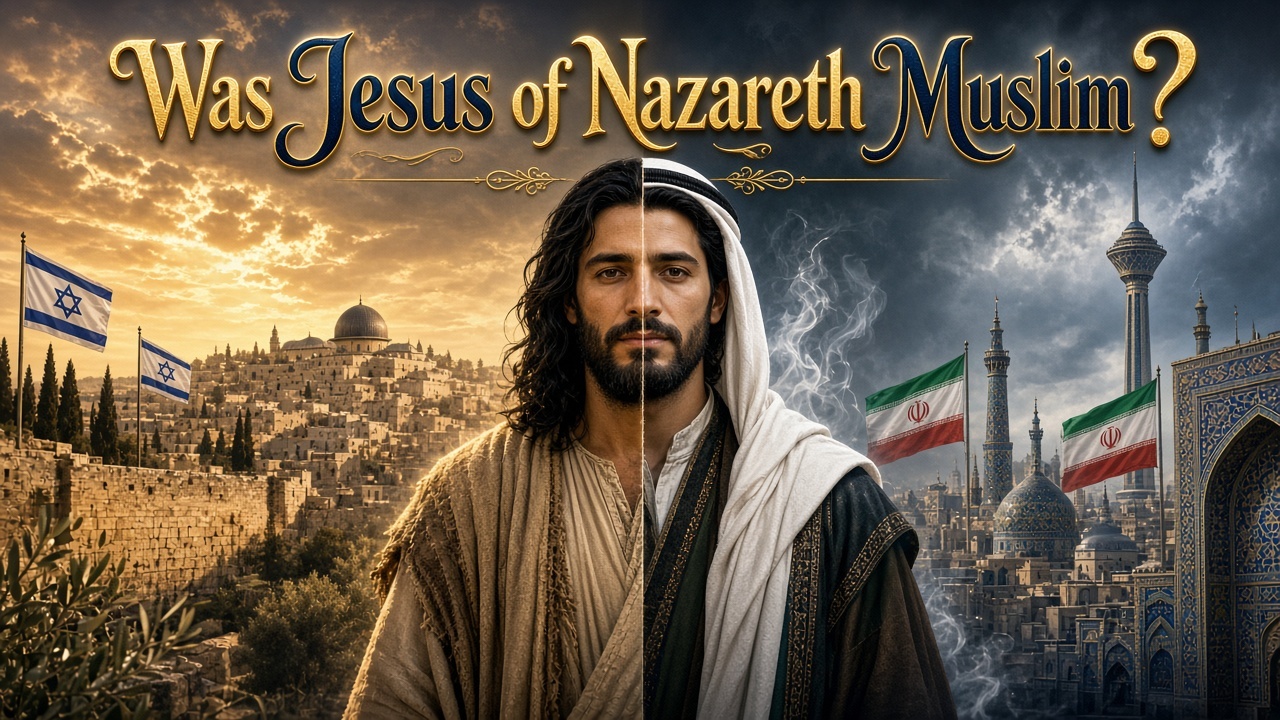
Was Jesus a Muslim?
"Beware lest anyone cheat you through philosophy and empty deceit, according to the tradition of men, according to the basic principles of the world, and not according to Christ. For in Him dwells all the fullness of the Godhead bodily." — Colossians 2:8–9
Beloved, we live in an age of bold revisions and clever counterfeits. In recent years, a claim has swept across internet videos, university lecture halls, and neighborhood conversations—a claim designed to sound warm, inclusive, and historically enlightened. It goes something like this: "Jesus was actually a Muslim."
At first glance, the argument is dressed up to look convincing. The presenters point out that Muslims honor Jesus as a great prophet, revere His mother Mary, affirm His virgin birth, and acknowledge His miracles. They observe that Jesus prayed with His face to the ground, fasted, greeted people with peace, and abstained from pork. And then they spring their trap: because the Arabic word Islam means "submission to God," and because Jesus submitted completely to the Father's will, Jesus must have been a Muslim!¹
Friends, that is what happens when someone plays a sleight-of-hand trick with dictionary definitions while ignoring six hundred years of history, two thousand years of Hebrew heritage, and the unmistakable testimony of the Word of God.
When a counterfeit bill is printed, the counterfeiter never changes the paper to bright purple or puts a cartoon character in the center. No—a good counterfeit copies as many surface details of the real currency as possible so that an untrained eye will accept it without question. Only when you hold the bill up to the light and examine the watermark, the security thread, and the engraving does the truth appear. Today, let us hold this claim up to the piercing light of history and Scripture. When we do, we will discover that Jesus of Nazareth was not a Muslim—He was, and forever remains, Yeshua HaMashiach, the Jewish Messiah and the eternal Son of the Living God!
I. A Necessary First Step: Six Hundred Years of History
Before we ever examine a single Arabic word or theological debate, we must establish the basic timeline of human history. Facts are stubborn things, and the timeline of the first seven centuries after Christ settles the foundational question before the argument even begins.
Jesus of Nazareth walked the dusty roads of Judea and Galilee in the first century A.D., roughly between 4 B.C. and A.D. 30. Within one generation of His crucifixion and bodily resurrection—between approximately A.D. 50 and A.D. 95—the eyewitnesses and apostles wrote down the twenty-seven books of the New Testament. We possess thousands of early Greek manuscripts, papyri fragments like the John Rylands fragment (P52) dating to the early second century, and complete codices like Codex Sinaiticus and Codex Vaticanus from the fourth century—all preserved in museums around the world centuries before Muhammad was ever born.²
Muhammad was born in Mecca around A.D. 570, received his first claimed revelations around A.D. 610, and died in A.D. 632. The standard written text of the Quran was compiled under Caliph Uthman around A.D. 650—more than six hundred years after Jesus rose from the dead and ascended into heaven!³
Think about what that means. Saying Jesus was a Muslim because He submitted to God is like saying George Washington was a modern Republican or Democrat because he loved the Constitution, or saying King David was a Southern Baptist because he sang hymns to the Lord! You cannot retroactively conscript a first-century Jewish Messiah into a seventh-century Arabian religion that did not exist until six centuries after His earthly ministry ended.
Even more remarkably, the Quran itself bears witness to the priority and authority of the earlier Scriptures! In Surah Yunus (10:94), Muhammad is told: "So if you are in doubt, [O Muhammad], about that which We have revealed to you, then ask those who have been reading the Scripture before you." In Surah Al-Ma'idah (5:47), the Quran commands: *"And let the People of the Gospel judge by what Allah has revealed therein."*⁴
Do you see the dilemma that creates for anyone claiming the Gospels were "corrupted"? The Quran tells seventh-century readers to go check the Gospel (Injil) that was already in their hands! And what did that Gospel say in the first century, the fourth century, the seventh century, and today? It proclaims with crystal clarity that Jesus Christ died on the cross for our sins, rose again on the third day, is the divine Son of God, and is coming back one day.
II. The True Name of Jesus: Isa or Yeshua?
When you sit down to talk with a Muslim neighbor about Jesus, one of the first things you will notice is that they never call Him by His real name. Across the 93 references to Him in fifteen different chapters (suras) of the Quran, He is never once called Yeshua, nor even the standard Christian Arabic form of His name, Yasu'. Instead, the Quran calls Him Isa (Isa ibn Maryam—"Isa, son of Mary").⁵
Why does that matter? Because in the biblical world, a name is never a mere label—it is a revelation of identity and mission.
When the angel Gabriel appeared to Joseph in a dream in Nazareth, he gave a specific command from heaven: "And she will bring forth a Son, and you shall call His name JESUS [Yeshua], for He will save His people from their sins" (Matthew 1:21).
In Hebrew, Yeshua (יֵשׁוּעַ) is a shortened form of Yehoshua (Joshua), which literally means "Yahweh is Salvation" or "The Lord Saves." Every single time Mary called her boy home for dinner in Nazareth, every time Peter, James, and John called out to their Master on the Sea of Galilee, and every time the blind beggar Bartimaeus cried out by the roadside in Jericho, they spoke the name Yeshua—"Yahweh Saves! Yahweh Rescues! Yahweh Delivers!"
Now, Arabic and Hebrew are sister Semitic languages. If the seventh-century compilers of the Quran had simply translated Yeshua into Arabic, the name would have been Yasu' (يَسُوع)—the exact name Arab Christians have used for two thousand years! Instead, the Quran introduced the name Isa (عِيسَى), a word that has no salvific meaning whatsoever in either Hebrew or Arabic.⁶
Where did the name Isa come from? Apologists and historians who have studied the origins of the Quran—including scholars like Dr. Jay Smith—point out that much of the Quran's material regarding Jesus was borrowed from fifth- and sixth-century Syriac texts and apocryphal legends circulating in Arabia. In Syriac, the name of Jesus was written as Eshu or Isho, which passed into seventh-century Arabic as Isa (or, as some linguists have noted, mirrored the phonetics of Esau, Jacob's estranged brother).⁶ So, in essence, Isa (Esau) could have been an intended slap to the face of the real Jesus.
And the historical confusion in the Quran does not stop with His name. Twenty-three times, the Quran calls Him Isa ibn Maryam—"Isa, son of Mary"—to emphasize that He was merely a human being born of a woman. Yet in Surah Maryam (19:28) and Surah Al-Tahrim (66:12), the Quran explicitly identifies Jesus's mother Mary (Maryam) as "sister of Aaron" and "daughter of Imran" (the Arabic form of Amram)!⁵
Beloved, open your Old Testament to Numbers 26:59 and 1 Chronicles 6:3: "The name of Amram's wife was Jochebed the daughter of Levi... and she bore to Amram Aaron and Moses and Miriam their sister."
Do you see what happened? The author of the Quran confused Miriam, the sister of Moses and Aaron who lived in 1400 B.C., with Mary, the mother of Jesus who lived in first-century Nazareth—an error of fourteen hundred years! Luke's Gospel records Mary's actual lineage through Heli back to King David (Luke 3:23–31).⁵
That single comparison tells us everything we need to know: Yeshua of the New Testament—whose very name means "Yahweh Saves," born in Bethlehem to Mary of the house of David—is not the Isa of the Quran!
III. The Nationality of Jesus: Not Arab, Not Muslim, Forever Jewish
In recent years, political activists and Islamic apologists have gone even further, claiming not only that Jesus was a Muslim, but that He was a "Palestinian Arab." Let us be unmistakably clear: Jesus of Nazareth was neither an Arab nor a Muslim. He was one hundred percent Jewish—by birth, by bloodline, by covenant, by culture, and by eternal calling.
In his landmark work The Real Kosher Jesus, Messianic Jewish scholar Dr. Michael Brown lays out the undeniable historical reality that you cannot separate Jesus from His Jewishness without inventing a fictional character.⁷ Likewise, Dr. Arnold Fruchtenbaum, founder of Ariel Ministries and author of Jesus Was a Jew, and Rabbi Jonathan Bernis of Jewish Voice Ministries have spent decades demonstrating from both Scripture and first-century archaeology that Yeshua lived, worshipped, taught, and died within the vibrant heart of Second Temple Judaism.⁸
Let us trace the biblical evidence of His nationality:
-
His Royal Jewish Genealogy: The very first verse of the New Testament announces: "The book of the genealogy of Jesus Christ, the Son of David, the Son of Abraham" (Matthew 1:1). Through both Joseph's legal line (Matthew 1) and Mary's bloodline (Luke 3), Jesus descended from Abraham, Isaac, Jacob, the tribe of Judah, and the royal house of King David. As the Apostle Paul wrote, He was "born of the seed of David according to the flesh" (Romans 1:3), and the writer of Hebrews affirms, "For it is evident that our Lord arose from Judah" (Hebrews 7:14).
-
His Covenant Circumcision and Temple Dedication: On the eighth day after His birth, in strict obedience to God's covenant with Abraham (Genesis 17:12), Joseph and Mary had Him circumcised and named Him Yeshua (Luke 2:21). Forty days later, they brought Him to the Jewish Temple in Jerusalem to present Him to the Lord according to the Law of Moses (Luke 2:22–24).
-
His Synagogue Worship and Biblical Feasts: Jesus wore the tzitzit (fringes) on the borders of His garment as commanded in Numbers 15:38 (Matthew 9:20; 14:36). He read from the Hebrew scroll of the prophet Isaiah in the synagogue of Nazareth on the Sabbath (Luke 4:16–21). He traveled to Jerusalem every year for Passover, celebrated the Feast of Tabernacles (John 7:2, 14), and even observed Hanukkah—the Feast of Dedication—in Solomon's Porch (John 10:22–23).
-
His Own Declaration of Salvation's Heritage: Speaking to the Samaritan woman at Jacob's well, Jesus Himself drew an unmistakable line of covenant identity: "You worship what you do not know; we know what we worship, for salvation is of the Jews" (John 4:22).
Now pause and think about the Muslim argument—the claim that because Jesus prayed on His face, fasted, greeted people with Shalom, and avoided pork, which made Him a practicing Muslim in obedience to Islam!
Friends, that turns history completely upside down! Why did Jesus avoid pork? Because He kept the kosher dietary laws given to Moses in Leviticus 11—fifteen hundred years before Muhammad! Why did Jesus greet His disciples with "Shalom aleichem" ("Peace be upon you")? Because Shalom is the ancient Hebrew greeting of Israel—which Muhammad later borrowed and adapted into the Arabic As-salamu alaykum! Why did Jesus fall on His face in prayer in the Garden of Gethsemane? Because biblical patriarchs and prophets like Abraham (Genesis 17:3), Moses (Numbers 16:22), and Joshua (Joshua 5:14) bowed face-down before Yahweh long before Mecca ever had a mosque!
Muhammad did not invent those practices and pass them backward to Jesus; rather, seventh-century Islam borrowed external customs from Judaism and Syriac Christianity while stripping out the very heart of God's redemptive plan! Jesus was not a Muslim practicing Islam—He was the Jewish Messiah fulfilling the Torah and the Prophets!
IV. The Divine Nature of the Son of God vs. the Isa of the Quran
Here we reach the continental divide between biblical Christianity and Islam. You cannot bridge this chasm with polite slogans, because the Jesus of the New Testament and the Isa of the Quran are diametrically opposed on the most important question in the universe: Who is Jesus Christ?
Muslim apologists love to quote skeptic scholars like Bart Ehrman or the Jesus Seminar to argue that Jesus never claimed to be God. Yet, as Christian apologists like Dr. John Ankerberg, Dr. Anis Shorrosh, Dr. John Warwick Montgomery, and former Muslim scholars like Dr. Mark Gabriel (a former professor of Islamic history at Al-Azhar University in Cairo) have repeatedly demonstrated, you have to tear out page after page of the New Testament to miss Jesus's claim to deity!⁹
Look at the stark contrast between the Biblical Yeshua and the Quranic Isa:
-
The Quranic Isa denies being God or the Son of God. In Surah Al-Ma'idah (5:72–75), the Quran declares that anyone who says "Allah is the Messiah, the son of Mary" has committed blasphemy and is barred from Paradise, insisting that Isa was "no more than a messenger." In Surah Al-Ikhlas (112:1–4), the Quran explicitly denies that God ever fathered a Son.
-
The Biblical Yeshua claims the eternal name and glory of God. In John 8:58, when the religious leaders challenged Jesus about Abraham, Jesus did not say, "Before Abraham was, I was created." He used the sacred, covenant name of Yahweh from Exodus 3:14: "Most assuredly, I say to you, before Abraham was, I AM." The crowd immediately picked up stones to execute Him for blasphemy because they understood His claim perfectly! In John 10:30, He declared, "I and My Father are one," and in John 14:9, He told Philip, "He who has seen Me has seen the Father." He forgave sins—something only God can do (Mark 2:5–7)—and accepted Thomas's direct worship when Thomas fell before the risen Christ and cried out, "My Lord and my God!" (John 20:28).
-
The Quranic Isa never died on the cross. In Surah An-Nisa (4:157), the Quran flatly contradicts the central event of human history: "And they did not kill him, nor did they crucify him; but [another] was made to resemble him to them." By denying the cross, Islam removes the shedding of blood without which there is no remission of sins (Hebrews 9:22).
-
The Biblical Yeshua came specifically to die and rise again. Jesus told His disciples plainly: "For even the Son of Man did not come to be served, but to serve, and to give His life a ransom for many" (Mark 10:45). On the cross, He cried out, "It is finished!" (John 19:30)—Tetelestai, "Paid in full!"—and three days later walked out of Joseph's borrowed tomb in physical, immortal glory (1 Corinthians 15:3–4).
-
The Quranic Isa returns as a Muslim enforcer. According to Islamic Hadith traditions (Sahih al-Bukhari 2476), Isa will return at the end of the age subordinate to the Islamic Mahdi to "break the cross," abolish Christianity, and compel the world to submit to Islam - world domination!
-
The Biblical Yeshua returns as King of Kings and Lord of Lords. Revelation 19:11–16 reveals the true Second Coming: heaven opens, and Yeshua rides forth on a white horse with eyes like a flame of fire, wearing many crowns, with the name written on His robe and thigh: KING OF KINGS AND LORD OF LORDS.
The Numbers Don't Lie: Prophecies Fulfilled by Jesus Alone
How can we be certain beyond a shadow of a doubt that the Jesus of the New Testament—and not the Isa of the Quran—is the true Messiah of God? Look at the mathematical probability of fulfilled prophecy.
In his classic work Science Speaks, mathematician and astronomer Dr. Peter Stoner (often referenced by apologetics teachers alongside scholars like Dr. Nathan Stone) calculated the odds of any single human being fulfilling just eight of the more than three hundred Old Testament prophecies concerning the Messiah—prophecies written four hundred to a thousand years before Jesus was born!¹⁰
Think of those specific predictions:
-
Born in Bethlehem of Judea (Micah 5:2)
-
Preceded by a forerunner crying in the wilderness (Isaiah 40:3)
-
Entering Jerusalem riding on a donkey (Zechariah 9:9)
-
Betrayed by a friend for thirty pieces of silver (Zechariah 11:12)
-
Silent before His accusers (Isaiah 53:7)
-
Hands and feet pierced by crucifixion—centuries before crucifixion was even invented! (Psalm 22:16)
-
Soldiers casting lots for His garments (Psalm 22:18)
-
Buried in a rich man's tomb, yet rising from the dead without His body seeing decay (Isaiah 53:9; Psalm 16:10)
Dr. Stoner calculated that the probability of one man fulfilling just those eight prophecies by sheer chance is 1 in 1017—that is 1 in 100,000,000,000,000,000! To picture that number, imagine covering the entire state of Texas two feet deep in silver dollars, marking one single coin with a red checkmark, stirring the entire state's worth of coins together, blindfolding a man, and telling him to walk anywhere in Texas and pick up that one marked coin on his very first try!¹⁰
When you expand that calculation to forty-eight prophecies, the probability reaches 1 in 10157—a number larger than the estimated number of electrons in the entire observable universe! The Quran's Isa fulfills none of those messianic prophecies because Islam denies the cross, denies His Davidic kingship, and denies His deity. Only Yeshua of Nazareth fulfilled every single prophecy of the Old Testament to a "T"!
V. Nabeel Qureshi: A Hope Beyond the Grave
Beloved, this is not merely an academic debate between theologians; it is a matter of eternal life and death. And nobody understood that more deeply than the late Dr. Nabeel Qureshi.
Raised in a loving, devout Ahmadi Muslim home in the United States, Nabeel memorized the final chapters of the Quran as a young boy, prayed five times a day in Arabic, and was trained from childhood to defend Islam and dismantle Christianity.¹¹ When he entered college, Nabeel befriended a committed Christian named David Wood, and the two entered into years of intense, respectful debate over the historical reliability of the New Testament, the resurrection of Jesus, and the deity of Christ.
Nabeel set out to prove that Jesus was only a Muslim prophet. Instead, as he examined the early historical evidence for the crucifixion and bodily resurrection of Jesus with the rigor of a medical student, the walls of his lifelong assumptions began to crumble. It cost him dearly—when Nabeel surrendered his life to Jesus Christ, it broke the hearts of the family he loved so deeply. He documented that agonizing, triumphant journey in his bestselling book Seeking Allah, Finding Jesus.¹¹
Then, in August 2016, at just thirty-three years old, Nabeel was diagnosed with advanced, Stage IV stomach cancer.
For more than a year, Nabeel endured grueling treatments while continuing to proclaim the Gospel with astonishing grace, tenderness, and joy. In September 2017, as his body grew weak and his earthly life drew to a close in hospice care, Nabeel recorded a final video message from his hospital bed. Barely able to whisper, the former Muslim who had once believed Jesus was merely a human prophet spoke words that echoed with the certainty of heaven:
"As I consider my ministry, I would like it to leave a legacy of love, of peace, of truth, of caring for one another... Our God is a God of love."¹²
On September 16, 2017, at the age of thirty-four, Nabeel Qureshi took his final breath on earth—and opened his eyes in the presence of the risen Jewish Messiah, Yeshua, the Savior who loved him and gave Himself for him!
Friends, look at the difference between submission to an impersonal system and surrender to a risen Savior. Islam says, "Submit to rules, hope your good deeds outweigh your bad deeds on the Scale of Judgment, and maybe—if Allah wills—you will escape the Fire." Even Muhammad himself admitted in the Hadith (Sahih al-Bukhari 3929) that he did not know what would be done with him or his followers!
Jesus Christ offers no such trembling uncertainty. He looks at every weary sinner—Muslim, Jew, and Gentile alike—and says: "I am the resurrection and the life. He who believes in Me, though he may die, he shall live" (John 11:25).
No beloved, Jesus was not a Muslim. He was the Lamb of God who takes away the sin of the world (John 1:29). And if you will turn from every counterfeit and place your trust in Yeshua—the crucified, risen, and reigning Son of God—you can know with unshakable certainty that when you take your last breath, you will be absent from the body and present with the Lord!
Endnotes
-
Summary of popular Islamic apologetic arguments asserting that Jesus (Isa) practiced Islamic monotheism (Tawhid) and submission (Islam), as presented in contemporary online apologetics videos.
-
Norman L. Geisler and William E. Nix, A General Introduction to the Bible (Chicago: Moody Press, 1986), detailing New Testament manuscript dating, including P52 (c. A.D. 125) and fourth-century uncial codices.
-
Classical Islamic historical chronology regarding Muhammad (c. A.D. 570–632) and the Uthmanic recension of the Quran (c. A.D. 650).
-
Quran 10:94 (Surah Yunus) and Quran 5:47 (Surah Al-Ma'idah), instructing readers to consult the earlier Scriptures and the Gospel (Injil).
-
Dr. Jay Smith, lecture on "Isa or Yeshua: The Name and Identity of Jesus in the Quran and the Bible," Pfander Centre for Apologetics (analyzing the 93 Quranic references to Isa, the 23 uses of Isa ibn Maryam, and the chronological confusion in Quran 19:28 and 66:12 between Miriam, sister of Aaron/daughter of Amram, and Mary, mother of Jesus).
-
Linguistic comparison of Hebrew Yeshua ("Yahweh is Salvation"), Christian Arabic Yasu', Syriac Eshu/Isho, and Quranic Arabic Isa.
-
Dr. Michael L. Brown, The Real Kosher Jesus: Revealing the Mysteries of the Hidden Messiah (Lake Mary, FL: FrontLine, 2012).
-
Dr. Arnold G. Fruchtenbaum, Jesus Was a Jew (San Antonio, TX: Ariel Ministries, 1981); Rabbi Jonathan Bernis, A Rabbi Looks at Jesus of Nazareth (Bloomington, MN: Chosen Books, 2011).
-
Dr. John Ankerberg and Dr. John Weldon, Fast Facts on Islam (Eugene, OR: Harvest House, 2001); Dr. Mark A. Gabriel, Jesus and Muhammad: Profound Differences and Surprising Similarities (Lake Mary, FL: Charisma House, 2004); Dr. Anis Shorrosh, Islam Revealed (Nashville: Thomas Nelson, 1988).
-
Peter W. Stoner, Science Speaks: Scientific Proof of the Accuracy of Prophecy and the Bible (Chicago: Moody Press, 1958; rev. ed. 1963), ch. 3 ("The Christ of Prophecy"), calculating the probability of fulfilling 8 prophecies (1in1017) and 48 prophecies (1in10157).
-
Nabeel Qureshi, Seeking Allah, Finding Jesus: A Devout Muslim Encounters Christianity (Grand Rapids: Zondervan, 2014).
-
Nabeel Qureshi, final hospital-bed video testimony recorded September 2017 prior to his passing on September 16, 2017 (Ravi Zacharias International Ministries / Nabeel Qureshi Ministries archive).