You Can See God
He Who Cannot Be Seen, Cannot Be Missed

John Di Giorgio
August 21, 2026
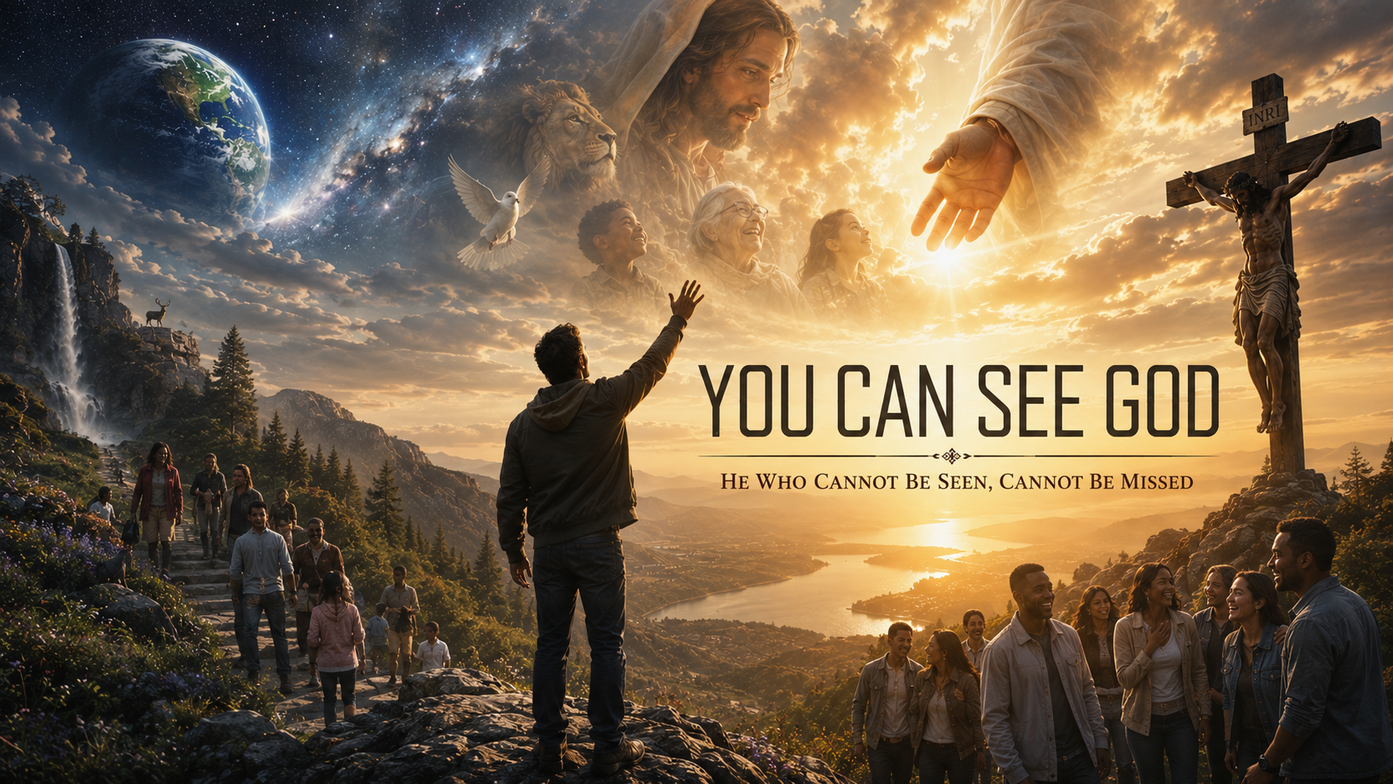
"No one has ever seen God." 1
At first glance, those words seem to close the door on every longing of the human heart. If no one has ever seen God, how can we know Him? How can we recognize Him? How can we worship Someone who remains invisible to our eyes?
Yet the Bible does not leave us in darkness. The same Scripture that declares no one has ever seen God also reveals that God may truly be known, encountered, and made visible — through His works, His Word, His Son, and His people.
Here is the holy paradox: He Who cannot be seen, cannot be missed. There is visible evidence of an Invisible God. Yes, God is invisible, yet He can be seen. He is beyond human sight, yet He has drawn near. He cannot be contained by creation, yet He has entered creation.
The God whom no eye can fully behold has made Himself known. And He is not hiding from the sincere seeker. He is not playing a cruel game of spiritual hide-and-seek. He has placed signs of His presence throughout the heavens, revealed His character in Jesus Christ, demonstrated His love at the cross, and planted His own life within those who belong to Him.
The question is not merely, "Does God exist?" The deeper question is: have I learned to recognize where God is revealing Himself?
You Can See God in His Creation
The psalmist lifts his eyes toward the heavens and declares:
"The heavens declare the glory of God; and the firmament shows His handiwork." — Psalm 19:1–4 2
The sky is not silent. The stars are preaching. The sunrise is announcing. The rhythm of the seasons is bearing witness.
Creation does not tell us everything about God, but it tells us something unmistakable: there is glory behind the beauty, wisdom behind the order, power behind the design.
A river does not explain the entire mountain from which it flows — but it proves a mountain exists somewhere upstream. In the same way, creation is a living stream of testimony flowing from the character of its Creator.
Consider the human eye — it does not merely exist; it receives light, interprets color, reveals astonishing complexity. Consider the human heart, beating thousands of times a day without a single conscious command from you. Consider the delicate balance of the earth, the architecture of a snowflake, the instinct of a bird, the unfathomable vastness of the night sky.
These are not empty accidents to be admired without interpretation. They are the fingerprints of the Eternal Artist.
The heavens declare. The earth reflects. The conscience whispers. Creation points beyond itself.
But there is a limit. Creation can reveal that God is powerful, wise, and glorious — yet creation alone cannot tell us the full story of His mercy. A sunset can move us, but it cannot tell us how God responds to sinners. A mountain can humble us, but it cannot explain or execute redemption.
For that, we need a clearer revelation.
Child of God, take time to deliberately slow down. Look at the world around you — not as scenery, but as testimony. Let the sunrise remind you of God's faithfulness. Let the complexity of life remind you of His wisdom. Let the vastness of the heavens remind you that your crisis is not larger than your Creator.
Creation is the first cathedral, and every morning its windows fill with light.
You Can See God Through Christ
The clearest revelation of the invisible God is not a star, a storm, or a sacred feeling. It is a Person.
Paul writes that Jesus Christ is "the image of the invisible God."3 The word image carries the idea of an exact representation — a perfect likeness, an accurate expression. Jesus did not merely speak about God. He showed us God.
When He touched the leper, we see the compassion of God. When He welcomed children, we see the tenderness of God. When He confronted hypocrisy, we see the holiness of God. When He wept at Lazarus's tomb, we see the heart of God entering human grief. When He forgave sinners, restored the broken, and sought the rejected, we see the mercy of God in motion.
John writes, "the Word became flesh and dwelt among us."4 The eternal Son stepped into time. The One whom heaven cannot contain was carried in a virgin's womb. The hands that formed galaxies were placed in a carpenter's household. The voice that spoke light into existence learned the language of a child.
This is the wonder of the incarnation: God did not remain a distant concept. He came near enough to be heard, touched, followed, and seen.
The disciples did not gather around an idea. They walked with Jesus on dusty roads. They heard Him teach beside the sea. They watched Him sleep in a boat during a storm. They saw Him embrace the suffering and confront the proud. They saw His tears at the tomb of a friend. They witnessed His death — and encountered Him alive after the grave.
Philip once said, "Lord, show us the Father." Jesus answered:
"He who has seen Me has seen the Father." — John 14:8–9 5
Do you want to know what God is like? Look at Jesus. Do you want to know whether God cares about the wounded? Look at Jesus. Do you want to know whether God receives the repentant? Look at Jesus. Do you want to hear the Voice of God? Listen to Jesus! Do you want to see the love of God in action? Look at Jesus. Do you want to know whether holiness and compassion can dwell together? Look at Jesus.
Friends, do not build your understanding of God primarily on circumstances, emotions, or human opinions. Build it on Christ. Read the Gospels slowly. Watch Jesus. Notice what moves Him, what angers Him, what He blesses, and what He refuses to tolerate. The more clearly you see Christ, the more accurately you will know God.
You Can See God at the Cross
The cross is where the invisible love of God became visible in the most undeniable way.
"God demonstrates His own love toward us, in that while we were still sinners, Christ died for us." — Romans 5:8 6
The word demonstrates (sunistēmi) carries an unmistakable weight. In classical Greek, the word was used in courtrooms and formal arguments to mean placing undeniable evidence side-by-side with a claim to establish its truth beyond a shadow of a doubt. God didn't merely declare, "I love you"—He stepped onto the stage of human history and placed His love directly beside our dark, broken reality, driving a spike into the ground with decisive, unshakeable action. Because Paul writes this in the present tense, the cross isn't a fading memory of the past; it stands right before us today as an active, living exhibit and continuous, undeniable proof of His character.
At the cross, love became blood. At the cross, justice and mercy met. At the cross, the holiness of God was not ignored, and the sinfulness of humanity was not minimized. Instead, Jesus bore the judgment we deserved so that grace could be offered without compromising righteousness.
Imagine a courtroom where the guilty person stands speechless before the evidence. The verdict is justified. The sentence is deserved. Then the judge rises, steps down from the bench, and pays the penalty himself.
That illustration cannot fully contain the glory of Calvary, but it helps us see the wonder: the Judge became the Substitute.
The cross demonstrates that sin is more serious than we want to admit, and that God's love is greater than we dare to believe.
Jesus did not die because humanity was lovable. He died because God is love. He did not wait for us to become worthy — He came while we were still sinners. He did not offer a vague sympathy from a safe distance — He entered our guilt, shame, pain, and death, and overcame them through His resurrection.
The cross is God's public declaration that He will go to the greatest possible distance to redeem those who trust in Christ.
Beloved, when shame tells you God has abandoned you, look at the cross. When suffering makes you question His love, look at the cross. When temptation whispers that sin is harmless, look at the cross. Calvary reveals both the horror of sin and the immensity of grace.
Never measure God's love by the weather of your circumstances. Measure it by the wounds of Jesus.
You Can See God Through His Children
John writes:
"No one has seen God at any time. If we love one another, God abides in us, and His love has been perfected in us." — 1 John 4:12 7
This is the next great paradox: the invisible God becomes visible through the transformed lives of His people.
Christians do not replace Christ, and our lives are never a perfect reflection of Him. Yet when the love of God governs His children, the world receives a glimpse of the God it cannot see with physical eyes.
A grieving believer who continues to trust. A wronged believer who chooses forgiveness. A wealthy believer who gives generously. A lonely believer who welcomes the forgotten. A persecuted believer who refuses hatred. A repentant believer who turns from sin and walks in obedience.
These are not merely admirable human qualities. They are evidence of divine life.
"Whoever claims to abide in Christ ought to walk as He walked."8 In other words, the person who claims they are a Christian should live as Christ did. The Christian life is not simply believing facts about Jesus — it is allowing the life of Jesus to become visible through us.
A stained-glass window does not create sunlight. It receives sunlight and displays its colors. In the same way, we do not manufacture God's love. We receive it, and then His character shines through our ordinary lives. We are to be proactive in allowing that light to shine through us. Jesus said, “...LET your light shine before people, (yield to the Spirit) so they can see the good things you do and praise your Father who is in heaven. (Matthew 5:16, CEB)
Sometimes the only Bible a person reads is the conduct of someone who claims to follow Christ. Sometimes the only sermon a neighbor hears is the way a believer responds under pressure. Sometimes the only evidence a wounded person has that God is loving and compassionate is the love and compassion shown by one of His children.
Jesus said the world would recognize His disciples by their love.9
Beloved, ask the Lord to make His unseen presence visible through one specific action today. Yield to the Spirit and allow His fruit to be manifested through your physical being. Encourage someone who is discouraged. Apologize without defending yourself. Forgive someone who has wounded you. Serve without seeking recognition. Give quietly. Speak truth with gentleness. Love generously.
Let others see God in you and through you!
Are You Looking For God? You Can Find Him
Maybe you’re reading this today and you want to see God. Here’s great news. Jeremiah records God's promise:
"You will seek Me and find Me, when you search for Me with all your heart. I will be found by you, says the LORD." — Jeremiah 29:13–14 10
The Hebrew word translated find carries the idea of discovering, encountering, or coming upon something that has been sought. God is not promising that casual curiosity will produce deep fellowship. He is promising that the wholehearted seeker will not search in vain.
There is a difference between looking at a map and beginning a journey. There is a difference between admiring a doorway and walking through it.
Many people want the benefits of God without surrendering to God. They want peace without repentance, guidance without obedience, comfort without commitment, and heaven without the Lordship of Christ.
But God gives Himself to those who seek Him — not as a religious accessory, but as the treasure of their lives.
The Faith Factor
Here is the key that unlocks every chapter of discovery: you do not see the invisible God with your eyes. You see Him by faith.
Scripture gives us a portrait of a man who did exactly that. Moses stood before Pharaoh, walked out of Egypt, and led an entire nation into the wilderness — not because he could see where the journey led, but because of what he trusted was true:
"By faith he left Egypt, not fearing the wrath of the king, for he endured as seeing Him who is invisible." — Hebrews 11:27 11
He endured as seeing Him who is invisible.
Think about the weight of that phrase. Moses did not have a photograph of God. He did not have a vision he could frame on a wall. He had a burning bush, a promise, a pillar of cloud and fire — and faith that turned those glimpses into unshakable certainty. He walked through forty years of wilderness, opposition, and exhaustion as though God were standing directly in front of him — because in the eyes of faith, He was.
That is the pattern for every believer since. We do not see God with our physical eyes, but faith gives us a kind of sight that eyes alone cannot provide. Faith is not the absence of evidence — it is confidence built on reliable testimony.
And here is something worth pausing on: you already live this way, every single day, in matters that have nothing to do with religion.
You believe the stars are still burning in galaxies you will never visit, though your eyes have never confirmed it firsthand — you trust the testimony of those who studied the light. You believe the earth spins on its axis at nearly a thousand miles an hour, though you feel none of it. You trust that gravity will hold your feet to the floor tomorrow morning exactly as it did today, though you cannot see the force itself — only its effects.
Modern scientists tell us that most of the universe is made of what they call dark matter and dark energy — invisible, undetectable to the eye, yet essential to holding galaxies together. No one has ever seen it. No telescope has ever photographed it. And yet it is accepted, without controversy, as real, because its effects are unmistakable and the testimony of careful observers is trusted.
If you can believe in unseen forces holding the universe together on the word of a scientist you have never met, how much more can you trust the testimony of Scripture, fulfilled prophecy, the changed lives of the redeemed, and the resurrection of Jesus Christ — all pointing to the God who cannot be seen, yet can be known?
This is not blind faith. This is the same kind of faith you already exercise toward the natural world — simply aimed, at last, toward its Maker.
Peter writes that believers love Christ even though they have not seen Him physically, and they rejoice in Him with "joy inexpressible and full of glory."12 He is talking about a real, undeniable experience inside the believer. Faith is not imagination. Faith is trusting the One whom God has revealed through reliable testimony — the Scriptures, fulfilled prophecy, the Holy Spirit, and the risen Christ.
You may not see God with your physical eyes today. But like Moses, you can endure as seeing Him who is invisible.
The Invitation
Friend, you can see Him in creation. You can see Him in Christ. You can see Him at the cross. You can see Him through His children. And if you are seeking Him today with all your heart, you will discover He has been seeking you all along.
The invisible God has made Himself known. The question is whether you will respond.
Open the Scriptures. Look to Jesus. Stand beneath the cross. Surrender your heart. Walk in love. Let His life flow through you like a river full of living water.
One day, faith will become sight in unimaginable ways. Until then, the church is called to display the glory of the unseen God before a watching world.
Amen?
_______
Endnotes
-
1 John 4:12.
-
Psalm 19:1–4.
-
Colossians 1:15.
-
John 1:14.
-
John 14:8–9.
-
Romans 5:8.
-
1 John 4:12.
-
1 John 2:6.
-
John 13:34–35.
-
Jeremiah 29:13–14.
-
Hebrews 11:27.
-
1 Peter 1:8.