You Will Rise Again
The Fall Does Not Have the Final Word

John Di Giorgio
August 17, 2026
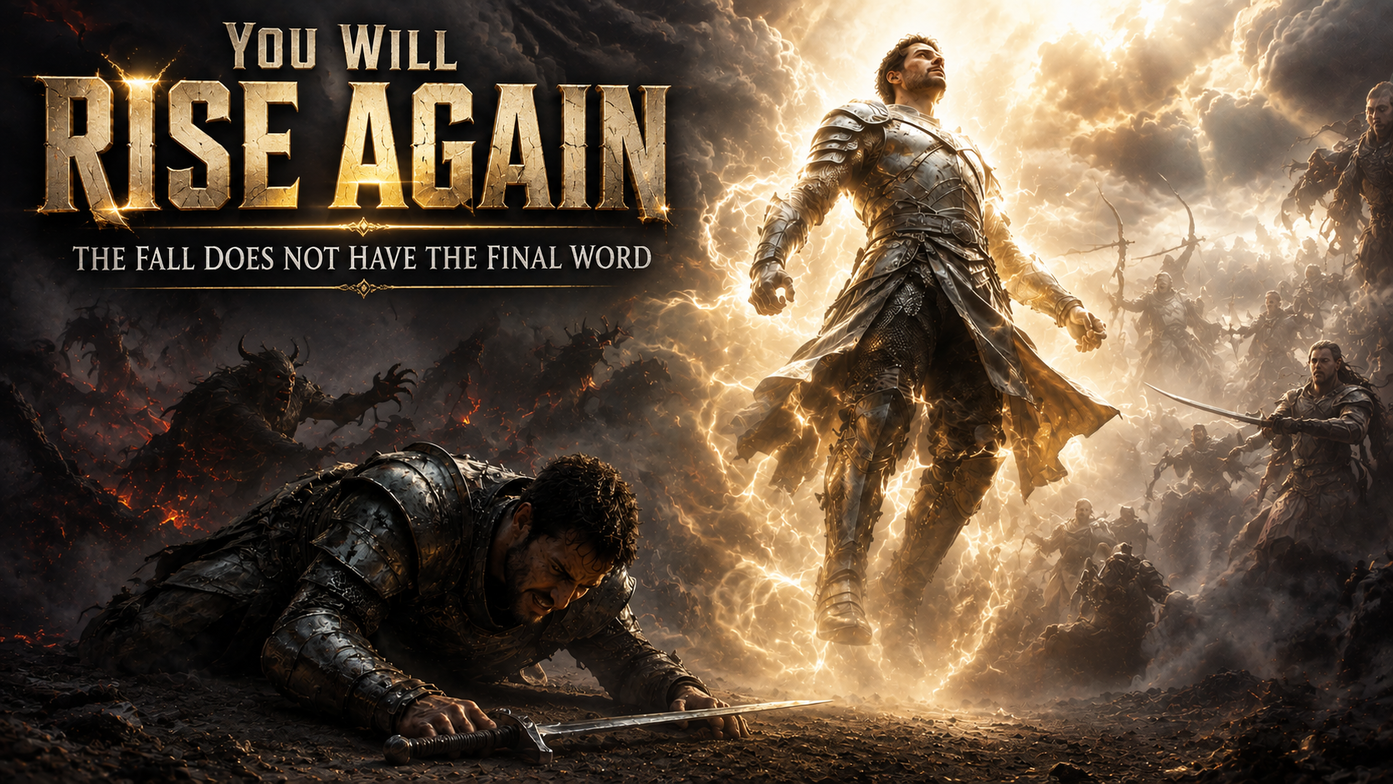
There is a verse tucked into the wisdom literature of Israel that has quietly held together more broken believers than perhaps any other single sentence in the Old Testament. It does not promise a trouble-free life. It promises something more honest:
"For though the righteous fall seven times, they rise again, but the wicked stumble when calamity strikes." — Proverbs 24:16
I. The Reality
Read that slowly. The righteous fall. Not might fall — the Hebrew states it as plain fact. There is no hedge in the grammar. The man or woman walking with God is not exempt from collapse.
And yet — here is the turn on which the whole verse hinges — he rises. וָקָם — va-qam (vah-KAHM). Two Hebrew words carry the entire theology of restoration: he falls... and he rises. No bridge of explanation stands between them, as though the second could not help but follow the first.¹
This verse — and the story I want to set beside it — has something to say to everyone who has looked at the wreckage of a decision, a season, a betrayal of their own convictions, and concluded: that's it for me.
It is not. And the rest of Scripture will not let us leave that claim untested. It presses in from every direction — from wisdom literature, from the letters of Paul, from the messy record of Israel's own kings — until the pattern becomes unmistakable.
II. The Righteous — And the Ruin
The righteous is not a title for the spiritually elite. In the language of the New Covenant, the righteous is simply the one made right with God through Christ — the regenerated, blood-bought child of God. That's you. That's me.
And that person falls — not once. The number seven, in the ancient Hebrew mind, rarely functioned as a literal tally. It symbolized **completeness, fullness, totality.**² When the writer says "seven times," he is not handing you a scorecard. He is saying: even when the failure feels total, the righteous do not stay down.
The Bible never tells us the righteous cannot fall. It tells us something better: the righteous cannot be permanently undone.
III. Rising, Rightly Understood
The word for "rise" — qum (koom) — is not merely about changing physical position, like a man getting up off the pavement.³ Throughout the Hebrew Scriptures, qum carries the sense of establishing, standing firm, taking one's stand — of becoming, after the rising, more rooted than before the fall.
The fall is not simply undone by the rising, as if God hits an undo button and returns you to where you were. The rising itself becomes part of your formation. You do not merely recover your former footing — you are established in a way the fall itself, paradoxically, helped prepare you for. This is not fatalism dressed as grace — it is something more astonishing: the God who could have prevented the fall chooses instead to meet you in it, and to build something out of the rising that could not have been built any other way.
IV. The Resource: Where the Power to Rise Comes From
Proverbs tells us the righteous rise, but not how. For that we let Scripture interpret Scripture. Paul knew what it was to fall under a weight most of us will never carry — beaten, shipwrecked, hunted from city to city. Yet this is what he wrote from the far side of it:
"Therefore we do not lose heart, but though our outer man is decaying, yet our inner man is being renewed day by day." — 2 Corinthians 4:16
Paul does not deny the decay. The body, the circumstances, the visible wreckage genuinely waste away. But he sets beside that decay a quieter reality happening beneath the surface, one the calendar cannot measure.
"Do not lose heart" translates egkakeō (eng-kah-KEH-oh) — to become spiritless, to yield to despair. Paul describes a refusal rooted in something outside himself, an endurance the righteous hold to precisely because their strength was never meant to be self-generated.
"Being renewed" translates anakainoō (an-ah-kai-NO-oh), built from ana (AH-nah), "upward," and kainos (kai-NOS), "fresh, new in kind." It does not mean merely restored to a previous condition, like a repaired object returned to working order. It means carried upward into something qualitatively new — renewal that exceeds the damage rather than just undoing it.
This is the same upward movement Isaiah promised the weary: they shall ya'alu (yah-ah-LOO) — rise — on wings like eagles.⁴ The naphal-and-qum (nah-FAHL / koom) pattern of Proverbs is one thread in a pattern woven through all of Scripture: fall, and be lifted higher than the place from which you fell.
And here is the detail that matters most on mornings when nothing feels renewed: the Greek construction behind "is being renewed" is present, passive, and continuous. Passive — it is not something Paul does to himself. Continuous — not a one-time event. The renewal proceeds whether he feels it or not. The Spirit is not waiting for you to feel renewed before He renews you.
The righteous do not rise because they gathered enough willpower to try again. They rise because strength was supplied that they did not manufacture themselves. The Spirit is not a coach on the sideline of your collapse, shouting encouragement while you claw your own way upright. He is not beside you. He is within you. The power that lifts the fallen righteous is not a self-help principle. It is a Person.
This is why Paul could write to the Philippians one of the most paradoxical sentences in Scripture:
"Work out your own salvation with fear and trembling, for it is God who works in you, both to will and to work for his good pleasure." — Philippians 2:12–13
He is not saying, "Work hard enough and God will notice." He describes a partnership so intimate that the willing itself — the very desire to rise — is already the Spirit's initiative in you before it becomes your own effort. God rises in you, and you experience it as your own feet finding the ground again.
That is the gospel compressed into a single verb: va-qam (vah-KAHM). He rises — not by his own strength, but because a power greater than the power that knocked him down now lives inside him.
V. A Representative: The King Who Fell Further Than Almost Anyone in Scripture
If you want this doctrine tested against the hardest case — not a stumble but a catastrophic, decades-long collapse — Scripture hands you Manasseh.
Manasseh became king of Judah at twelve and reigned fifty-five years, longer than any king before or after him.⁵ Yet he is remembered for the depth of his ruin. He rebuilt the pagan altars his father Hezekiah had torn down, erected shrines to the sun, moon, and stars inside the Temple itself, practiced sorcery, and burned his own sons as offerings. He filled Jerusalem with innocent blood and led the nation to do more evil than the peoples God had driven out before them.⁶
If Proverbs 24 speaks of a "complete" fall — pictured by the number seven — Manasseh is that fall taken to its furthest extreme.
His ruin followed accordingly. The Assyrian army captured him, put a hook through his nose, bound him in bronze shackles, and dragged him in humiliation to Babylon.⁷ A king — an anointed son of David — reduced to a captive on a chain. There is no lower place in the Old Testament for a king of God's people to fall.
And then comes the turn.
"And when he was in distress, he entreated the favor of the Lord his God and humbled himself greatly... and prayed to him, and God was moved by his entreaty and heard his plea and brought him again to Jerusalem into his kingdom." — 2 Chronicles 33:12–13⁸
Notice what the text does not say. It does not say Manasseh clawed his way back through years of proving himself worthy. It says God was moved. The restoration is God's action from beginning to end. Manasseh's part was simply this: he humbled himself. The Hebrew verb there — vayyikkana (vai-yik-KAH-nah) — shares its root with language used elsewhere for a heart bent low, subdued before God.⁹ That is the only "work" the fallen king contributed: surrender, not striving.
The fruit that followed was real. Manasseh tore down the very idols he had built, rebuilt the altar of the Lord, and commanded the nation he had corrupted to serve God once more.¹⁰ The turn reordered a kingdom.
VI. What This Means for You
If your own fall does not feel like a stumble — if it feels total, repeated, seven-times complete — hear this: the promise was never that the righteous never fall. The promise is that when they fall, God does not leave them there.
He rises — not because there was enough strength left in him, but because a power within him is greater than the power that knocked him down.
That power is not a metaphor. He is the Holy Spirit, given to dwell in you the moment you belonged to Christ — the same Spirit who renews the weary in Isaiah, the same Christ who is "in you, the hope of glory" in Colossians, the same God who "works in you both to will and to work" in Philippians. You do not rise on your own. He rises in you, and you call it standing up.
So if the wreckage behind you looks like a fall — even a Manasseh-sized fall — the verb is not finished yet. Naphal (nah-FAHL) is not the last word of your story. Qum (koom) is coming. And it will not come from you. It will come from the One who never left the place where you fell.
Endnotes
-
On the construction yippol...va-qam (yip-POL / vah-KAHM) in Proverbs 24:16.
-
On the symbolic use of seven (sheva, sheh-VAH) in Hebrew idiom for completeness.
-
On qum (קוּם, koom) — to rise, stand, arise, be established.
-
Isaiah 40:31; ya'alu (yah-ah-LOO, from alah, ah-LAH, "to ascend").
-
2 Kings 21:1.
-
2 Kings 21:2–16; 2 Chronicles 33:1–9.
-
2 Chronicles 33:11.
-
2 Chronicles 33:12–13.
-
On kana (כנע, kah-NAH), reflected in vayyikkana (vai-yik-KAH-nah), "he humbled himself."
-
2 Chronicles 33:15–16.