A Place Called Wit's End

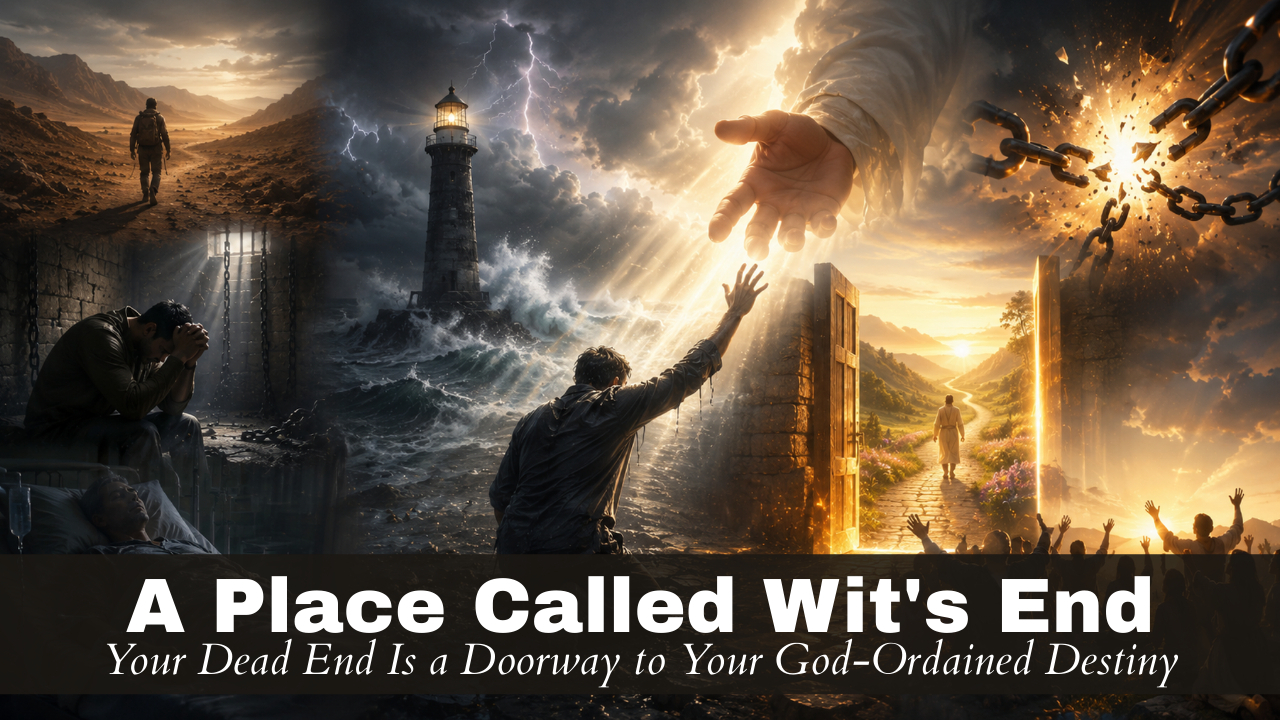
A Devotional Study of Psalm 107:23–32
Have You Been There?
You know the place. You may be there right now.
Every option has been explored. Every resource has been exhausted. The medical report has left you speechless. The marriage seems beyond repair. The financial ledger shows nothing but red. You have prayed, planned, strategized, and struggled — and still the storm rages on. And in that crushing moment, you realize with sudden, terrible clarity that you have arrived at a place the ancient Scriptures call Wit's End.
The phrase itself is not merely a figure of speech. It appears in the King James Version of Psalm 107 with the force of a declaration: "They reeled to and fro, and staggered like a drunken man, and are at their wit's end" (v. 27). These were not weaklings. These were seasoned mariners — professionals who had spent their lives reading wind and wave. And yet, in the grip of a storm beyond their reckoning, their expertise became worthless, their charts blurred, their wisdom dissolved like salt in rain.
That is Wit's End. And if you have ever been there, you already know that no human description fully captures it.
But here is what I want you to understand before we go one word further: Wit's End is not the end. It is, in the sovereign design of God, the very place where your story begins to turn.
The Myth We Must Release
Before we look into Psalm 107, we must dismantle a beloved but dangerous idea that has circulated through Christian culture for generations: "God will never give you more than you can handle."
It sounds comforting. It is not Scripture.
The Apostle Paul — the most prolific writer of the New Testament, a man of extraordinary spiritual gifts and relentless courage — wrote these startling words from his own experience: *"We were burdened excessively, beyond our strength, so that we despaired even of life."*¹ Not burdened beyond comfort. Beyond our strength. Not discouraged. Despairing of life itself.
Paul was at Wit's End. And God put him there — not out of cruelty, but out of calculated, redemptive love.
Why does God permit such extremity? Because He loves you far too much to leave you unchanged. Because He knows that only at the absolute end of human self-sufficiency will we finally — truly — cry out to Him alone. As one faithful minister once declared, *"God will bring you to a place where prayer is no longer optional. It becomes your only option."*²
The Storm God Sent
The sailors of Psalm 107 were not caught in a random squall. They were not victims of bad luck or demonic ambush. The text is breathtakingly direct: "He spoke and raised a tempest that stirred up the waves of the sea" (v. 25).
He spoke. The same verb — vayomer — that echoes through Genesis 1, where God called worlds into existence from nothing.³ This was not a meteorological accident. This was a theophanic storm — summoned by the voice of Yahweh for a redemptive purpose.
The sailors experienced this crisis on three devastating levels. Physically, the Hebrew verb yachogu describes a violent, lurching loss of equilibrium — their bodies manifesting what their souls were enduring.⁴ Mentally, these professional mariners found their decades of hard-won expertise rendered completely useless — navigation charts blurred, celestial markers swallowed by storm clouds, wisdom turned to ash. And emotionally, the text records that "their soul melted because of trouble" (v. 26) — the Hebrew nephesh depicting the inner person dissolving like wax under unbearable heat.
Everything failed at once. That is Wit's End.
And it is precisely there — not before, not after, but there — that God does His most magnificent work.
Three Purposes in the Darkness
I. To Cry Out to Him Alone
Four times across Psalm 107, the same refrain pulses like a heartbeat: "Then they cried out to the Lord in their trouble, and He saved them from their distresses" (vv. 6, 13, 19, 28). Four groups, four different crises — one consistent pattern. Desperation leads to a cry, and the cry leads to divine deliverance.
Notice what the sailors did not do. They did not dial a friend. They did not schedule a consultation. They did not search for an expert. When everything was stripped away, they cried out to Yahweh — and that cry, born in desperation, became the hinge on which their entire story turned.
How quickly we reach for secondary solutions! We exhaust horizontal resources while neglecting the vertical one. We treat prayer, as someone wisely observed, like a spare tire — something we only reach for in emergencies. God sometimes has to engineer the emergency so we will finally turn to the only resource that never fails.
The Hebrew word vayitz'aku — translated "cried out" — means to cry with urgency, with gut-wrenching desperation.⁵ This is not polite, after-dinner religious prayer. This is the cry of a drowning man. And to that cry — every single time — God responds.
II. To Die to Self
Jesus said it plainly: *"Unless a grain of wheat falls into the earth and dies, it remains alone; but if it dies, it bears much fruit."*⁶ The path to harvest passes through burial. The route to fruitfulness travels through death.
This death is not physical — it is the daily crucifixion of the self-reliant, controlling, proud inner man who insists on navigating his own life. It is the death of the flesh with its addictions, its pride, its desperate grip on control. And Wit's End is often the very instrument God uses to accomplish it.
Paul testified from the other side of that death: *"I have been crucified with Christ; it is no longer I who live, but Christ lives in me."*⁷ The old self — proud, self-sufficient, addicted to its own competence — had to die. And from that death, life came. Approximately 2.6 billion people on the earth today identify as followers of Jesus Christ — all from one buried Seed.⁸ Your death to self, however agonizing it feels, participates in that same eternal pattern.
III. To Rely on God Alone
Paul reveals the culminating purpose of his own Wit's End experience with remarkable candor: *"That was to make us rely not on ourselves but on God who raises the dead."*¹ Not to humble us for humility's sake. Not to crush us for the sake of crushing. But to transfer our trust — permanently, completely — from human ability to divine omnipotence.
And notice Paul's words carefully: God made them rely on Him. This is not something we accomplish through willpower. It is the inward work of the Holy Spirit, accomplished in us as we yield to the pressure of the storm rather than fighting our way out of it.
Paul captures the paradox with breathtaking clarity: *"We are pressed on every side by troubles, but not crushed and broken. We are perplexed, but we don't give up. We are hunted down, but God never abandons us. We get knocked down, but we get up again."*⁹ Why? Because *"we have this treasure in jars of clay, to show that the surpassing power belongs to God and not to us."*¹⁰ Our cracked vessels display His flawless power. And thank God — He still uses cracked pots.
God's Unchanging Pattern
Psalm 107 does not present one rescue story. It presents four — and in them, a divine manifesto. Wanderers lost in the desert. Prisoners rotting in darkness because of their own rebellion. The sick and afflicted brought to the very gates of death. And sailors storm-tossed on a raging sea. Four groups. Four crises. One faithful God. And in every case, the pattern is identical: cry out — and He will answer.
To the wanderers, He gave direction — leading them "by a straight way to a city to dwell in" (v. 7). The Hebrew derekh yashar implies not merely a physical path but moral and divine alignment with His purposes.¹¹ Your spiritual disorientation is not your final address.
To the prisoners, He gave liberation — breaking their chains with the Hebrew nathaq, a word depicting violent, decisive shattering.¹² Your prison sentence is not your permanent residence.
To the sick and dying, He sent His word and healed them (v. 20) — the same creative word that summoned light from darkness now summoning life from the brink of death.¹³ Your diagnosis is not your destiny.
And to the sailors at Wit's End — He calmed the storm, quieted their hearts, and then did something so tender it arrests the breath: "He guided them to their desired haven" (v. 30).
The Hebrew word for "their desired haven" — cheftzaham — appears nowhere else in the entire Old Testament. It is a hapax legomenon, a word coined once, for this moment alone.¹⁴ Its meaning: their desire. Their longing. The specific, personal, God-appointed destination that had been in His heart for them all along. The storm did not derail God's plan. The storm was the route to His intended harbor.
Your dead end is a doorway. Your crisis conceals a calling. Your Wit's End is God's workshop — where He crafts Christlikeness in the crucible of crisis.
The Response He Is Looking For
Before the harbor appears. Before the storm breaks. Before the answer arrives. Give thanks.
Four times across Psalm 107, the rescued are called to the same response: "Let them give thanks to the Lord for His mercy, and His wonders to the children of men!" (vv. 8, 15, 21, 31). This thanksgiving is not merely retrospective — it is prospective. It is gratitude offered while the waves still crash, confidence extended before the deliverance is seen.
Think of it this way: when a trusted friend promises to come for you in a moment of crisis, you thank them before they arrive — because you know their character guarantees their word. Is God not worthy of more? Scripture declares it is impossible for Him to lie.¹⁵ His Word is truth.¹⁶ He will do what He has promised.¹⁷ Therefore, praise Him now — not because the storm has passed, but because the God who controls the storm has spoken, and His word never returns empty.
Your Harbor Is Ahead
If you find yourself at Wit's End today, let this truth anchor your soul:
Your crisis is not random. Your storm is not meaningless. God has sovereignly orchestrated this moment to accomplish something in you that no calm season ever could.
As Max Lucado once wrote, *"God loves you just the way you are, but He refuses to leave you that way."*¹⁸ His love embraces you in your brokenness. His holiness transforms you through it. The storm was not sent to sink your ship. It was sent to steer it — toward the harbor He designed for you before the foundations of the world.
So cry out. Die to self. Rely on Him alone. And give thanks — because the God who spoke the tempest into existence has already spoken your deliverance.
Your dead end is a doorway.
Your Wit's End is where God begins.
"He guides them to their desired haven." — Psalm 107:30
Footnotes
¹ 2 Corinthians 1:8–9 (NASB) — "We were burdened excessively, beyond our strength, so that we despaired even of life... that we would not trust in ourselves, but in God who raises the dead."
² David Wilkerson, "Psalm 107: God's Pattern of Deliverance," Times Square Church Pulpit Series (New York, 1998). Wilkerson (1931–2011) founded Teen Challenge and served as founding pastor of Times Square Church.
³ The verb 'āmar (אָמַר) in Psalm 107:25 parallels its usage in Genesis 1:3, 6, 9, where God speaks creation into existence. The storm was not chance — it was command.
⁴ Ludwig Koehler and Walter Baumgartner, The Hebrew and Aramaic Lexicon of the Old Testament (Leiden: Brill, 2001), 398. The verb chûg (חוּג) conveys violent circular motion — complete loss of equilibrium.
⁵ Vayitz'aku (וַיִּצְעֲקוּ): from tsa'aq, to cry out in urgent distress. This is not casual petition — it is desperate supplication born of extremity.
⁶ John 12:24 (ESV) — "Unless a grain of wheat falls into the earth and dies, it remains alone; but if it dies, it bears much fruit."
⁷ Galatians 2:20 (NKJV) — "I have been crucified with Christ; it is no longer I who live, but Christ lives in me."
⁸ Pew Research Center, "The Global Religious Landscape" (December 2023 update), projecting approximately 2.6 billion Christians worldwide by 2025–2026.
⁹ 2 Corinthians 4:8–10 (TLB) — "We are pressed on every side by troubles, but not crushed and broken. We are perplexed because we don't know why things happen as they do, but we don't give up and quit."
¹⁰ 2 Corinthians 4:7 (ESV) — "But we have this treasure in jars of clay, to show that the surpassing power belongs to God and not to us."
¹¹ Derekh yāshār (דֶּרֶךְ יָשָׁר): "straight way" — used prophetically for divine guidance (Proverbs 3:6) and moral uprightness (Isaiah 40:3). God does not merely rescue; He realigns.
¹² Nāthaq (נָתַק): "to tear away, snap apart" — the same verb used of Samson breaking iron cords (Judges 16:9, 12). When God breaks chains, they stay broken.
¹³ Shālach (שָׁלַח): "to send forth" — echoing God's creative word in Genesis 1:2 and His sending of His Son in Galatians 4:4. The Healer's word carries the same authority as the Creator's.
¹⁴ Cheftzāhām (חֶפְצָהָם): a hapax legomenon — appearing only once in the entire Old Testament. From cheftzāh ("desire") + -ām ("their"). God does not guide His people to a generic destination. He guides them to their longing — a personalized harbor of His own design.
¹⁵ Hebrews 6:18 — "It is impossible for God to lie."
¹⁶ Psalm 119:160 — "The sum of Your word is truth."
¹⁷ Romans 4:21 — "Being fully convinced that God was able to do what He had promised."
¹⁸ Max Lucado, Just Like Jesus (Nashville: Thomas Nelson, 1998), 17.