A Sermon from the Signers 1776-2026

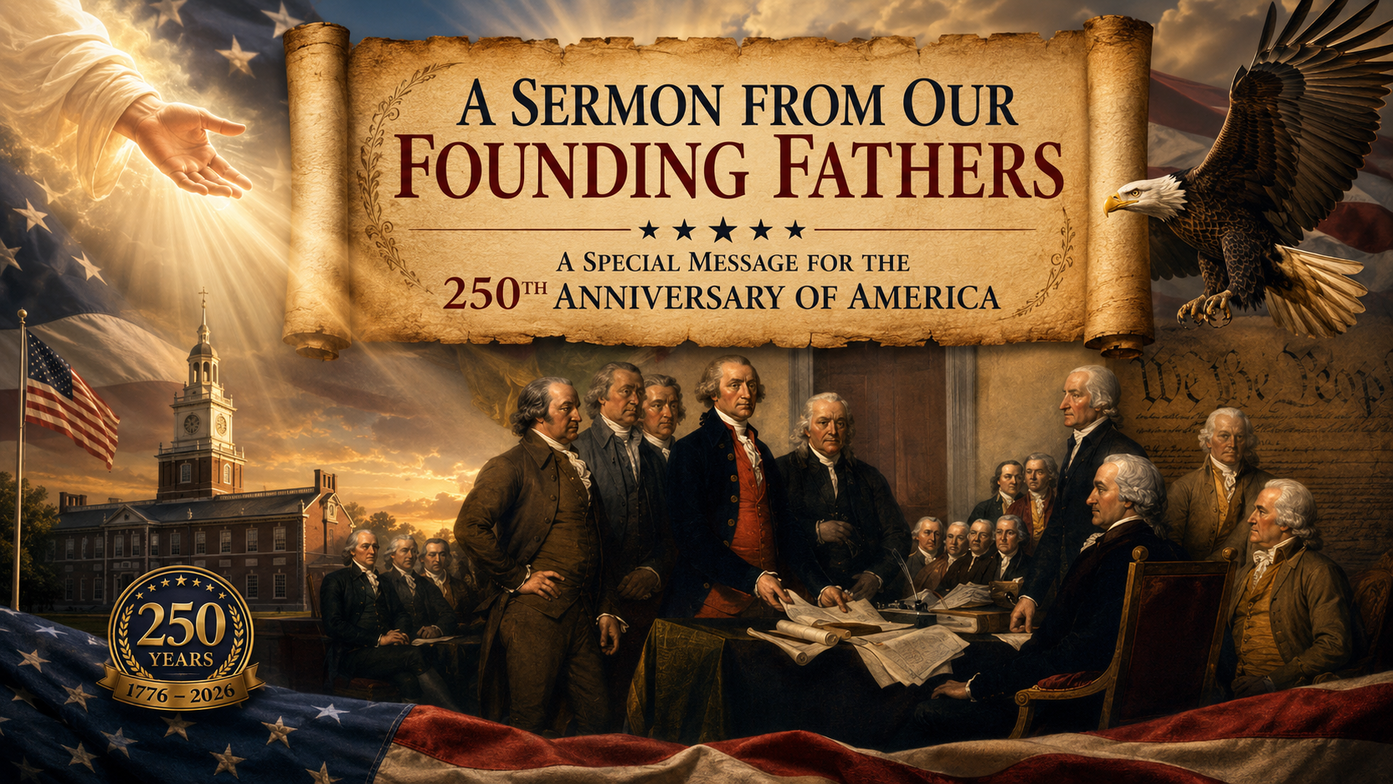
Two hundred and fifty years ago this Fourth of July, fifty-six men signed what amounted to their own death warrants. They did not call it a business transaction. They called it, in their own words, an appeal "to the Supreme Judge of the world for the rectitude of our intentions." [1] Beloved, that is not the language of secular men. That is the language of the spiritually enlightened.
When a man's name on parchment might be the last thing he ever signs, he stops pretending. So when fifty-six delegates, most of whom stood to lose their fortunes, their families, and their very lives, chose to invoke the Creator, the Supreme Judge, and divine Providence in the same breath as their declaration of independence, we ought to sit up and take notice. This anniversary is not merely a birthday with fireworks. It is an invitation to ask what these men actually believed — and to let their convictions preach to us the way colonial pulpits once preached to them.
The road there had not been quick. Reconciliation, not revolution, remained the hope of most colonists for years — until, in March 1775, Patrick Henry stood before the Second Virginia Convention and thundered, "I know not what course others may take, but as for me, give me liberty or give me death!" [2] Then in January 1776, an Englishman-turned-American named Thomas Paine published Common Sense, a fifty-page pamphlet that sold more than one hundred thousand copies within months and paved the road straight to Independence Hall. Fifty-six delegates — many of whom had never met one another — gathered in Philadelphia to decide the fate of a nation not yet born. What they did next tells you everything about who they really were.
Two Hours Upon Their Knees
Before a single grievance was debated, Congress began its days on its knees — as much as two hours of prayer, followed by the study of Scripture. [3] Write that down, friend. We complain if a church meeting runs five minutes long; they gave two hours to seeking God in prayer, then sought God's plan through the Scriptures before a single vote was cast.
During one such study, the delegates read Psalm 35 — David's cry for God to fight his enemies — and something moved in that room. John Adams was so stirred he wrote his wife Abigail, "I must beg you to read that Psalm... read the thirty-fifth Psalm to your friends. Read it to your father." [4] For the first time, this ragged band of colonists believed, deep in their bones, they could stand against an empire — because they heard from God believed He would stand with them. That is faith under fire, and our generation would do well to remember it, and recover it.
Five Self-Evident, God-Given Truths
Out of those prayer-soaked mornings, thirty-three-year-old Thomas Jefferson was handed the pen. On July 4, 1776, Congress adopted his 1,400-word draft — a preamble, twenty-seven grievances, and a declaration. [5] But it is the preamble that carries the theological weight of the whole document:
"We hold these truths to be self-evident, that all men are created equal, that they are endowed by their Creator with certain unalienable Rights, that among these are Life, Liberty and the pursuit of Happiness."
Five convictions hold up that sentence: all mankind is created equally — by God's design, not government decree; our rights come from God, not from kings; every person carries a God-given right to life, liberty, and the pursuit of happiness; government exists to protect those rights, nothing more; and when government fails that trust, the people have both the right and the duty to replace it. Historian David Barton and the researchers at WallBuilders (wallbuilders.com) have spent decades documenting that virtually every right named here had already been PREACHED from American pulpits in the years before 1763. [6] The Declaration was not invented in Philadelphia. It was preached in New England meetinghouses long before it was ever penned and it's inspiration came directly from the Bible!
Sermons from the Signers
Don't take my word for it. Hear the men themselves. John Adams, reflecting years later on what actually won the Revolution, wrote: "The general principles on which the fathers achieved independence were the general principles of Christianity... as eternal and immutable as the existence and attributes of God Himself." [7] That is an eyewitness telling us, in his own hand, that this nation was built on God and the Bible.
Benjamin Rush, physician and signer, contended above every other cause for the Bible as the very textbook of the American classroom — and of his own soul he wrote, "My only hope of salvation is in the infinite transcendent love of God manifested to the world by the death of His Son upon the Cross. Nothing but His blood will wash away my sins." [8]. Pretty certain you'll never hear that from media or in classrooms.
John Witherspoon, Presbyterian minister and president of what is now Princeton, published one of colonial America's first family Bibles and pleaded with his own congregation: "I entreat you in the most earnest manner to believe in Jesus Christ, for there is no salvation in any other... if not, you must forever perish." [9] John Hancock, whose bold signature dares the king to find it, called the people of Massachusetts to fast and pray twenty-two times as governor, asking them to pray "that the spiritual kingdom of our Lord and Savior Jesus Christ may be continually increasing until the whole earth shall be filled with His glory." [10] That does not sound like agnosticism to me. That sounds like a revival prayer meeting. Hallelujah! And Roger Sherman, the only man to sign all four of our founding documents, wrote plainly, "God commands all men everywhere to repent... and has assured us that all who do repent and believe shall be saved." [11]
Their Own Death Warrants
Never read the Declaration's closing line too quickly: "With a firm reliance on the protection of divine Providence, we mutually pledge to each other our Lives, our Fortunes and our sacred Honor." [12] In the eyes of the Crown, every signature was treason. Richard Stockton of New Jersey was captured and imprisoned so brutally his health never recovered [13] — a living picture of "greater love hath no man than this, that a man lay down his life for his friends" (John 15:13). When Congress fled to Baltimore, it was a printer named Mary Katherine Goddard who dared to be among the first to print the Declaration — attaching her own name beneath the signers', a single woman openly declaring her support for what the Crown called treason. [14] Sacrifice like that does not come from men and women merely playing politics. It comes from those who believe they are answerable to a Judge higher than any king. to the King of Kings, and Lord of lords - Jesus Christ!
Two Hundred Years — And the God Who Kept Us Past It
Students of history have long observed a sobering pattern: the average lifespan of a great nation or republic has hovered right around two hundred years. [15] Empires rise on courage, endure a season on industry and liberty, then soften — trading self-governance for dependency, conviction for comfort — until they collapse from within. Do the math with me, friend. 1776 to 1976 is two hundred years. By that pattern, America's clock should have run out at the Bicentennial. Yet here we stand in 2026 — fifty years past it.
I do not believe that is an accident of geography. I believe it is grace. Like a family with a troubled past of its own, this nation carries chapters it is not proud of. And yet it is a nation whose founding documents were signed by men who had first folded their hands in prayer — men who bound their new nation not to a king, but to "the Supreme Judge of the world." And its survival, long past the ordinary lifespan of nations, bears the fingerprints of a God who "blesses the nation whose God is the LORD" (Psalm 33:12).Two hundred fifty years is not the achievement of clever statesmen. It is the mercy of a patient God, extended to a people who dared to build their house upon the ROCK (JESUS!).
Have You Made a Declaration Today?
Fifty-six men declared their independence from an earthly king, and aligned their allegiance to their Heavenly King. They proudly professed that the nation was to be One Nation Under one GOD! But there is a far greater bondage than the tyranny of King George III — the bondage of sin — and a far greater Declaration than the one signed at Philadelphia. Paul wrote to the Galatians, "It is for freedom that Christ has set us free. Stand firm, then, and do not let yourselves be burdened again by a yoke of slavery" (Galatians 5:1). And to the Romans, he made the invitation as simple as any declaration in history: "Whoever calls on the name of the Lord shall be saved" (Romans 10:13).
Do you see it? You do not need fifty-six signatures, a congress, or a parchment. You need only one declaration — spoken from a heart that believes Jesus Christ died for your sins and rose again — and you will be free indeed (John 8:36). The signers pledged their lives, fortunes, and sacred honor for an earthly liberty that will not outlast this present age. Jesus Christ pledged His own life — and gave it — to secure a liberty that will outlast every empire that has ever risen, including this one.
Have you made your declaration today?
As America crosses this remarkable threshold, let this generation not merely wave the flag — let us get back down on our knees. Let us recover the two hours of prayer behind the two hundred fifty years of freedom that followed it, the Christ these signers believed in, proclaimed, and the gospel they published that alone secures a liberty no army or anniversary can guarantee. "Blessed is the nation whose God is the LORD" (Psalm 33:12). May it be said of America, two hundred fifty years from her founding, that she remained that nation still.
Soli Deo Gloria — to God alone be the glory.
Endnotes
- The Declaration of Independence, In Congress, July 4, 1776, closing paragraph. National Archives, "Declaration of Independence: A Transcription," archives.gov.
- Patrick Henry, address to the Second Virginia Convention, St. John's Church, Richmond, Virginia, March 23, 1775; Thomas Paine, Common Sense, published January 9/10, 1776, Philadelphia, sales figures widely cited across standard histories of the American Revolution.
- Accounts of the Continental Congress opening its sessions in prayer are documented in the Journals of the Continental Congress and discussed by WallBuilders, wallbuilders.com.
- John Adams to Abigail Adams, letters of 1776, Massachusetts Historical Society, "Adams Family Papers: An Electronic Archive," masshist.org.
- Word count and structural breakdown of the Declaration of Independence commonly cited by National Archives and standard constitutional histories.
- David Barton, WallBuilders, wallbuilders.com — research on colonial-era sermons and their relationship to the principles later enumerated in the Declaration of Independence.
- John Adams to Thomas Jefferson, June 28, 1813, in The Adams-Jefferson Letters, ed. Lester J. Cappon (University of North Carolina Press, 1959).
- Benjamin Rush, personal correspondence reflecting his Christian faith, collected in Letters of Benjamin Rush, ed. L.H. Butterfield (Princeton University Press, 1951).
- John Witherspoon, sermon addresses on salvation through Christ, referencing Acts 4:12, standard collections of Witherspoon's published sermons.
- John Hancock, Massachusetts proclamations for days of fasting and prayer during his governorship, Massachusetts State Archives.
- Roger Sherman, personal statement of Christian belief, widely reproduced in period biographical collections of the Connecticut delegation.
- The Declaration of Independence, closing pledge, July 4, 1776.
- Biographical accounts of Richard Stockton's capture and imprisonment by British forces in late 1776, standard sources on the New Jersey signers.
- Mary Katherine Goddard's January 1777 Baltimore printing of the Declaration of Independence, the first to list all signers by name; Library of Congress, Rare Book and Special Collections Division.
- The observation that republics and great powers have historically endured for roughly two centuries is a widely repeated pattern in popular historical commentary rather than a precise, universally agreed-upon academic metric; it is offered here devotionally, as a reflection on providence, rather than as a rigid historical law.
Read the Expanded Version here: https://www.ofhim.org/blog/a-sermon-from-the-signers