FOLLOW ME

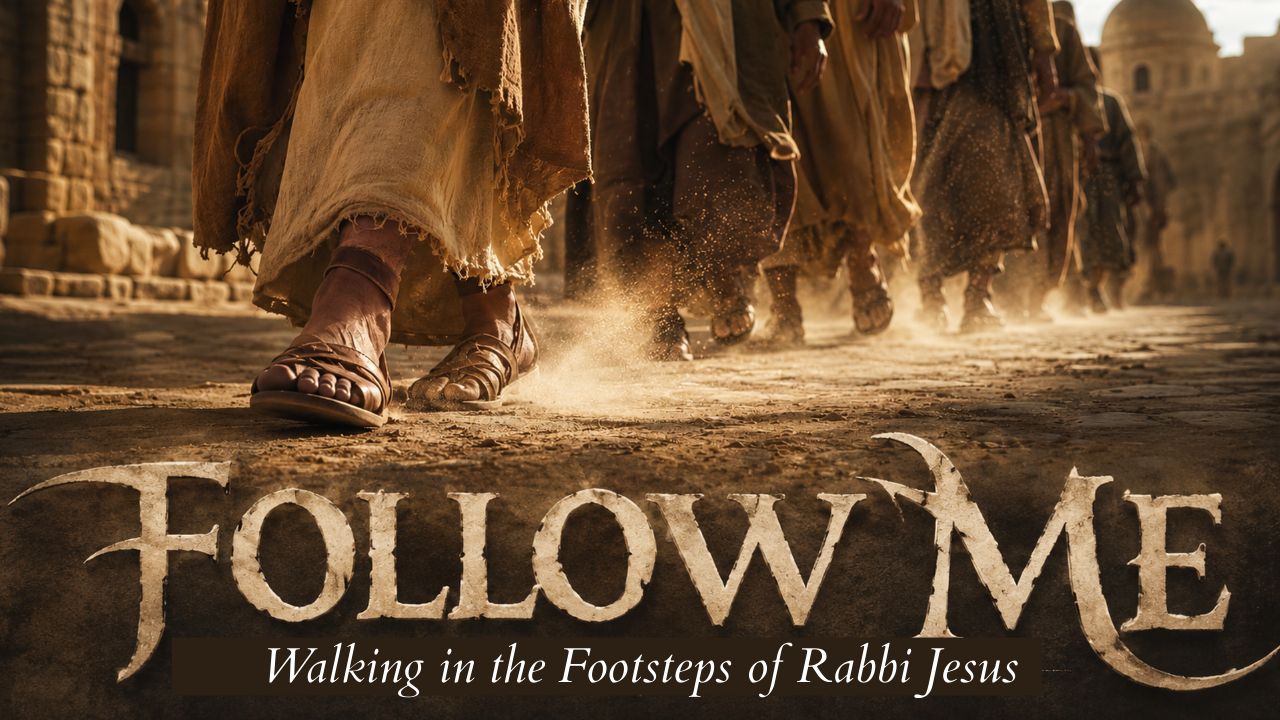
Matthew 4:19 "Follow Me, and I will make you fishers of men."
The Two Most Powerful Words Ever Spoken
Two words. That is all it took.
No application form. No entrance exam. No list of prerequisites or theological qualifications. Just two words spoken by one Jewish Rabbi on the rocky shore of the Sea of Galilee — and the entire trajectory of human history shifted on its axis. Simon Peter was hauling a net. Andrew was mending one beside him. And Jesus of Nazareth walked past and said simply, quietly, majestically: "Follow Me."[1]
We have heard those words so many times that the thunder in them has faded to a whisper. We have domesticated one of the most radical invitations ever issued in the history of the world. But if you could transport yourself back to that Galilean shoreline — feel the gravel under your feet, smell the fish, hear the lapping of the water — you would understand that what Jesus said to those fishermen was not a gentle suggestion. It was a summons. A radical interruption. The Voice of God calling out to His creation — the kind of call that divided life into two clean halves: before and after.
What "Follow" Really Means
The Greek verb translated follow is akoloutheo (ah-koh-loo-THEH-oh) — which, broken down to its ancient roots, literally means "one who goes down the very same road in close, binding union."[2] This was not a casual stroll at a comfortable distance. Akoloutheo was a technical term in the ancient world for a relationship of absolute surrender and total imitation — to identify completely with a leader and conform the entire shape of your life to his direction.[3] And wherever it appears in the Gospels as a command, it comes in the present imperative — a grammatical form meaning: begin this action right now and keep it going without interruption, as your permanent way of life.[4]
In Hebrew culture, a disciple — a talmid (tahl-MEED) — would halak achar (hah-LAHK ah-KHAHR) his Rabbi, literally "walk after" him.[5] The Mishnah preserved a saying that captures this vividly: "Sit amidst the dust of their feet, and drink in their words with thirst."[6] That phrase was utterly literal. The dust kicked up by the Rabbi's sandals would settle on the disciple's clothing, in his hair, on his face. The goal of the talmid was to walk so close that he was covered in his master's dust.[7] The dust told every passerby: I belong to Him. His path is my path.
The Aramaic Peshitta — written in the very dialect Jesus spoke daily — renders the phrase as "Ata batar'y" (ah-TAH bah-tahr-EE): "Come after My back — yield your own sovereignty and walk in My shadow."[8] Like a child placing his small feet into the deep footprints left by his father in the snow.
The Honor Nobody Expected
Here is the detail that changes everything.
In first-century Israel, the educational system was a rigorous, highly selective pyramid. Jewish boys began memorizing Torah around age five. By age ten, only the brightest advanced to deeper study. And from that smaller pool, only the absolute elite would dare approach a respected Rabbi with the request to become his talmid (tahl-MEED).[9] The Rabbi would examine the young man rigorously. If satisfied, he issued the phrase: "Follow me." If not, the boy was sent home: "Go, work in the family trade."
Now look at the scene at the Sea of Galilee with fresh eyes.
Peter, Andrew, James, and John were not in Jerusalem at the feet of Gamaliel. They had been sent home. They had gone through the system and been told, in effect, "You're not good enough." They were mending nets — doing what ordinary men did when their rabbinical ambitions had been quietly buried.
And then the Ultimate Rabbi appeared. Jesus of Nazareth — the One in whom "all the fullness of Deity dwells in bodily form" (Colossians 2:9) — looked at these overlooked, previously rejected fishermen and said two words: "Follow Me." In the rabbinic system, that call carried one unmistakable implicit message: "I believe you WILL become what I have called you to be."[10] It was not merely an invitation. It was a declaration of divine confidence.
They didn't need a moment to think it over. "And immediately they left the nets and followed Him" (Matthew 4:20). The net was their earthly security. Jesus was their eternal destiny. There was simply no comparison.
What Following Actually Costs
Later in His ministry, Jesus opened the invitation wider — but He did not soften the terms. "If anyone wants to come after Me, he must deny himself, and take up his cross and follow Me" (Mark 8:34).
Three requirements. Each one more costly than the last.
First: "Deny himself." The Greek word here means to utterly disown oneself — to say a final, absolute no to personal sovereignty, the very same word used when Peter denied knowing Jesus in the courtyard.[11] That depth of disavowal is exactly what Jesus is calling for.
Second: "Take up his cross." In first-century Judea, this image carried no metaphorical softening. A man carrying a cross was walking in one direction only: toward his own execution. To take up your cross meant a final, irrevocable march away from your own agenda.[12]
Third: "Follow Me." Only after the self is disowned and the cross is shouldered does akoloutheo become possible in its fullest sense. The road is clear. There is only one set of footprints to follow.
The Rich Young Ruler wanted Jesus as an addition to his life — not as the Lord of it. He went away grieving, still possessed by his possessions. There are no part-time disciples in the Kingdom of God.
The Dust on Your Clothes
Near the end of his long life, the Apostle John — the last surviving eyewitness, the man who had literally walked behind Jesus on those dusty Galilean roads for three years — wrote these words: "The one who says he abides in Him ought himself to walk in the same manner as He walked" (1 John 2:6).
The Greek word kathōs — "in the same manner as" — is a word of exact correspondence.[13] Not inspired by the way He walked. Not vaguely resembling the way He walked. In the same manner. The SAME WAY He walked. The standard for Christian conduct is the life of Jesus Christ — not as a distant ideal to admire from afar, but as a daily pattern to imitate up close.
And what did Jesus' walk look like? It looked like rising before dawn to pray (Mark 1:35). It looked like stopping for the one the crowd was trampling past (Luke 18:40). It looked like sitting with notorious sinners and reaching toward the outcast and the left-behind (Luke 15:2). And when the shadow of the cross loomed, it looked like forgiving His executioners from the very instrument of His death: "Father, forgive them, for they do not know what they are doing" (Luke 23:34). All in all, it looked like a Love that was not of this world!
The earliest believers — before they were ever called "Christians" at Antioch — were known simply as "People of the Way" (Acts 9:2).[14] This was no accident. It reflected a profound theological reality: following Jesus is a path, a movement, a total orientation of one's entire existence. It walks out the door with you every morning.
The Supernatural Payload: The Benefits of Following Christ
Walking so closely behind Jesus changes your identity — but it also releases a distinct kind of power into the world around you.
1. You Become a Living Mirror of the Master
In Acts 4:13, Peter and John stood before the powerful religious elite of Jerusalem, defending their faith with absolute courage. The text notes: "Now as they observed the confidence of Peter and John and understood that they were uneducated and untrained men, they were amazed, and began to recognize them as having been with Jesus."
They didn't have credentials or social standing. What they had was the distinct flavor of the Nazarene all over them — the same quiet authority, the same fearless compassion, the same sacrificial love, the same divine confidence as Jesus. Think of an apprentice who spends decades in the studio of a master sculptor. When the critics examine the finished work — the clean lines, the breathtaking depth — they don't look at the apprentice's resume. They instantly recognize the master's style. That is what happens when you walk in the footsteps of Christ. The world looks at your patience under fire, your speech seasoned with grace, your integrity in the dark, your love in the midst of hatred, and they say: "I recognize that. They have been with Jesus. I see Jesus all over them."
2. You Carry a Shadow That Heals
The Aramaic call — "Come after My back and walk in My shadow" — carries a stunning promise. When you step out of your own footprints and into His, you begin to operate within the shadow of Jesus. And that shadow carries the Master's healing presence.
In Acts 5:15-16, Luke records: "...they even carried the sick out into the streets and laid them on cots and pallets, so that when Peter came by at least his shadow might fall on any one of them...and they were all being healed."
There was nothing magical about Peter's physical shadow. The power belonged to the One Peter was walking behind. Because Peter stayed in absolute alignment, the life-giving, restorative presence of Christ cast His shadow directly over him onto the dusty streets of Jerusalem. When you walk strictly behind Jesus, your life creates a kind of spiritual atmosphere. You don't bring your own light — you reflect His presence. And as you pass through your workplace, your home, your neighborhood, your school, His presence brings a shift: deescalating arguments, comforting the brokenhearted, illuminating love, introducing hope to an anxious room. These are the modern-day miracles of a disciple walking in the shadow of the King.
He Believes You Can Do This
You may feel exactly like those fishermen on the Galilean shore — like someone who has been through the system and come up short. Like someone the religious world might have quietly classified as the spiritual B-team.
But Jesus is walking toward you right now. He is not reviewing your record of stumbles. He is looking at you — the you He made, the you He died for, the you the Father runs toward before the prodigal has even finished his rehearsed apology.
And He is saying two words.
"Follow Me."
In the language of the ancient rabbis, that means: "I believe you will become what I created you to be. I believe the dust of My feet belongs on your life — and I am choosing you to wear it."[15]. What an incredible honor!!!
Matthew didn't balance the books before he left the tax booth. Peter didn't service the nets before he left the boat. They heard the call, felt the full weight of the honor behind it, and left everything to step into the footprints of the One already walking ahead of them.
Will you?
"Follow Me." — Matthew 4:19
ENDNOTES
[1] Matthew 4:19 NASB. The parallel account in Mark 1:17 places the call in the same active context — Jesus walking by the sea, fishermen at work. See also Precept Austin, Matthew 4:19 Commentary: "The call was a radical disruption of their daily occupation and an unconditional summons to follow." preceptaustin.org/matthew_4_commentary
[2] Strong's Greek Dictionary, G190, akoloutheo (ἀκολουθέω). NASB Discovery Bible H.E.L.P.S. system, Core Word-Studies, s.v. "akoloutheō": constructed from a (a prefix expressing union, oneness, or likeness) + keleuthos (a path, road, or highway) — literally, "one who goes on the very same road in close union." biblehub.com/greek/190.htm
[3] Precept Austin, Luke 5 Commentary: "akoloutheo was a technical term in antiquity describing a relationship of absolute surrender and physical imitation — to identify completely with the leader, to side with his household, and to conform one's life to his standard and direction." preceptaustin.org/luke-5-commentary. See also Wenstrom Bible Ministries, Word Study on akoloutheo: "It implies total allegiance — not intellectual assent alone but behavioral conformity." wenstrom.org
[4] The present imperative in Greek commands an action to begin immediately and continue without interruption as a habitual, permanent way of life. See Precept Austin, Luke 5 Commentary, ibid; also HELPS Word Studies on the present imperative in the Gospels.
[5] David Stern, Messianic Jewish Commentary on the New Testament (Clarksville: Jewish New Testament Publications, 1992), 18–22: "Halak achar — 'walk after' — was the standard Hebrew idiom for the relationship of a talmid to his rabbi, echoing Deuteronomy 13:4 and the entire Old Testament pattern of walking after the Lord."
[6] Mishnah, Avot 1:4 (The Sayings of the Fathers): "Let your house be a meeting house for the sages, and sit amidst the dust of their feet, and drink in their words with thirst." Attributed to Yose ben Yoezer and Yose ben Yochanan, sages of the second century BC.
[7] David Bivin, "Be Covered in the Dust of Your Rabbi," Jerusalem Perspective (jerusalemperspective.com): "A student who followed so closely that the dust of his rabbi covered him was considered the ideal disciple." See also Ann Spangler and Lois Tverberg, Sitting at the Feet of Rabbi Jesus (Grand Rapids: Zondervan, 2009), 23–34.
[8] The Aramaic Peshitta New Testament Translation, trans. and notes by Janet M. Magiera (Light of the Word Ministry, 2006), notes on Matthew 4:19: "Ata batar'y — literally 'come after my back' — implies active surrender of one's own direction, stepping precisely into the physical footprint left by the one leading the way."
[9] Lois Tverberg, Walking in the Dust of Rabbi Jesus: How the Jewish Words of Jesus Can Change Your Life (Grand Rapids: Zondervan, 2012), 45–52, 102–111: "The educational pyramid of first-century Judea was extraordinarily selective...only the absolute elite would be chosen by a Rabbi to become a talmid. The rest were sent home to ply the family trade." See also ibid., 15–28 on the Bet Sefer and Bet Talmud system.
[10] Ibid., 15–28: "In the rabbinic system, a rabbi's invitation to 'follow me' carried an implicit message of confidence: I believe you have what it takes to become like me. This was the highest honor imaginable — a declaration of faith in the disciple's potential." See also Arnold Fruchtenbaum, Messianic Christology (Tustin: Ariel Ministries, 1998), 114–116.
[11] Strong's G533 aparneomai: "to deny utterly, to disown completely, to say a final and absolute no." Precept Austin, Mark 8:34 Commentary: "aparneomai is the same word used of Peter's denial of Christ in the courtyard — the strongest possible term for complete disavowal of personal sovereignty." preceptaustin.org/mark_8_commentary
[12] Michael Brown, Answering Jewish Objections to Jesus: Messianic Prophecy Objections (Grand Rapids: Baker Books, 2003), 89: "The image of taking up a cross in first-century Judea was entirely literal — a condemned man carrying the instrument of his own execution. There was no metaphorical softening of this image for Jesus' original audience." See also The Complete Jewish Bible, trans. David H. Stern (Clarksville: Jewish New Testament Publications, 1998), commentary on Mark 8:34.
[13] Strong's G2531 kathōs: "just as, even as, exactly as — establishing a direct point of exact correspondence." HELPS Word Studies: "kathōs sets a standard of precise imitation, not merely general resemblance." Precept Austin, 1 John 2:6 Commentary: "The standard here is not inspirational but exacting — the historical walk of Jesus Christ is the measure." preceptaustin.org
[14] Ann Spangler and Lois Tverberg, Sitting at the Feet of Rabbi Jesus (Grand Rapids: Zondervan, 2009), 23–34: "Before they were called Christians at Antioch (Acts 11:26), the followers of Jesus were known simply as 'People of the Way' (Acts 9:2) — a title capturing the active, ambulatory, journey-oriented nature of discipleship."
[15] Lois Tverberg, Walking in the Dust of Rabbi Jesus, op. cit., 15–28: "When a rabbi said 'Follow me' to a prospective disciple, he was making a declaration: 'I believe you have what it takes to become like me. I have confidence in your potential.' This is precisely what Jesus communicated to Peter, Andrew, James, John, and Matthew — men the religious establishment had already passed over."