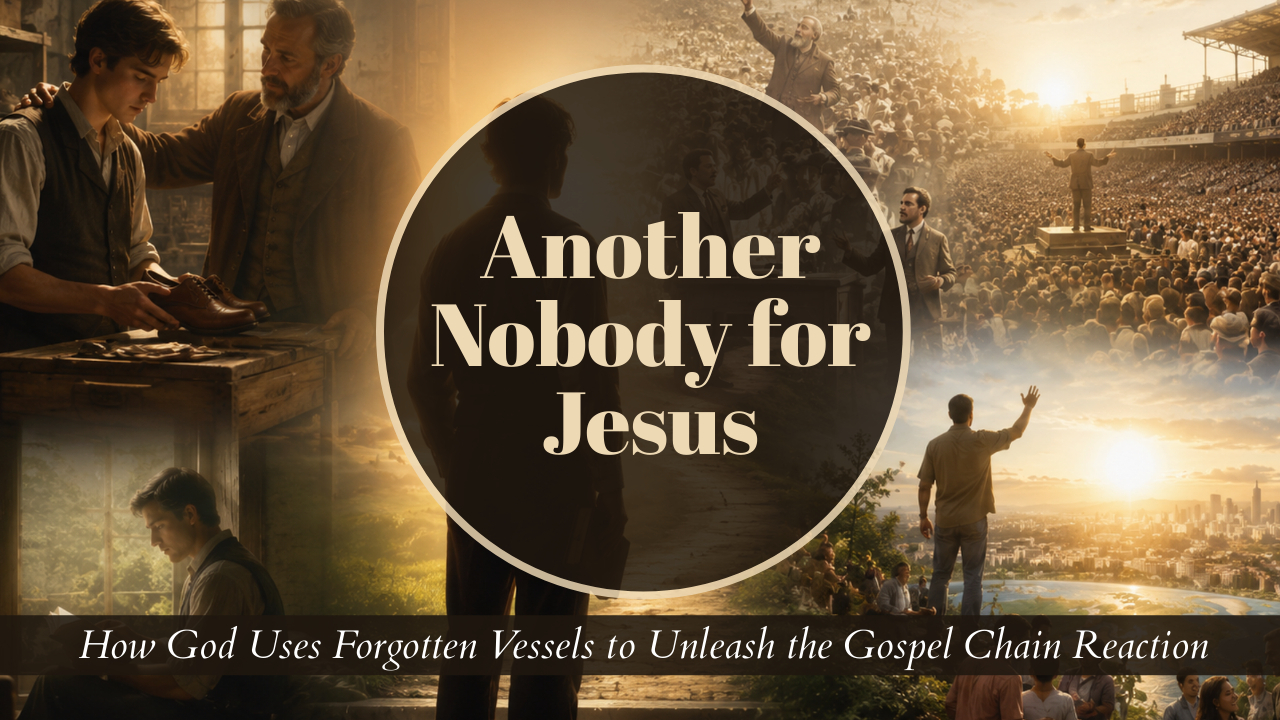
Another Nobody for Jesus

The Prelude: A Song for the Unchosen
Have you ever looked in the mirror and wondered if God could truly use someone like you? If we are honest, most of us have felt the sting of inadequacy. We live in a culture obsessed with celebrity, titles, and platforms. But the economy of heaven operates on a completely different set of principles. The contemporary Christian group Casting Crowns, alongside singer Matthew West, captured this profound biblical reality in their anthem, "Nobody."[^1] The lyrics speak directly to the heart of anyone who has ever felt overlooked:
“Why You ever chose me Has always been a mystery... 'Cause I'm just a nobody trying to tell everybody All about Somebody who saved my soul.”[^2]
The song reminds us that this "nobody mentality" is deeply rooted in Scripture. Consider John the Baptist. He had the opportunity to build a massive personal following, yet he chose to decrease so that Christ might increase, defining himself merely as "a voice crying in the wilderness."[^3] The pages of your Bible are heavily populated by flawed, unqualified, and ordinary people whom the world completely dismissed. Moses had severe stage fright and a stutter, yet he stood before Pharaoh.[[^4]] David was a forgotten shepherd boy who brought a mere smooth rock to a sword fight.[[^5]] And when Jesus set out to change the fabric of human history, He did not recruit from the elite rabbinical schools of Jerusalem. Instead, He picked twelve outsiders—rough fishermen, a hated tax collector, everyday men—and turned the world upside down.[[^6]]
My friends, the enemy loves to whisper a paralyzing question into your ear: “Who do you think you are?”[^7] The next time he throws that fiery dart at your confidence, you look him in the eye and give him the truth: “I am a nobody, trying to tell everybody, about the Somebody who rescued my soul!”[^8]
Enter a Nobody: The Anemic (Weak) Step of Edward Kimball
Let me take you back in time to the year 1855, to the bustling streets of Boston, Massachusetts.[[^9]] If you had walked into the Mount Vernon Congregational Church back then, you might have met a forty-year-old Sunday school teacher named Edward Kimball.[[^10]] Mr. Kimball was not a man of great academic renown or soaring eloquence. In fact, he had recently learned some devastating news—he was facing a terminal illness and believed his time on this earth was short.[[^11]] But Edward Kimball had a burden. He was deeply concerned about the eternal destiny of the young men in his class, particularly a seventeen-year-old boy who had recently left his family farm to find work as a boot salesman in his uncle's shoe store.[[^12]] Kimball later described this boy as having one of the darkest, most spiritually ignorant hearts he had ever encountered.[[^13]]
One Saturday morning, the Holy Spirit prompted Kimball to visit the boy at his place of employment. As Kimball walked down toward Holton’s Boot Store, he began to experience a wave of intense anxiety and self-doubt. He later recalled his hesitation:
“I began to wonder whether I ought to go just then during business hours. And I thought maybe my mission might embarrass the boy, that when I went away the other clerks might ask who I was, and when they learned, might taunt [him] and ask if I was trying to make a good boy out of him.”[^14]
How relatable that is! How often have you and I resisted the gentle whisper of the Holy Spirit because we were paralyzed by the fear of what others might think? Thankfully, Edward Kimball did not let fear dictate his steps. He decided to, in his words, “make a dash for it and have it over at once.”[^15] He walked into the back of that dusty stockroom, found the teenager wrapping up shoes, placed a hand on his shoulder, and delivered what he later lamented was a “very weak and anemic (i.e., weak) presentation” of the gospel.[[^16]] He simply spoke of Christ’s love for the boy, and the love Christ wanted in return.[[^17]]
That was it. No multi-media presentation. No complex theological debate. Just an ordinary, trembling Sunday school teacher speaking to a shoe clerk. But God took that anemic (weak) sacrifice, infused it with His supernatural power, and a miracle occurred.[[^18]] Right there in the back of that Boston shoe store, Dwight L. Moody surrendered his life to the Lord Jesus Christ.[[^19]] Moody would later write about the morning after his conversion, stating that the sun seemed to shine brighter, the birds on the Boston Common seemed to be singing a new song to him, and he fell in love with all of God's creation.[[^20]] Edward Kimball thought he had failed; instead, he had just unlocked a spiritual floodgate.
The Divine Domino Effect
What Edward Kimball did not see—and what he could never have humanly engineered—was the unbroken chain reaction of evangelism that his single act of obedience set into motion. Consider how God constructed this historic lineage:
- Edward Kimball stepped out in faith and led D.L. Moody to Christ.[[^21]]
- D.L. Moody crossed the Atlantic to preach in the British Isles, where his powerful testimony profoundly shook a young, traditional pastor named F.B. Meyer, transforming him into a fiery evangelist.[[^22]]
- F.B. Meyer later traveled to America to preach at Moody’s school in Northfield, Massachusetts. During his sermon, he uttered a searching phrase: “If you’re not willing to give up everything for Christ, are you willing to be made willing?”[[^23]] That single sentence revolutionized the heart of a student named J. Wilbur Chapman.[[^24]]
- J. Wilbur Chapman entered full-time evangelistic work and eventually hired a flashy, former professional baseball player to serve as his advance man and assistant. That young man was Billy Sunday.[[^25]]
- Billy Sunday learned the art of preaching by watching Chapman and became the premier evangelist of the early twentieth century, leading hundreds of thousands down the "sawdust trail."[[^26]] In 1924, Sunday held a massive crusade in Charlotte, North Carolina.[[^27]]
- Out of that Billy Sunday crusade, a dedicated group of local businessmen formed a permanent evangelistic club.[[^28]] Ten years later, in 1934, this very group pooled their resources and invited a hard-hitting Baptist evangelist named Mordecai Ham to town.[[^29]]
- Mordecai Ham set up a temporary wooden tabernacle on Pecan Avenue.[[^30]] During those meetings, a lanky, resistant sixteen-year-old high school student skipped school, hopped into the back of a friend's pickup truck, and sat in the back row.[[^31]] He felt as though the preacher was pointing a finger directly at his soul. To escape the conviction, he joined the choir loft the next night.[[^32]] Under that tent, that young man walked forward and gave his life to Jesus. His name was Billy Graham.[[^33]]
Think of it! Millions upon millions of souls were swept into the Kingdom of God through the ministry of Billy Graham. But if you trace the genealogical roots of his spiritual lineage all the way back through the decades, you will find a quiet, terminal Sunday school teacher who was terrified to walk into a shoe store.
The Biblical Program: The Anatomy of a Chain Reaction
Lest you think the story of Edward Kimball is an isolated historical anomaly, we must look to the authoritative pages of Scripture. The strategy of using "nobodies" to initiate historic chain reactions is God’s standard operational procedure. In the first chapter of John’s Gospel, we see the premier example of this evangelical blueprint. The Bible records:
“The next day Jesus decided to go to Galilee. He found Philip and said to him, ‘Follow me.’ Now Philip was from Bethsaida, the city of Andrew and Peter. Philip found Nathanael and said to him, ‘We have found him of whom Moses in the Law and also the prophets wrote, Jesus of Nazareth, the son of Joseph.’ Nathanael said to him, ‘Can anything good come out of Nazareth?’ Philip said to him, ‘Come and see.’” (John 1:43–46, ESV)
Notice the pattern. Philip has a life-changing encounter with Jesus, and he immediately seeks out his friend Nathanael.[[^34]] When Nathanael responds with cynical skepticism—questioning the validity of a Messiah from a backwater town like Nazareth—Philip doesn't enter into a complex, multi-hour theological defense. He simply issues a beautiful, three-word invitation: “Come and see.”[[^35]] He brought his friend to the feet of Jesus, and Nathanael's life was permanently transformed. We see this same divine program scattered across the New Testament landscape.
Just hours before Philip found Nathanael, Andrew was standing by the Jordan River when he heard John the Baptist declare that Jesus was the “Lamb of God.”[[^36]] Andrew didn't wait. He immediately ran to find his brother, Simon.[[^37]] He told him, “We have found the Messiah,” and he physically brought Peter to Jesus.[[^38]] Andrew is rarely mentioned as the frontman of the disciples; he was often in the background. But because this "nobody" brought his brother to Christ, Simon Peter became the rock of the early Church, preaching at Pentecost where three thousand souls were saved in a single day.[[^39]]
We also witness this in John chapter 4, where Jesus encounters a heavily marginalized, scandalous woman drawing water at a well in Sychar.[[^40]] After a brief, revealing conversation where Christ exposes her broken past and offers her living water, she leaves her water jar behind and runs headlong into her town.[[^41]] She tells the residents, “Come, see a man who told me everything I ever did. Could this be the Messiah?”[[^42]] Because an outcast woman had the courage to share her simple testimony, the entire town came out to meet Jesus, and many believed because of her word.[[^43]]
The Rewards of the Unseen
My friend, how does this apply to your life today? You might be a Sunday school teacher struggling with a class of rowdy children, wondering if a single word is actually getting through. You might be a mother or father praying over a wayward teenager whose heart appears as cold as stone. You might be an ordinary worker sitting in an office cubicle, wondering if your quiet life holds any eternal significance. You may be a struggling student, thinking you don’t have the qualifications to share the Good News. Hear me clearly: God has uniquely positioned you in a specific place, at a specific time, for a specific purpose, to a specific people!
The Apostle Paul wrote these words to the believers in Ephesus: “For we are his workmanship, created in Christ Jesus for good works, which God prepared beforehand, that we should walk in them.” (Ephesians 2:10, ESV) God has already laid out a track of good works for you to step into.[[^52]] He has orchestrated your history and placed people across your path who are ready to receive the light of Christ.[[^53]] But you must be willing to get in the game.[[^54]] You must be willing to step up to the plate and swing at the pitch God throws you.[[^55]]
The great tragedy of the modern church is that so many believers are content to sit on the sidelines, consuming entertainment, while missing out on the thrill of being used by the Almighty God. If you want to see your community won to Christ, you cannot do it by merely occupying a pew for an hour on Sunday morning.[[^56]] You must be purposeful in the world.[[^57]] You may never hold a microphone in front of a stadium of fifty thousand people like Billy Graham. But you might be the "nobody" whom God uses to lead the next great evangelist to the feet of Jesus.[[^58]]
And what is the reward for the hidden, faithful worker? The world may never carve your name into a marble monument. Your face may never grace the cover of a magazine. But when you step across the threshold of eternity into the glorious presence of the Lord Jesus Christ, the metrics of the world will fade away. The last will be first, and the first will be last.[[^59]] Our Heavenly Father looks at the heart. He promises a crown of righteousness to those who are faithful with the little things.[[^60]] Imagine the scene in glory when a long line of believers walks up to you, wraps their arms around you, and says, “Thank you. I am here because you had the courage to speak to me when you were trembling.” Do not let fear rob you of the immense blessing of serving God.[[^61]] Do not step out of the divine chain of events.[[^62]] Trust the Holy Spirit's prompting, rely on His dunamis power, and remember that in the hands of a holy God, nobodies are always somebodies.[[^63]]
Footnotes
[^1]: Based on the background and theological commentary surrounding the release of the song "Nobody" by Casting Crowns featuring Matthew West (July 2019). [^2]: Official lyrics of "Nobody," written by Mark Hall, Matthew West, and Bernie Herms (Only Jesus album). [^3]: See John 1:19–23 and John 3:30 regarding the humility and biblical mindset of John the Baptist. [^4]: Refers to Exodus 4:10, where Moses pleads his lack of eloquence and slow speech before the Lord. [^5]: Refers to 1 Samuel 17:40–50, detailed in Casting Crowns' lyrical themes regarding God using small things to defeat giants. [^6]: See Matthew 4:18–22 and Luke 5:1–11 regarding the secular backgrounds of Christ's handpicked disciples. [^7]: Matthew West's personal commentary on the spiritual warfare behind the song's writing process. [^8]: Theological core of the Casting Crowns track "Nobody" (2019). [^9]: Historical record of Edward Kimball's ministry in Boston, MA, during the spring of 1855. [^10]: Mount Vernon Congregational Church archival records regarding Kimball's role as a teacher of young men. [^11]: Edward Kimball biographical details from his personal letters and journals recorded in 1855. [^12]: Historical account of Dwight L. Moody's early employment at his uncle's boot shop in Boston. [^13]: Edward Kimball’s personal reflections on D.L. Moody’s spiritual state prior to April 1855, cited in A Passion for Souls: The Life of Dwight L. Moody by Lyle Dorsett (Moody Press, 1997). [^14]: Direct quote from Edward Kimball detailing his internal hesitation on the sidewalk before entering Holton's Boot Store. [^15]: Ibid. [^16]: Kimball's retrospective evaluation of his gospel presentation to Moody, noting its lack of formal polish. [^17]: Historical summary of the conversation in the shoe store stockroom. [^18]: Allusion to the Greek word dunamis (miraculous, inherent power) as utilized by God through weak human instruments. [^19]: Documented date of D.L. Moody's conversion in the back of the shoe store (April 1855). [^20]: D.L. Moody, reflecting forty years later during a sermon in Boston's Tremont Temple on the transformative cosmic beauty of his regeneration. [^21]: Dorsett, Lyle. A Passion for Souls: The Life of Dwight L. Moody (Moody Press, 1997). [^22]: Historical account of F.B. Meyer’s pastoral transformation after observing Moody’s transatlantic meetings in the British Isles. [^23]: Famous quote by F.B. Meyer delivered during a sermon series at Moody’s Northfield, Massachusetts campus. [^24]: Ottman, Ford C. J. Wilbur Chapman: A Biography (Doubleday, 1920). [^25]: Dorsett, Lyle. Billy Sunday and the Redemption of Urban America (W. B. Eerdmans, 1991). [^26]: Historical origins of the phrase "sawdust trail," characterizing the temporary tabernacles built for Billy Sunday's mass crusades. [^27]: Archival records of the Billy Sunday Evangelistic Campaign held in Charlotte, North Carolina (1924). [^28]: History of the Billy Sunday Layman’s Evangelistic Club, which later developed into the Charlotte Businessmen’s Club (CBMC). [^29]: Ham, Edward E. 50 Years on the Battlefront with Christ: A Biography of Mordecai F. Ham (Old Kentucky Home Revivalist, 1950). [^30]: Local historical records of the Pecan Avenue temporary tabernacle built on the outskirts of Charlotte, NC (November 1934). [^31]: Graham, Billy. Just As I Am (HarperCollins, 1997), Chapter 2 detailed timeline of his high school attendance at the Ham meetings. [^32]: Ibid. Graham notes his strategy to avoid the piercing gaze of the evangelist by relocating to the choir loft. [^33]: Official conversion documentation of William Franklin Graham Jr. (November 1934). [^34]: Exegesis of John 1:43–45 detailing the relational structure of first-century discipleship lines. [^35]: Contextual breakdown of Philip's apologetic approach in John 1:46. [^36]: Scriptural account of Andrew's initial exposure to Christ via John the Baptist (John 1:35–40). [^37]: John 1:41 (ESV). [^38]: John 1:42 (ESV). [^39]: Cross-reference to Peter's sermon at Pentecost in Acts 2:41. [^40]: Exegesis of the Samaritan narrative in John 4:1–9. [^41]: John 4:28 (ESV). [^42]: John 4:29 (ESV). [^43]: John 4:39–42 detailing the revival in Sychar sparked by a singular female witness. [^52]: Textual commentary on the Greek word poiēma (workmanship/masterpiece) in Ephesians 2:10. [^53]: Divine providence and the ordering of believer schedules as discussed in Jeremiah 1:5 and Psalm 139:16. [^54]: Contemporary application on Christian living from Apprehending Grace Ministries. [^55]: Ibid. [^56]: Missional challenges regarding passive church consumers versus active community witnesses. [^57]: Scriptural mandate of the Great Commission in Mark 16:15. [^58]: Historical application derived from the Kimball-Moody-Graham lineage. [^59]: Scriptural comfort drawn from Matthew 20:16. [^60]: See Matthew 25:23 regarding the rewards for small-scale, hidden faithfulness. [^61]: Practical strategies for overcoming individual witness anxiety. [^62]: Warning against spiritual passivity and forfeiting the specific blessings ordained for your life. [^63]: Concluding theological synthesis of the grace of God transforming ordinary nobodies for His ultimate glory.