A Place Called Heaven

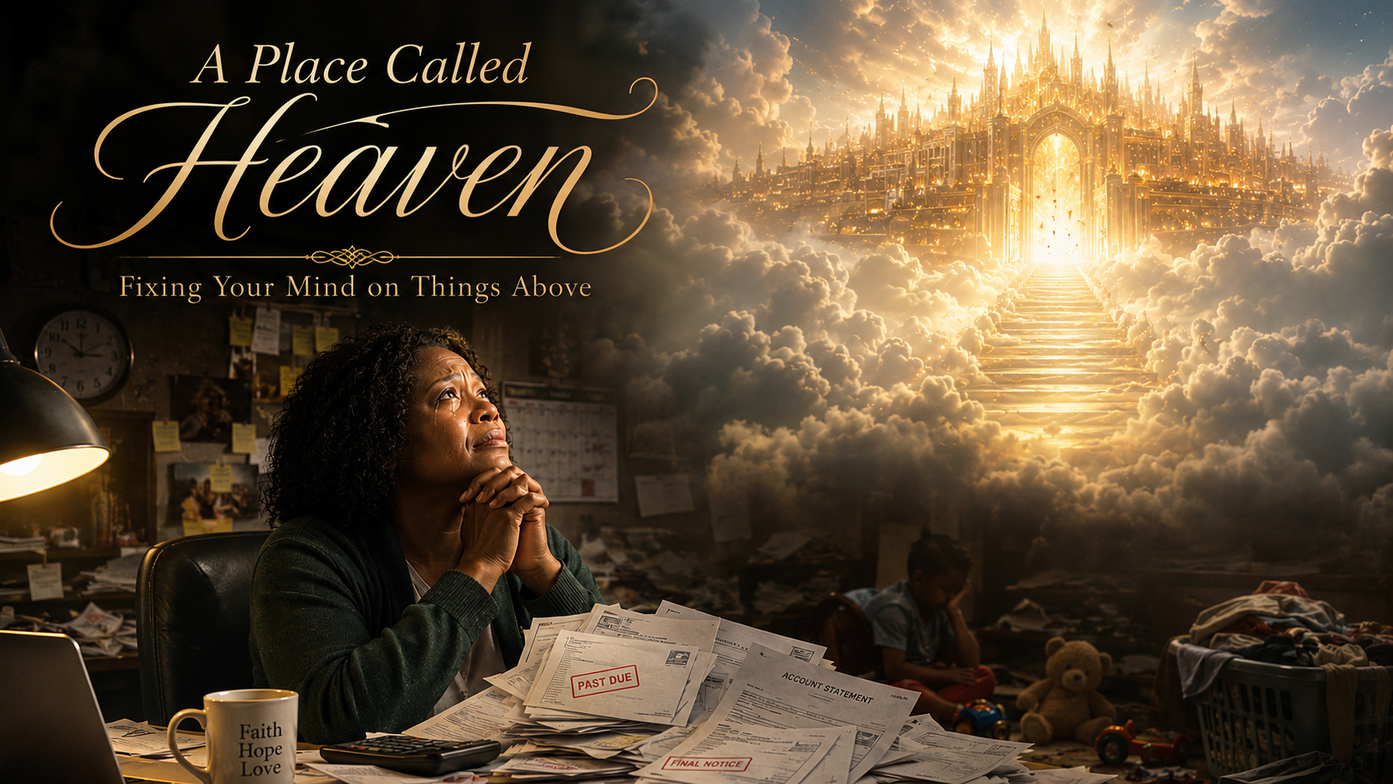
A PLACE CALLED HEAVEN
The Hope of Heaven — Part One
Friends, I want you to picture something extraordinary with me for a moment.
On a small strip of land in Mumbai, India — built on some of the most expensive real estate on the face of the earth — a man began to construct a place. It took him nearly four full years to complete.¹ When the workers finally stepped back, the structure stood twenty-seven stories tall, reaching nearly six hundred feet into the sky, containing over four hundred thousand square feet of living space.²
Now let me tell you what sits inside those walls. Three private helipads built onto the roof. Six entire floors devoted strictly to parking — housing a personal fleet of one hundred and sixty-eight luxury automobiles. A fifty-seat private theater. A ballroom with chandeliers so massive you would have to see them to believe them. A spa, a yoga studio, multiple swimming pools, and hanging gardens cascading down level after level, so that living, green vegetation spills over the side of the skyscraper like a modern Wonder of the Ancient World.³
And — I want you to catch this — it contains a custom-built snow room, where, in a tropical city that regularly bakes past a hundred degrees, real, freezing snow falls from the ceiling every single day.⁴
Six hundred full-time staff members are employed just to keep the place running. And depending on whose valuation you consult, the total cost to build it ran somewhere between **one and two billion dollars.**⁵
Beloved, that building is not a hotel. It is not a resort. It is not a civic monument. That towering estate, known as Antilia, is the personal “home” of a man named Mukesh Ambani — built for his wife, Nita, and their family.⁶
A home!
Let that settle into your heart for a moment. A mortal man — limited by flesh, constrained by time, possessing a bank account that will not follow him one inch past the grave — loved his bride enough to spare no expense and build her a dwelling place beyond anything the ordinary mind could dream up.
And I must ask you today: if an earthly husband can love like that — if a finite human being can build a home with real falling snow in the middle of the desert heat for the woman he loves — what do you suppose your Heavenly Father, who owns the cattle on a thousand hills, who flung the stars into the black expanse of space with nothing but the word of His power, has prepared for you?
The Master Builder's Promise
Scripture reveals that those who belong to Jesus Christ are collectively called the Bride of Christ.⁷ And on the very night before He walked to Calvary to lay down His life, Jesus gathered His eleven faithful disciples in an upper room. Knowing the darkness about to fall on them, He spoke words that have anchored the souls of believers for two thousand years:
"In My Father's house are many rooms; if that were not so, I would have told you, because I am going there to prepare a place for you. And if I go and prepare a place for you, I am coming again and will take you to Myself, so that where I am, there you also will be." (John 14:2–3, NASB)⁸
Would you allow me a few moments to open the treasure chest hidden inside those two verses? Because I believe with everything in me that your future home in heaven is real, it is coming, and it is infinitely greater than anything Mumbai — or any city on this earth — could ever offer.
Your Home Is An Indisputable Fact!
It is a Concrete Residence — Monē
The Greek word translated "rooms" in John 14:2 is monē.⁹ In classical and Hellenistic Greek, this word never referred to a vague cloud or an abstract state of mind. Historians and geographers used it to describe physical waypoints, official lodgings, and military quarters. Along the great Roman road system, monē translated the Latin mansio — a structured stopping station, a real villa built for travelers to rest and abide in comfort.
Jesus was not promising His followers a mystical trance. He was promising real, permanent, personal dwelling quarters inside His Father's house.
It Has a Confirmable Location — Topos
Notice, second, how Jesus describes the destination itself: "I go to prepare a place for you." The Greek word for "place" is topos¹⁰ — the very root from which we get our English word topography, the science of mapping the tangible, physical contours of real land.
Aristotle used topos to describe a concrete physical location.¹¹ Thucydides used it to describe the exact geographic spread of the plague through Athens.¹² And throughout the Gospels, whenever Jesus Himself uses the word topos, He means something you could point to and stand on — a seat at a table,¹³ a scabbard for a sword, a town that receives or rejects a traveler,¹⁴ a quiet countryside for rest.¹⁵
So when Jesus promises to prepare a topos for you, He is not offering you a feeling. He is offering you a literal, physical, geographical destination. As I have said many times over the years:
*"Heaven is not a figment of imagination. It is not a feeling or an emotion. It is not the 'Beautiful Isle of Somewhere.' It is a prepared place for a prepared people."*¹⁶
It is Certified by Jesus Himself
Jesus staked His own character on this truth when He added, "If it were not so, I would have told you." Here, He is giving His disciples an absolute guarantee of His honesty and care for them.
He is essentially saying: "You can trust Me completely. I would never give you false hope about eternal life or My Father’s home."
Because Jesus knew His followers were scared and confused about His upcoming death, He used these words to reassure them that Heaven is a real place prepared specifically for them. It shows His deep integrity and heart as a compassionate teacher—promising that if their hopes were based on a lie, He would have been honest enough to break it to them. If heaven were merely a metaphor, He would have been duty-bound to say so. But God cannot lie.¹⁷ Your home in heaven is an absolute, guaranteed reality — bought and paid for by the precious blood of the Lamb of God. It carries a title deed that can never be lost to foreclosure. And…it is FREE!
The Hand That Provides the Key
Let me tell you a story from the life of the late Dr. Ben Crandall, former president of Zion Bible College.¹⁸
Dr. Crandall shared how, as a boy, his father abandoned the family, leaving his mother to raise three children alone. Months later, the landlord told her that unless she produced the past-due rent, she and her children would be put out on the street. Instead of panicking, this godly woman opened her home to her sister and her blind niece, who also needed shelter. Furious, the landlord pressed harder. With no money and nowhere else to turn, Mother Crandall did the only thing she knew to do — she went to the altar to meet with Jesus.
The evening service was already underway, but she walked straight down the aisle, fell to her knees, and wept. Hour after hour passed. Around midnight, she suddenly stood, wiped her eyes, and cried out in faith: "It's done! It's done! The Lord is going to come through!"
About a week later, her brother — who rarely visited — asked her to take a ride with him. He pulled the car over in front of a house she had never seen. He walked her up the front walk, reached into his pocket, and placed a brass key into her hand.
"What does this mean?" she asked, stunned.
He smiled. "Open the door, Sis. The house is yours."
She turned the key, opened the door, and walked into a beautiful, debt-free home — given entirely as a gift.
Beloved, if an earthly brother can hand his sister the keys to a physical house, how much more will your loving Heavenly Father hand you the keys to the eternal residence He has custom-built for you?
Beyond Human Imagination
The Apostle Paul captured the breathtaking scope of God's preparation when he wrote:
"No eye has seen, no ear has heard, and no mind has imagined the things that God has prepared for those who love Him." (1 Corinthians 2:9, ISV)¹⁹
Human language lacks the vocabulary. Human eyes lack the capacity. Human minds lack the bandwidth to process the splendor that awaits us. And remember — in that eternal city, pure gold is so abundant that God uses it merely as *pavement for the streets.*²⁰ If gold is nothing more than asphalt in the New Jerusalem, imagine the glory of the residence Christ is building for your arrival.
Set Your Mind on Things Above
I know that many of you reading this today are weary — worn down by trials, physical pain, financial pressure, and heartbreak. There are mornings it is hard just to put your feet on the floor, and your heart whispers, "Even so, come, Lord Jesus."
I understand that ache. But God has given us a divine prescription for spiritual fatigue. The Apostle Paul wrote it plainly:
"Set your mind on the things above, not on the things that are on earth." (Colossians 3:2, NASB)²¹
When the storms of this life rage around you, fix your gaze on your true home. Remember: if Mukesh Ambani can spend two billion dollars to build a temporary home with real falling snow for his bride, what kind of home do you suppose the Creator of the cosmos is building for you?
Rejoice, Beloved — Your Home Is Real
So hear me clearly today: your home in heaven is not wishful thinking. It is not a poetic metaphor invented to comfort grieving hearts. It is a monē — a real, prepared dwelling. It is a topos — a literal, locatable place. It was promised by a Savior who cannot lie, purchased by His own blood, and it is being prepared for you right now, at this very moment, by the nail-scarred hands of Jesus Christ Himself.
Selah. Pause and think about that, dear friends.
You do not have to grovel in the dust of this world's counterfeit glory — its snow rooms that melt, its garages that rust, its mansions that will one day pass to someone else's name. You have a home that no fire can burn, no thief can steal, and no market can crash. Lift up your eyes. Set your mind on things above, where Christ is seated at the right hand of God.²²
Your home in heaven is waiting. And it was built — not by a billionaire — but by the King of Kings, for you.
Hallelujah to the Lamb!
Endnotes
- Construction of Antilia, the 27-story residential tower in Mumbai, took approximately four years (2006–2010). Celebrity Net Worth, "Inside Mukesh Ambani's Mumbai Mansion 'Antilia.'"
- Antilia stands approximately 568 feet tall with over 400,000 square feet of living space. Wikipedia, "Antilia (building)."
- Amenities include three rooftop helipads, six floors of parking for 168 cars, a 50-seat theater, a ballroom, a spa, a yoga studio, multiple pools, hanging gardens, and a private temple. News24; Celebrity Net Worth.
- Antilia's "snow room" produces real indoor snowfall as a retreat from Mumbai's tropical heat. Mansions Platter; Home First Haven.
- The residence is staffed by roughly 600 employees; construction cost estimates range from $1 billion to $2 billion depending on the source. Gulf News, "Mukesh Ambani's Mumbai Home Is World's Most Expensive."
- Antilia is the residence of Mukesh Ambani, Chairman of Reliance Industries, and his wife, Nita Ambani. Wikipedia.
- Ephesians 5:25–27; Revelation 19:7–9; Revelation 21:2.
- John 14:2–3 (New American Standard Bible).
- Monē (Greek: μονή), from menō ("to abide/remain"), describes a concrete dwelling place or lodging, historically used to translate the Latin mansio, a Roman roadside stopping station. Liddell & Scott, A Greek-English Lexicon.
- Topos (Greek: τόπος), root of the English word "topography," denotes a physically defined spatial location.
- Aristotle, Physics, Book IV, 208b.
- Thucydides, History of the Peloponnesian War, Book II, Section 48.
- Luke 14:9–10.
- Mark 6:11; Matthew 24:15.
- Mark 6:31; Matthew 12:43.
- David Jeremiah and Carole C. Carlson, Invasion of Other Gods (Thomas Nelson, 1995), p. 52.
- Titus 1:2; Hebrews 6:18.
- Illustration attributed to the late Dr. Ben Crandall, former president of Zion Bible College and frequent guest speaker at Times Square Church, New York City, from his message "How to Receive from God."
- 1 Corinthians 2:9 (International Standard Version); see also Isaiah 64:4.
- Revelation 21:21.
- Colossians 3:2 (New American Standard Bible).
- Colossians 3:1.