How to Make Jesus Marvel

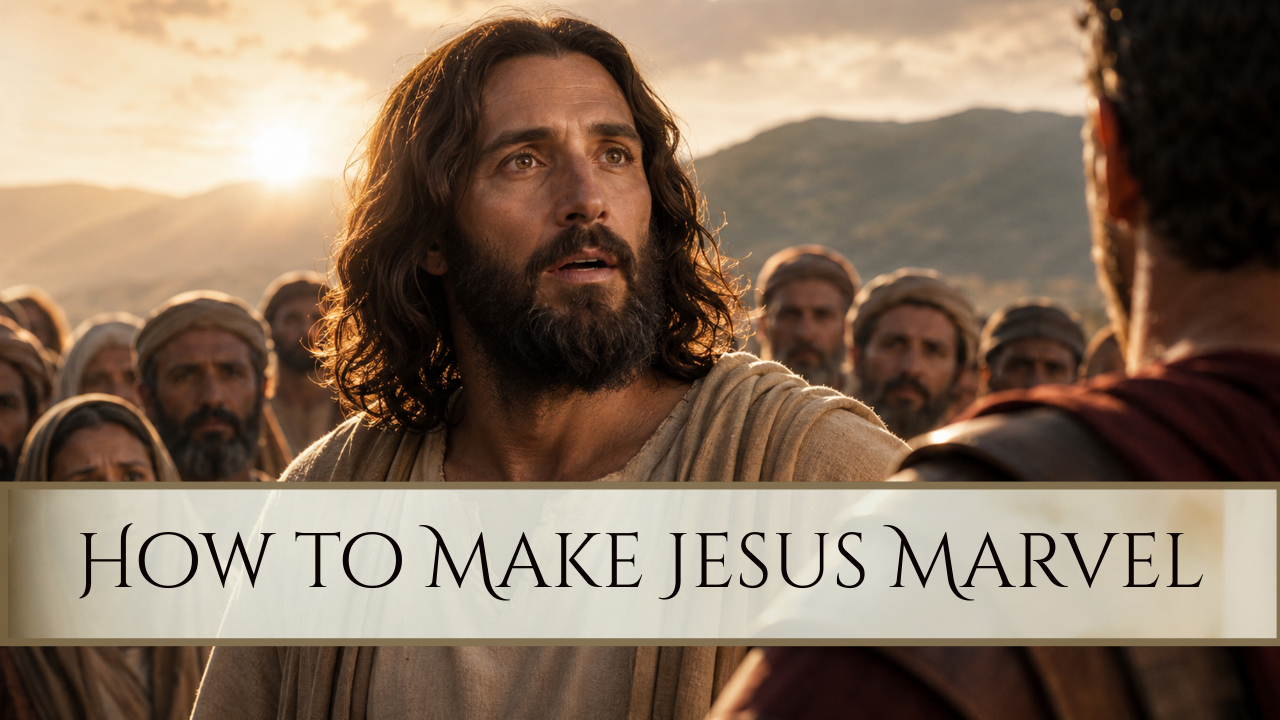
“Now when Jesus heard this, He marveled at him, and turned and said to the crowd that was following Him, ‘I say to you, not even in Israel have I found such great faith.’” — Luke 7:9 (NASB)
Marvel. Of all the words in the English language, few carry more weight than that one. It has been the response of every honest soul who has ever stood at the rim of the Grand Canyon and felt small, or looked up on a clear night at a sky blazing with a hundred billion stars and felt even smaller, or held a newborn child and watched those impossibly tiny fingers curl around their own. Marvelous is the only honest response.
And when we turn our eyes toward God — the One who spoke those stars into existence, who stretched out the heavens like a curtain (Isaiah 40:22), who holds the very planets in their orbits by nothing more than the word of His power (Hebrews 1:3) — marvel and wonder become the only posture a human being can take. The psalmist looked at the night sky and wrote, “The heavens are telling of the glory of God; and their expanse is declaring the work of His hands” (Psalm 19:1, NASB). The prophet Isaiah, staring into the vastness of the universe, recorded God’s own voice: “Lift up your eyes on high and see who has created these stars, the One who leads forth their host by number, He calls them all by name” (Isaiah 40:26, NASB). The disciples of Jesus marveled and said, Even the waves obey Him. Even the wind takes its orders from Him (Mark 4:41). No one can look honestly at creation or the human body and deny that the marvels of God have a way of making us marvel ourselves.
But I want to bring you to a truth today that is even more staggering than the orbits of the planets or the architecture of a single living cell. I want to show you something from the Gospels that stopped me cold the first time it fully landed in my heart — and has never stopped stirring me since. The truth is this:
You have the potential to make God marvel.
Not the other way around. Not you standing in wonder of God — as right and natural as that is. But God, the eternal Creator of all things, standing and marveling over you. It sounds almost too bold to say. But it is not my idea. It is the clear, unmistakable testimony of the Gospels.
The Word That Changed Everything
The Greek word is thaumazo (pronounced “thou-MAD-zo”).¹ It means to wonder, to be struck with awe — to be so astonished that, for a moment, the mind comes to a complete standstill. Scholars who study this word carefully tell us that it describes the stunned recognition of something transcendent — something that breaks through all the ordinary categories of the observer’s experience and simply will not fit inside them. When the New Testament writers reached for thaumazo, they were not describing a polite acknowledgment or a mild surprise. They were describing a full stop. A moment when everything pauses because something has appeared that was not expected.
Now here is what takes my breath away. The Gospels record Jesus experiencing this precise, full-stop wonder on exactly two occasions. And those two occasions could not be more different from each other. On one side, there is a faith so extraordinary that it brought wonder and delight to the Son of God. On the other, there is an unbelief so profound that it brought a different kind of wonder — a grief-filled, heartbroken astonishment. And you need to understand both if you want to impact God in a positive way.
When Faith Left Jesus Speechless
The first case is Luke chapter 7. A Roman centurion — a Gentile soldier, a man standing completely outside the covenants and promises of Israel — came to Jesus on behalf of a servant who was gravely ill. He did not ask Jesus to come in person. He sent word: “Lord, do not trouble Yourself further, for I am not worthy for You to come under my roof; for this reason I did not even consider myself worthy to come to You, but just say the word, and my servant will be healed” (Luke 7:6–7, NASB). And then he explained his reasoning: I am a man under authority. When I say go, they go. When I say come, they come. I understand what it means when a command carries absolute power behind it. And I believe Your word — spoken from right there, without You ever entering my house — is enough.
Luke records what happened next in a sentence that I believe is one of the most breathtaking in all of Scripture: “Now when Jesus heard this, He marveled at him” (Luke 7:9, NASB).²
I want you to picture that moment. Slow it down. Jesus is walking along, surrounded by a pressing crowd. He has heard petitions before. He has answered need after need. But at the words of this soldier, something changes. His face — that face which had looked upon the face of the Father before the world was made — shifts. His eyes widen. There is a brightness in them, something between joy and astonishment, something that the crowd standing near Him would not have expected to see. His countenance opens, the way a face opens when it encounters something genuinely, unexpectedly beautiful. He stops walking. He turns. And the expression on His face is not that of a teacher approving a student’s correct answer. It is the expression of someone who has been genuinely, deeply moved by what they have just heard. It is a face lit with wonder.
And then He speaks — not quietly to the centurion, but publicly, to the crowd: “I say to you, not even in Israel have I found such great faith” (Luke 7:9, NASB). Not among the scribes. Not among the Pharisees. Not among those who had grown up memorizing the Torah and singing the Psalms and carrying the promises of God on the doorposts of their homes. This man — this Gentile outsider — had believed with a quality and a completeness that the Son of God had not encountered anywhere else. His faith was so pure, so uncluttered by doubt, so grounded in the absolute sufficiency of Christ, in His Word, that it genuinely moved the heart of God. Jesus turned, and the look on His face said everything before a word came out of His mouth.
This is not a figure of speech. This is not theological metaphor. The eternal Son of God, in His genuine human experience, was captivated by this man’s trust. Real, wholehearted, unhesitating faith — faith that does not require Him to show up in person, faith that takes Him at His word from a distance — that kind of faith moves God to marvel!
When Unbelief Grieved Him to the Core
But there is a second case. And it is the dark mirror of the first.
In Mark chapter 6, Jesus returned to His hometown of Nazareth. These were people who had known Him since childhood — who had watched Him learn to walk, who had bought bread from His family, who knew His mother Mary and His brothers by name. You would think that of all people on earth, these would be the ones who believed. Instead, the text says bluntly: “They took offense at Him” (Mark 6:3, NASB). They explained Him away. They could not get past the familiar. And the result is one of the most sobering lines in all four Gospels: “And He could do no miracle there except that He laid His hands on a few sick people and healed them. And He wondered at their unbelief” (Mark 6:5–6, NASB).
The same word. Thaumazo. But what a different face.³
Picture this moment too — but slowly, with honesty. This is not the bright-eyed wonder of Luke 7. This is something else entirely. Jesus is standing among faces He has known all His life. He looks from one to the next. He sees arms folded. He sees eyes narrowed with skepticism, lips pressed together in the particular way lips press together when a mind has already decided. He sees people who have every reason in the world to believe — who have heard His words, who have perhaps even seen His works from a distance — and who have chosen, deliberately, to remain closed. And the expression that moves across His face is not the open brightness of wonder and delight. It is the still, deep, sorrowful astonishment of a heart that cannot quite comprehend how this is possible. There is grief in it. There is pain in it. The word thaumazo carries the force of a mind brought to a standstill — and here, what brings the Son of God to a standstill is the sheer, bewildering hardness of hearts that will not open to Him.
He did not throw up His hands. He did not respond with anger or contempt. But the grief on His face — the quiet, sorrowful wonder of it — is perhaps one of the most searching images in all the Gospels. These were His own people. And they would not believe.
If the wonder of Luke 7 is the smile of God upon a faith-filled soul, then the wonder of Mark 6 is the broken heart of God over a soul that will not trust Him. Both are real. Both are the result of a choice. And both are choices that every one of us makes, every single day.
Where Are You Standing Today?
Now I want to ask you a very direct question — and I ask it as a fellow traveler, not as someone who has arrived. As you reflect on these two portraits of Jesus — the marvel of delight in Luke 7 and the wonder of grief in Mark 6 — which expression is your faith producing today?
If you are honest, as I must be honest, there are probably more days than we would like to admit when the scales tip toward unbelief. The diagnosis does not improve. The answer to the prayer we have prayed a hundred times does not come. The situation looks the same today as it looked last week, and quietly, without even meaning to, we begin to function as if God is not quite sufficient for this particular need. We do not say it out loud. But our anxiety says it. Our sleepless nights say it. Our habit of solving everything in our own strength before we ever bow our knee says it.
If you find yourself there today, hear me clearly: do not be discouraged. The struggle with faith is not a sign of a failed Christian life. It is the very struggle the first disciples lived every single day. Jesus had to look at those men — men who had walked beside Him, watched Him raise the dead, held the multiplied bread in their own hands — and say to them again and again: “Where is your faith?” (Luke 8:25, NASB). “Do you not yet have faith?” (Mark 4:40, NASB). These were not failures. These were men in process. And so are we.
The beautiful truth is that faith is not a fixed quantity. It can grow. It can be built upon. It can be increased. And the disciples knew it — because they asked for it. “The apostles said to the Lord, ‘Increase our faith!’” (Luke 17:5, NASB).
Lord, Increase Our Faith
I love that prayer. Three words. But they are three of the most powerful words a human being can pray. “Increase our faith.” The Greek word behind “increase” is prostithemi (pronounced pros-TITH-ay-mee) —a word that means to place in addition to something that already exists, to supplement, to build upon, to add to what has already been given.⁴ The disciples were not praying from nothing. Jesus had already given them faith. And the Bible is clear that God has given to each of us, “a measure of faith” (See Romans 12:3, CSB). So, it has been deposited in you by grace. But the disciples were wise enough — honest enough — to recognize that what they had was not yet sufficient for what lay ahead. They needed more. And so they simply asked.
That is the prayer of the humble heart. Not a prayer of self-condemnation. Not “I am a failure at faith.” Simply: Lord, add to what You have already placed in me. Build on the foundation You have already laid. Supplement my belief with Yours.
And God answers that prayer — we know He does, because we can read what came next. Those same disciples who woke Jesus in a panic on a storm-tossed sea, who scattered when the soldiers came to the garden, who hid behind locked doors after the crucifixion — those men walked out of the upper room at Pentecost and turned the world upside down (Acts 17:6, NASB). They healed the sick, preached without fear before councils that threatened their lives, and planted the church of Jesus Christ across the known world. What changed them? The Holy Spirit was poured out upon them (Acts 2:4, NASB), and the faith of Jesus Christ was activated in them in a way they had never before experienced.
Now, the same Holy Spirit is available to you. That same increase is possible for you. The Jesus who marveled with delight at the centurion’s faith is watching yours right now. He is not waiting to find fault. He is waiting to find the kind of trust that makes Him turn to the watching world and say: I am amazed! I have not found faith like this.
Let that be your prayer today. Let the prayer of the apostles be your prayer. And then watch — as it was in the book of Acts — as faith begins to blossom.
A Prayer for Increasing Faith
Lord Jesus, we come to You today — not with great faith, but with honest hearts. We confess that the scales have tipped toward unbelief more times than we can count. We have seen Your faithfulness with our own eyes and still doubted. We have heard Your promises and still worried. Forgive us, Lord.
But today, we come with the prayer of Your disciples: Lord, increase our faith. Add to what You have already placed within us. Lay Your strength alongside our weakness and build something in us that honors You and moves Your heart. Fill us again with Your Holy Spirit — the same Holy Spirit who transformed frightened fishermen into fearless witnesses, who turned timid disciples into bold apostles, who can move in us today just as powerfully as He moved in the upper room.
Activate the faith of Christ in us like never before. Let us be among those who — by the grace of Your mercy alone — make You marvel. Not at our greatness, but at what You have done in us. Lord, in Your mercy and grace, again we ask, increase our faith.
In the mighty and matchless name of Jesus, we pray. Amen.
Notes
- Thaumazo (θαυμάζω, Strong’s G2296). The NASB Discovery Bible with HELPS Word Studies defines thaumazo as: “to wonder; to be in awe, i.e. astonished (amazed). Thaumazo means being so astounded that one’s mind is, for a moment, at a standstill.” The root noun thauma (θαῦμα) refers to a wonder or marvel — something so far outside the ordinary that it arrests the observer entirely. HELPS further notes that thaumazo belongs to a cluster of words describing the stunned recognition of something transcendent that breaks through all ordinary categories of experience. In classical Greek, the word was used to describe a mortal’s response to encountering the divine. In Luke 7:9 and Mark 6:6, the usage is remarkably and deliberately reversed: it is the Divine who encounters the human — and marvels.
- The verb in Luke 7:9 is ethaumasen (ἐθαύμασεν), the aorist active indicative form of thaumazo. The HELPS Word Studies note that the aorist tense here records a completed, decisive, historical action — not a vague internal impression, but a specific and total moment of wonder. The active voice is equally significant: Jesus was not passively overcome by an external force. He actively marveled. He participated in the wonder. The HELPS further observe that the aorist implies totality: the amazement was complete and full, not partial or qualified. This was not God approving from a comfortable distance. This was the Son of God genuinely, wholly, and actively arrested by one man’s faith.
- Mark 6:6 uses thaumazo in close parallel with Luke 7:9, creating what many scholars recognize as an intentional theological pairing — the two poles of human response to Christ, and Christ’s two corresponding responses to humanity. The HELPS Word Studies note that thaumazo in this context carries not just the force of surprise, but of a mind brought to a standstill by something it cannot fully account for. In Mark 6, what brings the Son of God to that standstill is the sheer depth of willful unbelief among those who had every reason, every proximity, and every opportunity to believe. The NASB Discovery Bible renders the phrase “wondered at their unbelief,” which preserves the full weight of the Greek: this was not mild disappointment. This was genuine, sorrowful astonishment.
- Prostithemi (προστίθημι, Strong’s G4369). The NASB Discovery Bible with HELPS defines prostithemi as “to place in addition to, i.e. add to.” The word carries the concrete sense of supplementing or building upon something already present — not creating from nothing, but adding to what already exists. Used in Luke 17:5 (“Increase our faith”), it implies that the disciples already possessed genuine faith given to them by Christ, and were asking God to add to, enlarge, and build upon that foundation. HELPS further notes the word’s use throughout the New Testament to describe the act of God multiplying what He has already graciously given — a profoundly encouraging truth for any believer who feels their faith is insufficient.
All Scripture quotations from the New American Standard Bible (NASB). Greek definitions from the NASB Discovery Bible with HELPS Word Studies.