I Will Fight For You!

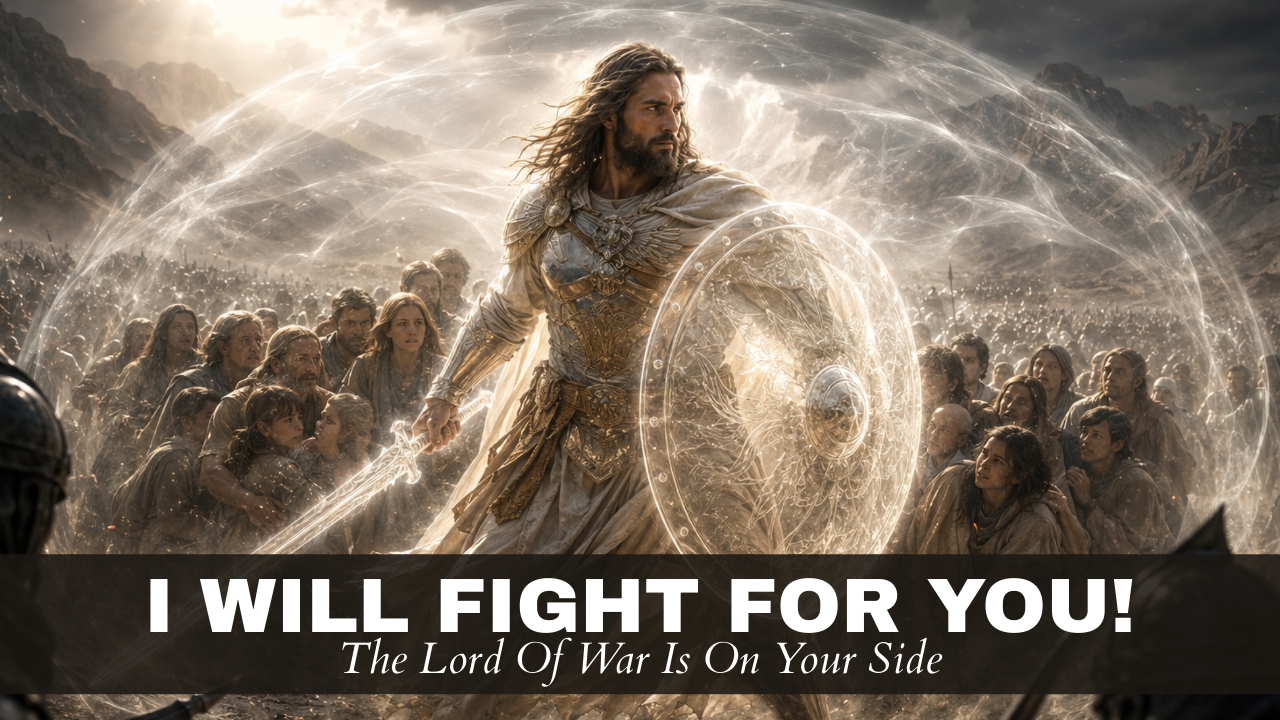
A Soldier Who Never Missed
The year was 1967, and the Six-Day War had just shattered every military expectation in history.
Israel stood surrounded — outnumbered, outgunned, and given no chance of survival by the analysts of the world. Egypt, Jordan, and Syria had amassed their armies on every border. The newspapers were already writing Israel's obituary. And yet, in those six extraordinary days, something happened that military strategists still cannot fully explain with human logic alone.
On the third day of the war, a small Israeli armored unit found itself pinned down in the Sinai Peninsula, outflanked, with no reinforcements in sight. Their radio communications had failed. Their maps were wrong. By every calculation, they were finished.
And then — suddenly — a sandstorm rose from nowhere.
It blinded the Egyptian artillery units surrounding them. It confused the radar. It created a corridor through which the entire Israeli unit escaped without a single casualty. When it was over, the storm vanished as quickly as it had come. Their Egyptian pursuers later described it as inexplicable. The Israeli soldiers who survived it called it something else entirely.
They called it God.
The God Who Goes to War
There is a truth about the Almighty that is seldom preached from polished pulpits, a truth that the ancient Israelites knew with bone-deep certainty as they stood on the far shore of the Red Sea with water still drying on their sandals and Pharaoh's chariots swallowed beneath the waves behind them.
The Lord is a man of war.
That is not a metaphor. That is not poetic hyperbole borrowed from an ancient culture that did not know better. That is Scripture — the song of Miriam, born spontaneously from the lips of a woman who had just witnessed the impossible with her own eyes (Exodus 15:3). And it is a truth that should transform the way you face every battle in your life today.
The prophet Isaiah confirmed it with breathtaking boldness: "The Lord will go forth like a warrior, He will arouse His zeal like a man of war. He will utter a shout, yes, He will raise a war cry. He will prevail against His enemies" (Isaiah 42:13).
And the Psalmist, who had himself stood in the valley of the shadow of death more times than he could count, declared with absolute confidence: "The Lord is my rock and my fortress and my deliverer; my God, my strength, in whom I will trust" (Psalm 18:2).
I want you to feel the weight of what these men of God understood. They were not writing theology from the safety of a library. They were writing testimony from the battlefield.
God has never lost a war.
There is, somewhere in the archives of Heaven, what might be called the Book of the Wars of the Lord. It contains thousands — perhaps millions — of battles. And I challenge you to find a single page, a single paragraph, a single sentence in that divine record where the Lord of Hosts was defeated.
You cannot find it. Because it does not exist.
The Cross: The Greatest Kill Shot in History
You may have heard of Chris Kyle — America's most decorated military sniper, a man of remarkable courage and sacrifice who served four tours in Iraq. His confirmed longest shot was 2,100 yards — nearly a mile and a quarter. Twenty-one football fields. It is the kind of precision that staggers the imagination.
But here is what I want you to understand with every fiber of your being:
Jesus made a shot that echoed through eternity.
From a Roman cross outside Jerusalem, the Son of God fixed His sights on the enemy of every human soul — and He fired. And when He said those three words, "It is finished," the powers of hell did not retreat. They did not regroup. They were obliterated.
Colossians 2:15 records the result with stunning clarity: Jesus made a public spectacle of all the powers and principalities of darkness, stripping away from them every weapon and all their spiritual authority — and by the power of the cross, He led them around as prisoners in a procession of triumph.
Read that again slowly. He led them as prisoners. On the cross, Jesus was not the captive. The enemy was.
And this Lord who triumphed over darkness — this Warrior who has never been defeated — is on your side.
Romans 8:31 asks the question that answers itself: "If God is for us, who can be against us?" The answer, of course, is no one. No power in this world. No principality in the heavenly realms. No one.
Three Ways God Fights for You
The question every honest believer eventually asks is this: If God is truly fighting for me, then why does the battle still feel so hard?
It is a fair question. And the Word of God provides a profoundly practical answer — because God does not fight every battle in the same way. He has three distinct strategies, and each one requires something different from you.
Strategy One: Be Still
When Pharaoh's army thundered toward the shores of the Red Sea, two million Israelites stood with their backs to the water, terror rising in their throats. There was nowhere to run. Nowhere to hide. And Moses — the man of God, the leader of the nation — looked at that terrified multitude and said something that must have seemed absolutely maddening in the moment:
"Do not be afraid. Stand firm... The Lord will fight for you; you need only to be still" (Exodus 14:13–14).
Be still.
The Hebrew word used here, raphah, means to slacken — to let go, to loosen your grip, to cease striving. It carries with it the image of two fighters locked in combat until someone comes and separates them — forces them to drop their weapons.
That is what God was asking of His people. And it is what He sometimes asks of you.
There are moments in life when every instinct screams at you to do something — to fix it, to fight back, to engineer your own escape. And in those moments, God quietly says, "This battle is not yours. It is Mine."
Psalm 46:10 does not say "Try harder and know that I am God." It says, "Be still, and know that I am God." The stillness is not passive defeat. It is active trust. It is the most courageous act of faith available to you — to put down your weapons, open your hands, and say, "Lord, I cannot fix this. But You can."
When you are still enough to get out of God's way, you will see His hand move.
Strategy Two: Wait for the Suddenlies of God
There is a word that appears again and again throughout the pages of Scripture, and it is one of the most thrilling words in the Bible.
Suddenly.
"Suddenly, there came a sound from heaven like a rushing mighty wind" (Acts 2:2). "Suddenly, a great light from heaven shone around" Saul on the road to Damascus (Acts 9:3). "Suddenly, an angel of the Lord appeared" in Peter's prison cell, light flooding the darkness, chains falling from his wrists (Acts 12:7).
Peter had been asleep when the angel arrived — asleep in prison, the night before his scheduled execution. Do you understand the depth of peace that requires? He was so resting in the faithfulness of God that an angel had to physically strike him to wake him up.
That is what trust in the God of "suddenly" produces — a peace that surpasses all understanding.
But here is the great truth about the "suddenly" of God: it is not random. It is not accidental. There is a divine equation at work. When the promises of God collide with the timing of God — when those two rivers meet — the suddenlies happen.
You may be standing in what feels like an impossible situation right now. You may feel like Israel on that beach — hemmed in on every side with no visible way forward. But I want you to know something with absolute certainty: God is never early, and He is never late. He is always exactly on time. And when His moment arrives, He does not need your help to execute it. He needs only your faith.
Strategy Three: Sing Your Way To Victory
Of all of God's battle strategies, this is perhaps the one that confounds us most.
King Jehoshaphat was facing annihilation. Three nations had allied against Judah, and by every human calculation, the outcome was already decided. In desperation, Jehoshaphat sought the Lord — and the strategy Heaven sent down was, to put it plainly, unprecedented.
Send the worship team first.
Not the cavalry. Not the swordsmen. The singers.
"After consulting the people, Jehoshaphat appointed men to sing to the Lord and to praise Him for the splendor of His holiness as they went out at the head of the army" (2 Chronicles 20:21).
And their song? It was not complex. It was not theologically sophisticated. It was ten simple words, repeated over and over as they marched toward three hostile armies:
"Give thanks to the Lord, for His love endures forever."
"Give thanks to the Lord, for His love endures forever."
Step after step. Breath after breath. Ten words. And as they sang — as they worshiped — the Lord set ambushes against their enemies. The three armies turned on each other in confusion and destroyed one another. By the time Jehoshaphat's people arrived at the battlefield, there was nothing left to fight. Only the plunder remained.
Your worship is not background music. It is a weapon.
Paul and Silas understood this. Beaten, shackled, and bleeding in a Philippian dungeon at midnight, they did the one thing that made no earthly sense — they sang. And suddenly the foundations shook. The doors flew open. Every chain fell off.
Praise ushers in the presence of God, and where the presence of God is, captivity cannot remain.
I know what it is to receive a midnight phone call carrying the worst news imaginable. I know what it is to have a song rise in your heart in the middle of grief so profound that you cannot explain it — except to say that the Holy Spirit is the greatest Comforter who ever lived. He will give you a song in your darkest night. And that song will be the very instrument of your deliverance.
Give thanks to the Lord, for His love endures forever.
He Is Fighting for You Right Now
Wherever you are as you read these words — whatever battle you are carrying, whatever Pharaoh is behind you, whatever impossible sea stands before you — I want you to hear this truth with your whole heart:
The Lord will fight for you.
He is not wringing His hands. He is not consulting an advisor. He is not wondering whether your situation is too complicated. He is the God who has never been defeated. He is the God who spoke the universe into existence and calls every star by name. He is the God who went to the cross to obliterate the power of darkness — not merely to win a battle, but to secure your eternal victory.
And He is for you.
Sometimes He will tell you to be still. Let Him. Sometimes He will act suddenly, in a way that leaves everyone in the room speechless. Expect it. And sometimes He will ask you to do the thing that makes least sense in the natural — to sing. Obey Him.
Because here is the promise that anchors everything:
"God causes us always to triumph in Christ Jesus" (2 Corinthians 2:14).
Always. Not sometimes. Not usually. Not when circumstances cooperate. Always.
You are not the victim. You are not the defeated. You are more than a conqueror through Him who loved you — and proved that love at Calvary.
So lift your head. Open your hands. Let the worship rise.
The Lord of War is on your side — and He has never lost.
"The Lord will fight for you; you need only to be still." — Exodus 14:14
Footnotes
¹ Exodus 15:3 — "The Lord is a man of war; the Lord is His name."
² Isaiah 42:13 — "The Lord will go forth like a warrior, He will arouse His zeal like a man of war. He will utter a shout, yes, He will raise a war cry. He will prevail against His enemies."
³ Psalm 18:2 — "The Lord is my rock and my fortress and my deliverer; my God, my strength, in whom I will trust; my shield and the horn of my salvation, my stronghold."
⁴ Colossians 2:15 — "Having disarmed the powers and authorities, He made a public spectacle of them, triumphing over them by the cross."
⁵ Romans 8:31 — "What, then, shall we say in response to these things? If God is for us, who can be against us?"
⁶ Exodus 14:13–14 — "Moses answered the people, 'Do not be afraid. Stand firm and you will see the deliverance the Lord will bring you today... The Lord will fight for you; you need only to be still.'"
⁷ Psalm 46:10 — "He says, 'Be still, and know that I am God; I will be exalted among the nations, I will be exalted in the earth.'"
⁸ Acts 2:2 — "Suddenly a sound like the blowing of a violent wind came from heaven and filled the whole house where they were sitting."
⁹ Acts 9:3 — "As he neared Damascus on his journey, suddenly a light from heaven flashed around him."
¹⁰ Acts 12:7 — "Suddenly an angel of the Lord appeared and a light shone in the cell. He struck Peter on the side and woke him up."
¹¹ 2 Chronicles 20:21 — "After consulting the people, Jehoshaphat appointed men to sing to the Lord and to praise Him for the splendor of His holiness as they went out at the head of the army, saying: 'Give thanks to the Lord, for His love endures forever.'"
¹² 2 Corinthians 2:14 — "But thanks be to God, who always leads us as captives in Christ's triumphal procession and uses us to spread the aroma of the knowledge of Him everywhere."
¹³ Romans 8:37 — "No, in all these things we are more than conquerors through Him who loved us."