Tears In A Bottle

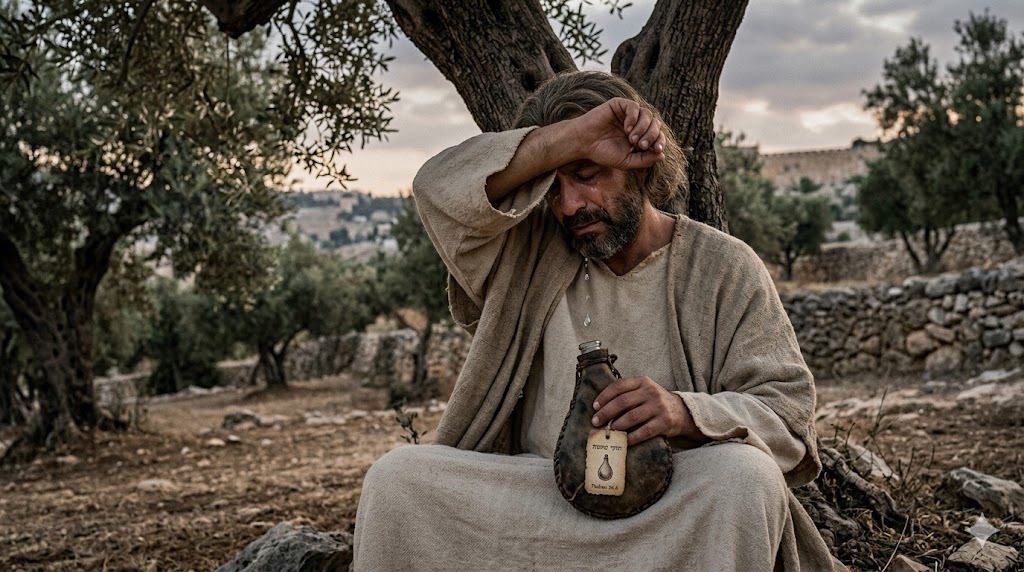
TEARS IN A BOTTLE
A Devotional on Psalm 56:8
“You keep track of all my sorrows. You have collected all my tears in Your bottle. You have recorded each one in Your book.”— Psalm 56:8 (NLT)
This is not a devotional about crying. It is a devotional about what God does with your tears. And before you reach the final word, I pray you will never weep the same way again.
Somewhere in the ancient poetry of the Hebrew Scriptures, a fugitive king sat in enemy territory — dirty, afraid, pretending to be insane to stay alive — and looked up through his tears to say something that would echo across three thousand years of human heartbreak. What he said in that desperate moment has the power to change the way you cry for the rest of your life.
- The Background of Your Tears
The superscription of Psalm 56 — the inspired header at the very top — tells us exactly where David was: “When the Philistines seized him in Gath.” Gath. The hometown of Goliath. The city of his most legendary enemy. David had fled there in desperation while King Saul hunted him, and the Philistines recognized him immediately. Trapped, exposed, and terrified, David made a humiliating choice: he pretended to be mad, clawing at the gateposts, letting saliva run down his beard, acting like a fool so they would let him go.
In that moment of degrading performance, nobody in that courtyard saw the real David — the anointed king, the shepherd poet, the man after God’s own heart. Nobody saw the tears falling where no one could witness them.
Nobody but God. And that is why this verse was written. You have had your own “Gath” — a season when you had to hold yourself together in public while privately falling apart. Today I want you to know with absolute certainty: God saw every tear.
- The Vessels for Your Tears — The Waterskin and the Written Word
David describes God’s remembrance of his suffering using two remarkable vessels: a Bottle and a Book. Together, they reveal the two dimensions of how God responds to your pain. He feels it — and He files it.
The Hebrew word for “bottle” is no’d (נאד) — a rough, weathered animal-skin flask. Not a delicate ornament. This was a shepherd’s waterskin, the survival tool David had slung over his shoulder every morning of his youth. And buried in the text is a breathtaking wordplay: the Hebrew word for his “wandering” is nod (נד) — essentially the same root as no’d, the bottle. Every aimless, grief-soaked mile he walked as a fugitive was being poured into God’s own container. And notice it is one bottle — singular, personal, intimate. God does not have a warehouse of generic grief receptacles. He has the bottle for you.
The second vessel is the Book — the Siphrah (ספרה) — a legal scroll of the kind that ancient kings used to record every act of loyalty and every injustice in their kingdom. The phrase “Are they not in Your book?” is not a timid question — in Hebrew, it is a declaration of certainty: “I know for a fact they are already written there!” This is the Sefer Zikaron — the Book of Remembrance — echoed in Malachi 3:16, a vindicatory register that guarantees divine justice for the faithful who suffer. He feels your grief in the bottle. He documents your grief in the book. Both are real.
- The Vicarious Sacrifice for Your Tears
Here is a question the Hebrew quietly forces us to ask: How does a no’d come to exist? There was only one way, in the ancient world, that a leather bottle was made. An animal had to die. The hide was removed in one careful piece — every inch of it — then tanned, sealed, and prepared until it was strong enough to carry precious liquid through desert heat without losing a drop. No death — no bottle. No sacrifice — no container.
Do you see what that means for Psalm 56:8? When David cried, “Put my tears in Your bottle,” he was — perhaps without fully knowing the depths of his own prayer — crying out for a sacrifice. Because without one, his tears would fall in the sand and vanish forever.
This is where the ancient text walks us, with trembling holy wonder, straight to Calvary. Isaiah 53 tells us the Messiah was “smitten, pierced, and marred.” Just as the skin of a lamb was prepared and sealed to become a vessel for precious liquid, the body of Yeshua was prepared through suffering to become the divine container for every human tear. Here is the linguistic bridge that will take your breath away: in the Septuagint — the Greek Old Testament that the Apostles read — the word for David’s “bottle” in Psalm 56:8 is Askos (ἀσκός). That is the exact same word Jesus uses in Matthew 9:17 when He speaks of new wineskins. Jesus is the New Askos — the New Bottle — the prepared, sacrificed vessel strong enough to carry the new wine of the Holy Spirit and tender enough to hold your every sorrow. No Lamb, no bottle. No Calvary, no container. But there was a Lamb. And there is a Bottle. And your tears are inside it right now.
- The Volume of Your Tears
The verse opens with the Hebrew word saphartah — “You have counted.” This is not a vague, general awareness. The word carries the force of a royal census — a precise, mathematical tally. Every sleepless night. Every tear brushed away quickly so no one would notice. Every silent grief carried in public while screaming on the inside. God did not estimate. He did not approximate. He counted. Every single one, with the precision of a King who keeps perfect records.
In the ancient world, a traveler’s waterskin told the story of his journey. The salt stains and road dust were evidence of how far he had gone and how hard the road had been. David is saying: God, look at my waterskin — it is full and heavy and stained, and You know every mile. Your suffering has been measured. Your journey has been logged. Nothing has fallen outside the accounting of Heaven.
- The Value of Your Tears
The Hebrew verb for “collected” or “stored” is simah (שִימָה) — a word that speaks of deliberate, intentional treasuring. This is not the language of a careless catch. It is the language of a jeweler lifting a precious stone and setting it carefully in velvet. In the ancient world, you did not put something in a no’d unless you needed it to survive, unless it mattered, unless you intended to use it again. God is keeping your tears because He intends to use them. He is not storing them as evidence of your weakness. He is treating your grief the way a master vintner treats his finest wine — preserving it, setting it apart, saving it for a purpose and a day that you cannot yet see. Your tears are not waste product in the economy of God. They are a precious liquid He refuses to let vanish into the dirt.
- The Vindication of Every Tear
The bottle and the book together build your case before the throne of Heaven. The bottle holds the physical evidence — the emotional exhibit. The book holds the legal testimony — the written record. Together they constitute an airtight brief before the Supreme Judge of the universe. One day the King will return, and when the books are opened, every tear in the bottle will be matched to a line in the book. Every injustice, every betrayal, every midnight of grief will be addressed with divine precision. Revelation 21:4 delivers the final verdict: “He will wipe every tear from their eyes.” Those same hands that formed the galaxies — the same hands that were nailed to a cross for you — will reach out and wipe your face. No tear will be forgotten. No sorrow will be unanswered. Every tear will be vindicated.
- The Victor Whose Tears Are Mingled with Yours
Here is the most breathtaking truth of all. When Jewish scholars translated the Hebrew Scriptures into Greek roughly two centuries before Christ, they chose the word dakryon (δάκρυον) for “tears” in Psalm 56:8. Now open Hebrews 5:7, where the author describes Jesus in the Garden of Gethsemane: “While Jesus was here on earth, He offered prayers and pleadings, with a loud cry and tears (dakryōn), to the One who could rescue Him from death.” The exact same Greek word. David’s tears in enemy territory. Jesus’s tears in the Garden. One golden thread, stitched across a thousand years of Scripture.
In Gethsemane, the night before the cross, the Son of God fell on His face and wept with a loud cry — not for Himself, but for you. His tears were intercessory. They were the tears of your Great High Priest, bearing the weight of every human sorrow He was about to carry to Calvary. And where did those tears go? Into that one singular bottle. Which means this: your tears and the tears of the Son of God are intermingled in the same vessel, before the same Father, right now.
When God looks at that bottle — when He opens the record of your sorrow — He does not see your tears alone. He sees them mixed with the tears of His own Son. Your grief is not separated from the grief of God. It is united with it. Eternally. Irrevocably.
So do not be ashamed to cry before your God. Do not wipe your tears away as though they are an inconvenience to Heaven. Every translucent, trembling, silent tear has a language all its own — and God speaks it fluently. Because His Son wept it first.
The Bottle is real. The Book is real. The Sacrifice was real. The Victor is alive. And your tears — every single one of them — are safe.
“You keep track of all my sorrows. You have collected all my tears in Your bottle. You have recorded each one in Your book.”— Psalm 56:8
To the Glory of the Father, the Son, and the Holy Spirit — Amen.
Footnotes & Scholarly References
- Barrick, William D. Psalm Inscriptions: Inspired? The Master’s Seminary Journal. Argues the Psalm superscriptions are divinely inspired hermeneutical keys.
- Keil, C.F. & Delitzsch, F. Commentary on the Old Testament. Hendrickson Publishers. Definitive analysis of no’d as a leather flask for water, wine, and milk.
- Brown, Michael L. The Expositor’s Bible Commentary: Psalms. Zondervan. Documents the phonetic wordplay between nod (wandering) and no’d (bottle).
- Stern, David H. Complete Jewish Study Bible. Hendrickson Publishers. Establishes the Sefer Zikaron (Book of Remembrance) as a motif of divine vindication.
- Frydland, Rachmiel. What the Rabbis Know About the Messiah. Messianic Publishing Company. The Suffering Servant as the one who vicariously bears the sorrows of His people.
- Aramaic Peshitta Lexicon. Analysis of Talya (ܓܠܝܐ) as both “lamb” and “servant” — the Servant-Lamb who absorbs our tears into His own skin.
- Spurgeon, Charles H. The Treasury of David. Pilgrim Publications. God as the passionate, meticulous Keeper of every individual tear.
- Potgieter, Henk. Psalm 56 Read Within Its Literary Context. Old Testament Essays. The vindicatory function of Psalm 56 as a legal appeal to the Supreme Judge.
- Scherman, Nosson. The Stone Edition Tanach. ArtScroll/Mesorah Publications. The Book of Remembrance as a divine register guaranteeing justice for the faithful.
- Brown, Michael L. Answering Jewish Objections to Jesus, Vol. 2. Baker Books. The linguistic bridge between dakryon in Psalm 56:8 (LXX) and Hebrews 5:7.
- Gesenius, Wilhelm. Hebrew-Chaldee Lexicon to the Old Testament. Baker Academic. Entry on no’d documenting the preparation of animal skins as bottles.
- Stafford, Matt. Psalm 56 Commentary. David as wanderer in the tradition of Abraham and Moses — whose suffering God meticulously recorded.
All Scripture quotations from the New Living Translation (NLT) unless otherwise noted.