Tears In A Bottle

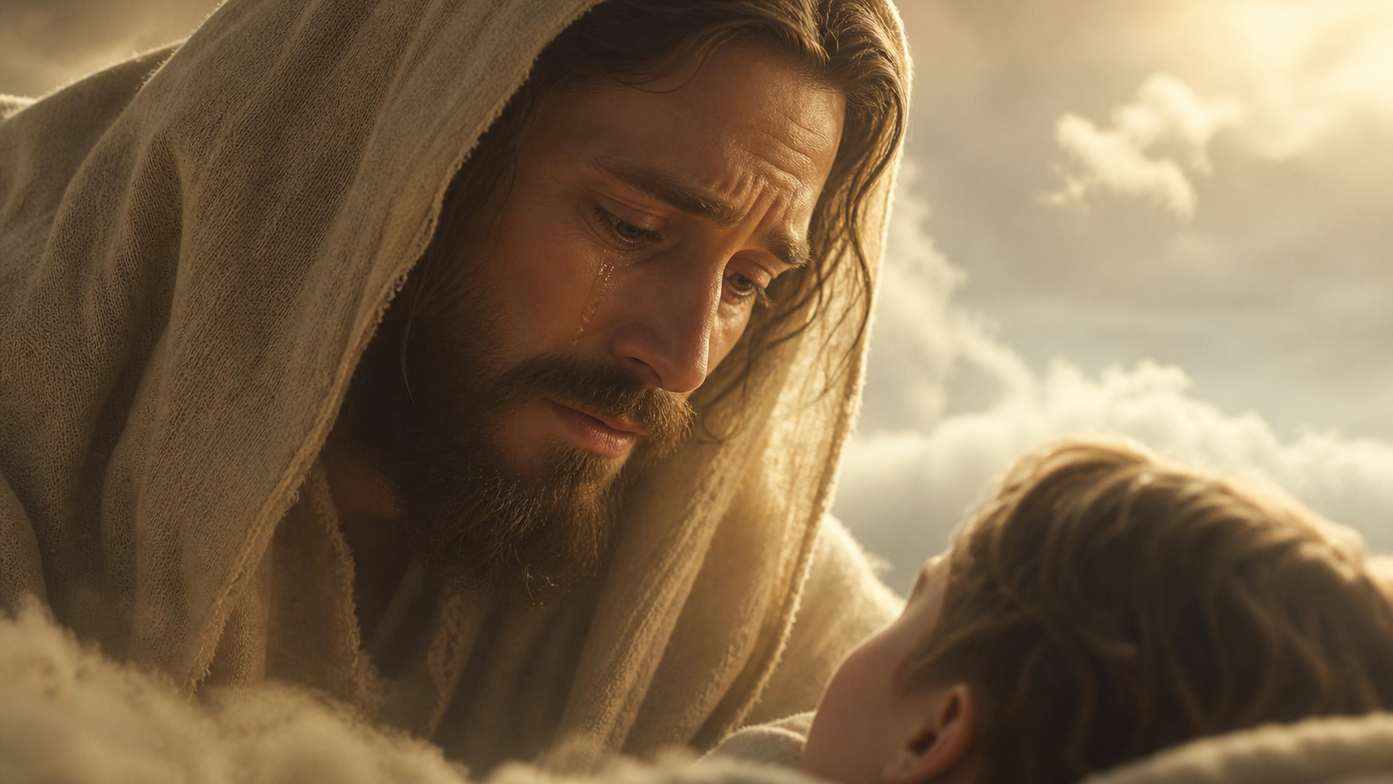
Part 1: Your Tears Are Visible to God
“You keep track of all my sorrows. You have collected all my tears in Your bottle. You have recorded each one in Your book.”
— Psalm 56:8 (NLT)
Let me ask you something. When was the last time you really cried?
Not a polite dabbing of the eyes at a sentimental movie. I mean the kind of crying that comes from somewhere deep — the kind that shakes your shoulders and catches in your throat and leaves you feeling wrung out and emptied. The kind that comes out in the stillness of an empty bedroom when the house has gone quiet. The kind that catches you off guard in the front seat of your car, parked in a lot somewhere, where you thought you could finally let it out without anyone noticing. The kind where you press your face into a pillow so no one down the hall can hear. The kind you would never let the world see.
And that's just it, isn't it? We rarely let the world see. Tears are not public performances. They are private confessions. They are poured out behind closed doors — in the quiet of a bedroom, in the stillness of an empty house, in the front seat of a car pulled into a parking lot because you simply couldn't hold it together one more mile. We hide our tears from our neighbors. We hide them from our coworkers. We even hide them from the people sitting in the pew right next to us.
But here is what I want you to understand: There is One who sees every tear you have ever cried.
Not some of them. Not the dramatic ones. Every. Single. One. And I'm not going to simply ask you to take my word for it. I want to take you to the Word of God itself, and let the Scripture make the case.
Hagar
I want to introduce you — or perhaps reintroduce you — to a woman named Hagar.
Hagar was the handmaid of Abraham and Sarah. And if ever there was a woman whose life was shaped entirely by the decisions of other people, it was Hagar. She had very little say in her own story. You see, Sarah — that great woman of faith — had been unable to conceive a child. And in a moment of impatience with the promises of God, she approached her husband Abraham with a suggestion that, by any modern standard, would be absolutely scandalous.
She told Abraham to go in to Hagar — her own servant — and have a child through her.
Now, I want you to notice something that the Bible conspicuously does not record. You will search the Scripture from beginning to end and you will never find a single verse where Abraham puts his foot down and says, "Absolutely not, Sarah. That is the most preposterous thing I have ever heard!" No resistance. No pushback. No righteous indignation. Abraham simply... complied.
And so Hagar — this woman with no voice and no vote — found herself at the center of a plan she never asked to be part of. She conceived. She bore a son — Ishmael. And for a season, it seemed as though the arrangement had worked.
But then the weight of jealousy and guilt came crashing down on Sarah's heart — and she could not bear it. Hagar and her son were cast out. Banished. Sent away into the wilderness with nothing but a loaf of bread and a skin of water. Just imagine that for a moment. Everything she had known — gone. Every sense of security — stripped away. Every familiar face — vanished behind her. Just a woman and her boy, swallowed up by the vast, merciless desert.
And then the water ran out.
She had nothing left to give her son. No well nearby. No help on the horizon. No one to call. And so she did the only thing a mother with an empty skin and a dying child could do — she placed Ishmael under a shrub to give him what little shade she could, walked about a bowshot away, sat down in the sand...
and she wept bitterly.
Now, I don't want you to rush past those words. She wept bitterly. This was not a quiet, dignified shedding of tears. This was the kind of weeping that comes from the very bottom of a person's soul — the kind that has no words left, only sounds. The kind where your whole body is involved because the pain is simply too big to be expressed any other way. Hagar was not weeping over a disappointment. She was weeping over what appeared to be the end — the end of hope, the end of provision, the end of her child's life, and perhaps her own.
She sat down in the wilderness and she sobbed. Alone. Unseen. Or so she thought.
Because the Bible tells us what happened next — and it is one of the most breathtaking moments in all of the Old Testament.
"God heard the boy crying, and the angel of God called to Hagar from heaven and said to her, 'What is the matter, Hagar? Do not be afraid; God has heard the boy cry ing as he lies there.'" (Genesis 21:17)
Did you catch that? In the middle of the desert. In the middle of her despair. In the middle of what felt like complete and total abandonment — God heard. And because He heard, He saw. And because He saw, He spoke. And then — Glory to God — the Scripture tells us that "God opened her eyes, and she saw a well of water" (Genesis 21:19).
It was there the whole time. She just couldn't see it — until God opened her eyes.
And in an earlier encounter — back in Genesis 16, before Ishmael was even born, when Hagar had first fled into the desert from Sarah's harsh treatment — she had been so overwhelmed by this experience of being seen by God that she gave Him a name. She lifted her eyes toward heaven and called Him:
El Roi.
In Hebrew, it means simply — and magnificently — "The God Who Sees Me." (Genesis 16:13)
Oh, my friend. Do you understand what that means? Hagar — a servant woman, a foreigner, a person of no social standing and no political power — sat down in a desert and cried bitter tears that she thought no one would ever see. And the God of heaven and earth looked down, took notice, and came to her rescue.
He saw her tears. And because He saw them, He responded.
The God Who Stood at a Graveside and Wept
Now I want to take you to the New Testament — where God is no longer speaking from heaven but has come down from heaven, wrapped in human flesh, walking on human soil. I want to take you to the Gospel of John, chapter eleven.
Lazarus — the dear friend of Jesus, the beloved brother of Mary and Martha — had died. By the time Jesus arrived in Bethany, Lazarus had already been in the tomb for four days. Four days of grief. Four days of tears. Four days of sitting in the wreckage of a loss that no one had been able to prevent.
Mary fell at the feet of Jesus, weeping. The mourners who had come to comfort her were weeping. And the Bible tells us something extraordinary about what Jesus did when He looked at that scene.
The text says He saw them weeping. (John 11:33) But that word in the original Greek is not a casual, passing glance. It carries the force of perceiving with full understanding — of taking something in not merely with the eyes but with the heart. Jesus did not observe the tears from a safe distance. He comprehended them. He understood the full weight of what every one of those tears was carrying.
And then something happened inside Him. He was “deeply moved in spirit.” The Greek word used here — embrimaomai — describes a stirring so powerful, so visceral, so deeply seated that it could barely be contained. This was not polite sympathy. This was a holy turbulence. A compassion that rose from the depths of His spirit and would not be quieted.
And then: “Jesus wept.” (John 11:35)
The Son of God. The Creator of the universe. The One by Whom and through Whom all things were made — stood at a graveside and cried. Because He saw the tears of those He loved. And what He saw moved Him. And what moved Him eventually raised the dead.
He Sees You Too
Let me bring this home to where you live today.
The God who heard Hagar weeping bitterly in a desert where she believed no one could see her — He sees you. The God who opened the eyes of a desperate mother and revealed a well of water that was there all along — He can open your eyes too, to provisions and possibilities you cannot yet perceive. And the God who stood at the tomb of Lazarus, who looked upon broken, tear-stained faces and was moved so deeply that He wept alongside them — that same God sees you right now. Today. In whatever room, in whatever car, in whatever quiet corner you find yourself carrying your grief.
Your tears are not invisible. They are not falling into an empty room. The God who never sleeps, who never slumbers, who never once turns His face away — He is watching.
And not merely watching from a detached, clinical distance. He is moved by what He sees. He has a deep, profound, unbreakable emotional connection to you.
David knew this. He wrote it from the lowest point of his life, sitting in Gath — enemy territory — hunted, humiliated, and heartbroken. And yet he looked up toward heaven and declared:
“You keep track of all my sorrows. You have collected all my tears in Your bottle. You have recorded each one in Your book.”
— Psalm 56:8 (NLT)
You are not invisible to God. You are not forgotten. You are not alone.
El Roi - He sees YOU! Every single tear! He is moved. And He will respond.
Hallelujah!