The Anatomy of a Normal Christian Church

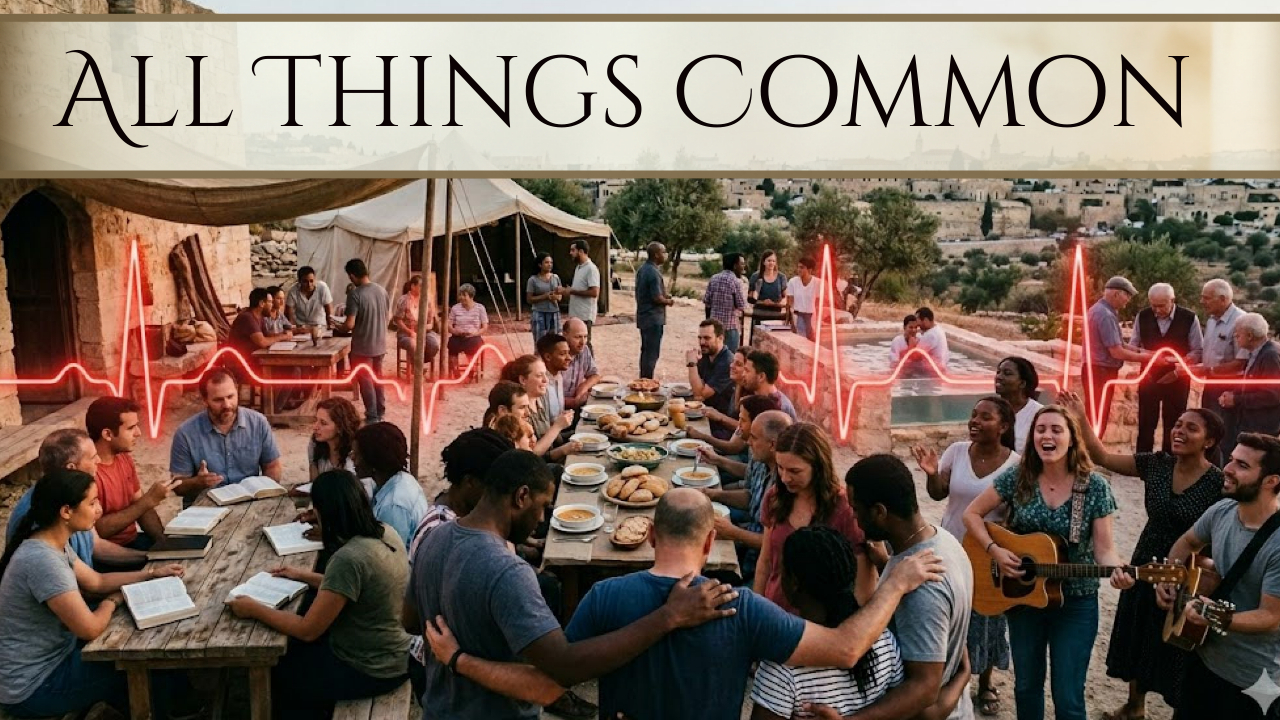
When You Think of "Normal" — What Comes to Mind?
Your physical body is doing something remarkable right now. Your immune system — a network of thirty-seven trillion cells — is neutralizing threats you will never know existed.¹ Your bone marrow is producing two million new red blood cells every single second.² Your liver is performing over five hundred biochemical functions simultaneously — without a single conscious instruction from you.³ When one system is under stress, others compensate, redistribute, adapt. The body does not abandon its members. It rallies around them.
Medical science has a word for this coordinated, whole-body vitality working toward the flourishing of every member.
They call it *normal.*⁴
If that's the normal way our physical bodies function, what should normal look like for the spiritual Body of Christ?
The Day the Church Was Born
Consider Acts 2. The disciples are gathered. The Holy Spirit arrives — not quietly, but like a rushing violent wind,⁵ like tongues of fire,⁶ like something that cannot be contained. Peter preaches with a power explainable only by the Holy Spirit working through a surrendered vessel. When the sermon ends, three thousand people are added to the church in a single day.⁷
Not over a quarter. Not through a carefully structured campaign. One day. One sovereign movement of God.
That was the birthday of the Church. And what the Church looked like on its birthday tells us everything about what the Church was always meant to be.
Luke describes it plainly: "They were continually devoting themselves to the apostles' teaching and to fellowship, to the breaking of bread and to prayer. Everyone kept feeling a sense of awe; and many wonders and signs were taking place." Acts 2:42–43 (NASB).⁸
Here are just four marks of the normal church. The apostles' teaching — taken in not occasionally but continually, the Greek carry’s the force of persistent, stubborn, unwavering devotion.⁹ Fellowship — the Greek koinōnia, not coffee hour after the service, but lives brought into contact at a depth that goes past Sunday morning into the actual substance of daily existence.¹⁰ The breaking of bread — the Lord's Supper and shared daily meals, because this community never divided the sacred from the ordinary.¹¹ And prayer — the desperate, expectant, heartfelt petition, and urgent request of people who had stopped pretending they could manage without God.¹²
The result? People on the outside were mesmerized with those on the inside. There was the reverent, wide-eyed recognition that something is happening here that human beings did not arrange and cannot explain.¹³ Signs and wonders. The supernatural activity of God operating through a community so surrendered to Him that the line between the possible and the impossible had effectively ceased to matter.
That was normal.
The World They Lived In
But here is what I need you to understand about the people living that way.
They were not comfortable. They were not middle class. The majority of believers in the early church were laborers, artisans, slaves, and recent immigrants.¹⁴ They lived under the Roman Empire — an economic system built on the systematic exploitation of the poor, designed to keep most people in permanent scarcity. The majority of believers from the lower classes faced challenges common to ancient society — landlessness, debt, and economic vulnerability at every turn.¹⁵ And many of the three thousand who came to faith on the day of Pentecost had traveled to Jerusalem from across the Roman world for the feast. When the Holy Spirit fell and they surrendered their lives to Jesus Christ, they stayed. Many of these new converts were foreigners who did not have the ability to provide food and shelter for themselves in Jerusalem.¹⁶
Three thousand people. Many of them strangers in the city. No local income. No safety net. No government program. No food bank. No family nearby to call.
Does that sound familiar? It should. Because the financial pressure bearing down on the first-century church in Jerusalem is not so very different from the pressure bearing down on Americans today. As of 2025, sixty-nine percent of American adults are living paycheck to paycheck — an all-time high.¹⁷ More than one in three households reports significant difficulty paying for regular expenses — food, rent or mortgage, car payments, medical bills.¹⁸ In 2025 alone, 574,314 Americans filed for bankruptcy — an eleven percent increase from the year before.¹⁹
These are not statistics. These are people. People sitting in our churches right now. Dressed well enough that nobody knows. Smiling on Sunday morning. Terrified every other morning of the week. Maybe I'm describing you.
But there's hope. At this precise moment of impossible need Luke shows us what the early church did.
All Things Common — What Those Words Actually Mean
"And all those who had believed were together and had all things in common; and they began selling their property and possessions and were sharing them with all, as anyone might have need." Acts 2:44–45 (NASB)²⁰
"And the congregation of those who believed were of one heart and soul; and not one of them claimed that anything belonging to him was his own, but all things were common property to them." Acts 4:32 (NASB)²¹
Do you see that? those impoverished followers of Messiah had "all things common." "The congregation of those who believed were of ONE HEART and SOUL..." In other words, there was never lack among the early believers. They shared with each other because "not one of them claimed that anything belonging to [them] was [their] own...all things were common property to them." That’s quite an incredible picture of the Early church, isn't it?
Let us slow down and look at what the Holy Spirit has preserved for us here.
The phrase "had all things in common." The Greek word hapanta is not the ordinary word for all. It is a strengthened, intensified, no-exceptions form of the word, meaning *every single thing, completely, without remainder.*²² It is not that they had SOME things in common. Not the surplus. Not the things they had finished with. No. Every. Single. Thing. All supplies. All goods. All food - were common.
And "not one of them" —that is, not one person. Not one exception. Not one believer in that entire community of more than three thousand souls who looked at what they owned and said, *this one I am keeping for myself.*²³
This was normal Christian living.
BUT HOW?
This is the detail I do not want you to miss — Luke tells us how they did it. First, those who had — "began selling" (Acts 2:45). The verb in Greek is in the imperfect tense. And in Greek, the imperfect tense does not describe a single completed event. It describes *ongoing, repeated, habitual action.*²⁴ Each and every time a need arose, those who had, began selling and continued doing so. This was not a one-time response to an emergency. This was not a single dramatic moment of collective generosity that passed and was never repeated. This was the continuous, living, breathing rhythm of the community — every time a need arose, the Body responded. Every time a crisis appeared, assets were liquidated, resources were redistributed, and the need was met. Again and again and again. Day after day. Week after week.
It was not a program. It was not a policy. It was not even a decision, in the ordinary sense of the word. It was simply what the Body did — the way your immune system responds to infection not because it decides to but because that is what a living, healthy body does. Automatically. Completely. Without abandoning a single member.
It was…normal!
And the result? "There were no needy persons among them." Acts 4:34.²⁵
Not fewer needy persons. Not a reduced number of people struggling. None. In a community of more than three thousand people — drawn from the poorest strata of the Roman world — not one person lacked anything.
That was normal.
The Deeper Secret
How does a community arrive at a place where selling a piece of land to pay someone else's rent feels not like sacrifice but like the most natural response in the world?
Look again at these key verses:
"And all those who had believed were together and had all things in common; and they began selling their property and possessions and were sharing them with all, as anyone might have need." Acts 2:44–45 (NASB)
"And the congregation of those who believed were of one heart and soul; and not one of them claimed that anything belonging to him was his own, but all things were common property to them." Acts 4:32 (NASB)
They “sold” yes, but they “shared.” Why? Because “not one of them claimed that anything belonging to him was his own…all things were common property to them.” Did you notice that? There was such love among the believers that they did not, for a moment, claim that anything belonged to them.
A mindset that goes back centuries to a man named David who said:
"Everything comes from You, and we have given You only what comes from Your hand." 1 Chronicles 29:14 (NIV)²⁶
That is it. That is the entire theology that made Acts 2 possible.
The early believers did not consider anything their own — not because they were required to surrender it, but because they understood, as David understood, that none of it was ever truly theirs to begin with. It came from God's hand. It belonged to God's purposes. They were not owners. They were stewards. And a faithful steward does not hoard what flows through his hands when a member of the Body is in crisis.²⁷
This is why the sharing was never compulsory. The story of Ananias and Sapphira in Acts 5 makes this unmistakably clear — Peter does not condemn them for retaining a portion of their property. He condemns them for lying about it. The giving was always, entirely, beautifully *voluntary.*²⁸ What compelled other believers was not obligation. It was love — the love of God poured into their hearts by the Holy Spirit, producing in them the irresistible impulse to open their hands because God had first opened His.
What did they sell? Houses. Land. Fields. Vineyards. Goods both moveable and immoveable.²⁹ Real assets. Significant assets. The kind of assets that, in the first century, represented a family's entire financial security — liquidated, repeatedly, because genuine, pressing, material need — existed somewhere in the Body, and the Body could not rest until that need was met.³⁰
And they did it again. And again. And again. Not once. Not as a special occasion. As normal. As simply what it meant to be the Body of Christ, alive and functioning and filled with the Holy Spirit.
Is the Western Church Doing That Today?
Now let me ask you something directly.
Is that normal in the American church today?
When a family in your congregation cannot make their mortgage payment — does the Body respond the way a healthy body responds to a wound, automatically and completely, rallying every available resource to the point of need? When a single mother cannot feed her children — does the community of believers around her sell something of genuine value to ensure that her table is not empty?
When an unbeliever looks at the church from the outside — are they stopped in their tracks by the undeniable, supernatural, humanly inexplicable reality of a community where nobody lacks anything? Do they lean in the way the crowds leaned in on the day of Pentecost and ask, bewildered and hungry: *"What does this mean?"*³¹
Or have we built something considerably more comfortable — and considerably less powerful — than what God described?
The honest answer is that the Western church, for all its organizational sophistication and all its genuine love for God, is largely not replicating the vital signs of the Acts 2 community. We have benevolence funds instead of sold fields. We have food pantries open two Tuesdays a month instead of daily distribution to every person in need. We have programs where God designed a living organism — a Body that rallies around its suffering members not occasionally but continuously, not out of obligation but out of overflowing, Holy Spirit-generated love.
Unfortunately friends, we are not normal.
And the watching world knows it. They can see the difference between an institution that helps occasionally and a Body that loves completely. They can feel the difference. And until they can no longer tell the difference between what we are and what the world already offers — we will not see three thousand added in a day.
Lord, convict us. Convince us. Change us.
Lord, Make Us Normal…Again
My friend, I want to be part of the Acts church. Getting there requires something that does not come naturally to people formed by a culture of individualism and self-sufficiency.
It requires real repentance, the complete reorientation of mind and heart and will.³² It requires looking honestly at what we have built, comparing it to what God described, and being willing to sit in the discomfort of that comparison long enough to let it do its work in us.
Lord, make us normal. Convict us of the pride disguised as self-sufficiency. Convince us — really convince us, down where belief becomes behavior — of our need for one another. Clarify the vision of every pastor who opens Your Word and reads what You plainly say about the community You died to create. Break the grip of individualism over the imagination of Your people. Fill us again with Your Spirit — not as theological proposition but as present, daily, overflowing, life-changing reality. Let every member be supplied. Let every need be met. Let every table be full. Let every heart be one.
And then Lord — let them come. The way they always come when Your Church is finally, gloriously, unapologetically normal. By the thousands.
"And the Lord was adding to their number day by day those who were being saved." Acts 2:47b (NASB)³³
Jehovah Jireh — He Is Still Your Provider
And listen -- I want to speak one more time directly to you. The one carrying the weight of financial crisis into this reading. The one with the unopened letter on the kitchen table. The one who filed for bankruptcy and still cannot shake the shame. The one lying awake at three in the morning running numbers that will not cooperate.
I want you to hear this.
Your God is still Jehovah Jireh — the Lord Who Provides.³⁴ He has not changed His name. He has not revised His promises. He has not changed His address. And even if the church around you is not yet functioning the way Acts 2 describes — even if you are not yet surrounded by a community that sells its fields to pay your rent — your God is not limited by the church's current condition. He is not waiting for us to get our act together before He ACTS on your behalf. He is still the God of ACTS!
He is the God who sent Peter to a fish's mouth to find a coin to pay the tax bill — not to a benevolence fund, not to a wealthy patron, but to a *fish.*³⁵ He is the God who multiplied a widow's jar of oil until every debt was paid and there was still enough left to live on.³⁶ He is the God who fed five thousand people with five loaves and two fish — and had twelve baskets of leftovers remaining when it was done.³⁷
He did it then. He will do it again. For you. In your situation. With whatever He chooses to use — because He is not short of resources, and He is not short of creative methods for getting those resources to the people He loves.
"And my God will supply all your needs according to His riches in glory in Christ Jesus." Philippians 4:19 (NASB)³⁸
Not some needs. All needs. Not according to the economy, or your account balance, or the verdict of a bankruptcy court. According to His riches in glory — and those have never once been affected by anything happening on Wall Street or in Washington.
"Give, and it will be given to you — good measure, pressed down, shaken together, running over." Luke 6:38 (ESV)³⁹
"The Lord is my shepherd; I shall not want." Psalm 23:1 (NKJV)⁴⁰
So praise Him now. Before the answer comes. Before the provision arrives. Before the numbers add up and the crisis resolves. Praise Him now — because He is worthy of your praise not because of what He is about to do, but because of Who He has always been.
He is Jehovah Jireh. He is your Provider. He is working. He is moving. And He will not leave you or forsake you.⁴¹
Hallelujah.
Amen?
Amen.
Footnotes
¹ Bianconi, E. et al., "An estimation of the number of cells in the human body," Annals of Human Biology, 40:6 (2013), pp. 463–471.
² Hillman, R.S., Ault, K.A., & Rinder, H.M., Hematology in Clinical Practice, 5th ed. (McGraw-Hill, 2011), p. 1.
³ Trefts, E., Gannon, M., & Wasserman, D.H., "The liver," Current Biology, 27:21 (2017), R1147–R1151.
⁴ Cannon, W.B., The Wisdom of the Body (New York: W.W. Norton, 1932).
⁵ Acts 2:2 (NASB). The Greek pnoē biaias — rushing violent wind — carries the force of something entirely supernatural and irresistible.
⁶ Acts 2:3 (NASB).
⁷ Acts 2:41 (NASB).
⁸ Acts 2:42–43 (NASB).
⁹ Proskarterountes (Acts 2:42): present active participle of proskartereō — to persist in, to hold fast without wavering. The pros prefix intensifies the devotion toward single-minded persistence. See: Zodhiates, S., The Complete Word Study Dictionary: New Testament (AMG Publishers, 1992), #4342; PreceptAustin.org, commentary on Acts 2:42.
¹⁰ Koinōnia (Acts 2:42): HELPS Word Studies: "partnership (community, commonality), emphasizing what is shared in common as the basis of the fellowship." See: PreceptAustin.org; Zodhiates, #2842.
¹¹ Bruce, F.F., The Book of Acts, NICNT (Grand Rapids: Eerdmans, 1988), pp. 79–80.
¹² Proseuchais (Acts 2:42): comprehensive, habitual communal prayer — the full orientation of the person toward God in dependence and worship. See: PreceptAustin.org, commentary on Acts 2:42.
¹³ Phobos (Acts 2:43): reverent awe attending undeniable divine manifestation, distinct from cowardly fear. See: Zodhiates, #5401.
¹⁴ Kakwata, F., "An inquiry into socio-historical factors contributing to poverty within the Early Church in Palestine," In die Skriflig/In Luce Verbi, 49:1 (2015).
¹⁵ Ibid. Meggitt (1998:96) and Marchal (2012:84) confirm the systemic nature of landlessness and debt among first-century lower-class believers under Roman economic structures.
¹⁶ Institute for Faith and Culture, "Acts 2–5 and Poverty," tifwe.org (2013).
¹⁷ Debt.com Annual Budgeting Survey, July 18, 2025.
¹⁸ LendingTree analysis of U.S. Census Bureau Household Pulse Survey, April 2024.
¹⁹ U.S. Bankruptcy Courts statistics, reported by Debt.org, 2025.
²⁰ Acts 2:44–45 (NASB).
²¹ Acts 4:32 (NASB).
²² Hapanta / hapas (Acts 2:44): strengthened form of pas (all), admitting absolutely no exceptions. See: HELPS Word Studies, #537; PreceptAustin.org, commentary on Acts 2:44.
²³ Oudeis (Acts 4:32): absolute and unqualified — not one person, no exception whatsoever. See: HELPS Word Studies, #3762; Zodhiates, #3762.
²⁴ Epipraskon (Acts 2:45): imperfect active indicative of pipraskō, indicating not a single completed transaction but ongoing, repeated, habitual action continued over time. See: Wallace, D.B., Greek Grammar Beyond the Basics (Grand Rapids: Zondervan, 1996), pp. 546–547; PreceptAustin.org, commentary on Acts 2:45.
²⁵ Acts 4:34 (NASB): "For there was not a needy person among them."
²⁶ 1 Chronicles 29:14 (NIV).
²⁷ Payne, J.B., "1, 2 Chronicles," cited in Constable, T.L., Notes on 1 Chronicles (Sonic Light, 2023), commentary on 1 Chronicles 29:14: "The truth that everything we have comes from God is the foundation for the doctrine of stewardship. Its basis is this: since our property is His, and since we hold it only temporarily and in trust, it should therefore be used for Him." See also: StudyLight.org, commentary on 1 Chronicles 29:14.
²⁸ Barker, K. & Kohlenberger, J. (eds.), Zondervan NIV Bible Commentary, vol. 2 (Grand Rapids: Zondervan, 1994), p. 398: the Christian sharing was strictly voluntary, in deliberate contrast to the compulsory community of goods practiced among the Essenes at Qumran. See also: BibleRef.com, commentary on Acts 5:1–11.
²⁹ Gill, J., Exposition of the Entire Bible, commentary on Acts 2:45, cited at BibleStudyTools.com: "Their houses and lands, their fields and vineyards, their goods, moveable or immoveable."
³⁰ Chreia (Acts 2:45): genuine, pressing need — not desire or preference but necessary requirement. HELPS Word Studies: "a lack which needs to be supplied." See: Zodhiates, #5532.
³¹ Acts 2:12 (NASB).
³³ Metanoia: change of mind (meta + nous) so complete it produces a corresponding change in direction and behavior. See: Zodhiates, #3341; HELPS Word Studies, #3341.
³³ Acts 2:47b (NASB).
³⁴ Genesis 22:14 (NKJV): "And Abraham called the name of the place, The-Lord-Will-Provide [Jehovah Jireh]." The name established at Moriah — where God provided the ram in place of Isaac — remains the unchanging character of God toward His people in every generation.
³⁵ Matthew 17:27 (NASB): Jesus instructed Peter to cast a hook into the sea: "Take the first fish that comes up; and when you open its mouth, you will find a shekel. Take that and give it to them for you and Me." God's provision is not limited to conventional means.
³⁶ 2 Kings 4:1–7 (NASB): the widow whose oil multiplied until every jar was full and every debt was paid — a pattern of divine provision that the character of God makes permanently available to those who trust Him.
³⁷ John 6:1–13 (NASB): the feeding of the five thousand, with twelve baskets remaining — abundance, not mere sufficiency, as the hallmark of God's provision.
³⁸ Philippians 4:19 (NASB).
³⁹ Luke 6:38 (ESV).
⁴⁰ Psalm 23:1 (NKJV).
⁴¹ Hebrews 13:5b (NASB): "I will never desert you, nor will I ever forsake you."