THE SHADOW
Tower Two: Dwelling in the Presence of Jesus (Psalm 91:1) - A Second Message for 9/11

John Di Giorgio
October 3, 2026
A Cruel Routine
It was a cruel routine. Every afternoon, an eight-year-old boy walked home from school, and every afternoon his worst nightmare was waiting for him. A group of older, bigger bullies would step out from the alleys and the trees and surround him. He was completely outmatched, with nowhere to run. His heart pounded, and the afternoon sun beat down on his face, yet inside he was frozen with fear.
Finally, the boy told his older brother, a tall high-schooler, what had been happening week after week. His brother listened, gave a gentle nod, and told him everything was going to be okay.
The very next day, the bullies stepped out again, taunting him and closing in. And then, suddenly, the sun vanished. A long, massive shadow stretched across the dusty ground, casting cool, dark shade over the little boy and every one of those bullies. They froze and looked up in terror. Standing between the boy and everyone who wished him harm was his big brother: tall, broad-shouldered, and completely silent.
As you can imagine, the bullies took off running. Without a word or a punch, that younger brother won a great victory.
You see, my friends, that little boy didn't have to fight. He didn't have to run, and he didn't have to conjure up strength he didn't possess. All he had to do was stand in the shadow of someone far greater than his enemies.
Our Elder Brother
I don't know if you've ever thought about this, but that is a picture of what Jesus Christ has done for you. In Mark 3:35, He said that whoever does the will of God is His brother, His sister, and His mother.¹ In Luke 8:21, He said, "My mother and My brothers are these who hear the word of God and do it."² And the writer of Hebrews gives us one of the most astonishing statements in all of Scripture: Jesus "is not ashamed to call them brethren."³
The Greek word for "brethren" there is adelphoi (ah-del-FOY). It comes from a root that means "from the same womb." In other words, it describes people who share the same family and the same origin. Jesus does not look down on us from a distance. He claims us as family.
Paul said it another way in Romans 8:29, calling Jesus "the firstborn among many brethren."⁴ The Greek word is prōtotokos (pro-TOT-oh-kos), which means "firstborn," the one who holds the place of honor and responsibility in the family. Jesus is our Elder Brother. He is stronger than every bully, closer than any earthly friend, and the One who steps between you and whatever is coming after you.
And here is the beautiful part: you don't have to fight your battles alone. The older brother in our story didn't ask the boy to get stronger. He simply stepped in front of him. That is exactly what Jesus did at Calvary. He stood between us and the greatest enemy we will ever face, and He took the blow that was meant for us.
If you are feeling outmatched today, if life has cornered you, or if the heat of your trial feels like more than you can bear, I have good news. You can rest in His shadow.
A Refuge from the Storm
That word shadow leads us straight into one of the most beloved passages in the Bible. In Psalm 91, verse 1, we find what I like to call a spiritual 9-1-1, an emergency number from our heavenly Father. Listen to the words:
"He who dwells in the secret place of the Most High shall abide under the shadow of the Almighty."⁵
When life overwhelms you and circumstances crash in from every direction, where do you turn? In our world, we dial 9-1-1 and cry out for rescue. God has His own emergency number, and it is Psalm 91:1. It is for those sudden, terrifying assaults: a medical diagnosis, a financial collapse, a family torn apart. In those moments fear screams for our attention, and God whispers, "Come into the shelter."
Let's look closely at this verse, because every word is a treasure.
The Secret Place
First, notice the phrase "secret place." The Hebrew word is seter (SAY-ter), and it means a hiding place, a covering, a shelter that no enemy can find.⁶ Think of a child who runs to a parent and buries his face in a coat. The danger hasn't necessarily disappeared, but the child is hidden. That is seter.
The Most High
Next, the psalmist calls God "the Most High." The Hebrew word is Elyon (el-YOHN), which means the Supreme Sovereign, the One who is high above every power on earth.⁷ Whatever is threatening you is not higher than He is. No diagnosis, no bank account, no enemy, and no headline is above Elyon.
The Almighty
Then the verse calls Him "the Almighty." This is the Hebrew name El Shaddai (el shad-DYE). It describes the all-sufficient God, the One who is more than enough to meet every need.⁸ Some ancient Jewish scholars noticed something fascinating about this name. The three Hebrew letters that spell Shaddai, shin, dalet, and yod, can be read as an acrostic, a kind of code, for the phrase Shomer Daltot Yisrael (shoh-MER dal-TOTE yis-rah-EL). That means "the Guardian of the Doors of Israel."⁹
Think about that. The very letters of God's name picture a doorkeeper. He stands at the door of your life, and no enemy gets past Him without His permission. On that terrible morning when the Twin Towers fell and doorways became traps for thousands, the God who stood at the doorposts on the night of the Passover was still standing at every door that matters.
The Shadow
Finally, we come to the word that ties it all together: shadow. The Hebrew word is tsel (tsale). We usually think of shadows as dark or scary, but that is not how the psalmists used the word. In the blistering heat of the Judean desert, a shadow meant relief. To be in someone's tsel meant you were standing so close to your defender that his body blocked the scorching sun and stood as a wall between you and whatever was coming after you.¹⁰
Do you see it? That is the shadow of the older brother falling across the dusty road! David used this same picture when he prayed, "Hide me under the shadow of Your wings."¹¹ And Isaiah described the Messiah as "the shadow of a great rock in a weary land."¹²
Dwelling, Not Just Visiting
Now notice one more thing. The verse speaks of the person who dwells in the secret place and who abides under the shadow. The Hebrew word for "dwells" is yashab (yah-SHAB), and it means to sit down, to settle, to make your home.¹³ The psalmist does not say, "He who visits the secret place once a week on Sunday morning." He does not say, "He who rushes into the shelter only when the emergency strikes." He is describing someone who makes God's presence his permanent address.
I'll be honest with you: many of us treat God like a fire station. We know where He is, and we call Him when the house is burning. But He wants to be more than your emergency number. He wants to be your home.
The Shadow of the Cross
How can a holy God cast a shadow of safety over sinful people? Think about what it takes to make a shadow. A shadow cannot exist in midair. Something massive has to stand between you and the blazing sun.
At Calvary, that is exactly what happened. Jesus Christ stood between us and the burning heat of God's judgment against sin. He took the full force of it on Himself so that we would not have to. Because He hung between heaven and earth, He became the great Rock whose shadow shelters every guilty sinner who runs to Him.
That is why Paul could write, "There is therefore now no condemnation to those who are in Christ Jesus."¹⁴ And that is why he could say, "Your life is hidden with Christ in God."¹⁵ You are not merely near the shadow. You are in Christ, hidden in the Elder Brother who stepped in front of you.
The Light That Shines Upon You
Now, as many of you know, a shadow cannot exist without a light source. Jesus tells us in John 8:12, "I am the light of the world." And when you walk in close proximity to the true Light, His presence shines upon you, casting His divine shadow through your life wherever you go. It doesn't stay in the church building. It goes with you to the workplace, the hospital room, the classroom, and the kitchen table. And when it does, it makes a difference in the lives of others.
For the bullies of this world, it may work just like it did in our story. When people who are set on harming others encounter someone who walks in the shadow of the Almighty, they often find themselves unsettled, even afraid. Like those bullies on the dusty road, they sense that someone far greater is standing there.
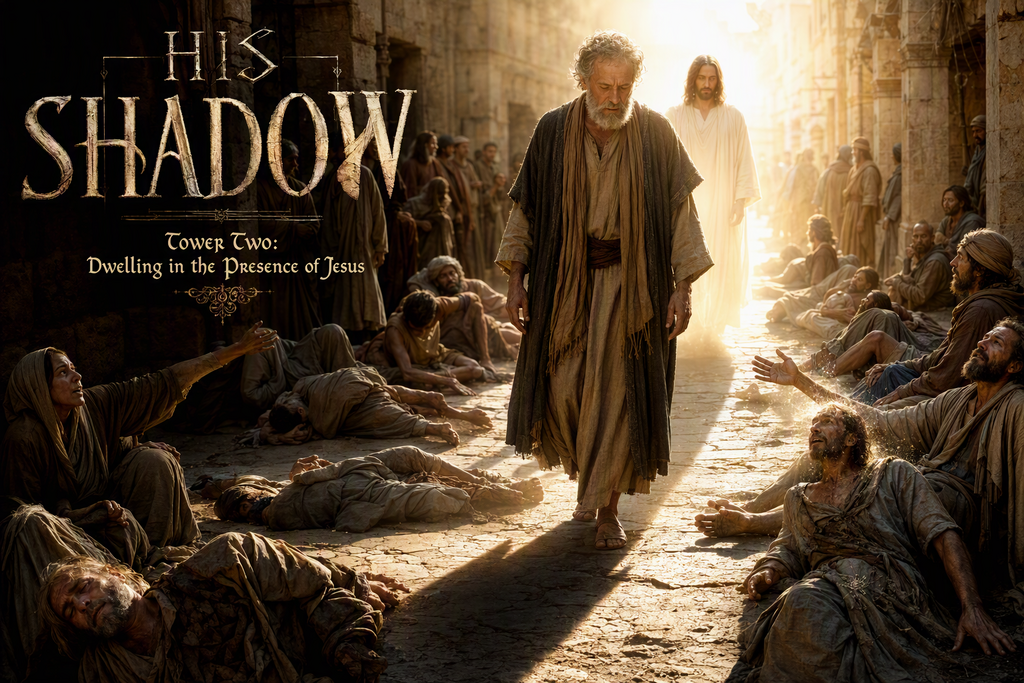
But for most of the people you meet, the Light of Christ that causes a shadow upon you will bring healing. Listen to this incredible account from the early church. In Acts 5, verses 15 and 16, Luke writes:
"To such an extent that they even carried the sick out into the streets and laid them on cots and pallets, so that when Peter came by at least his shadow might fall on any of them. The people from the cities in the vicinity of Jerusalem were coming together as well, bringing people who were sick or tormented with unclean spirits, and they were all being healed."¹⁶
Listen beloved, because the church was expanding so rapidly, because the miracles were so extraordinary, and because faith was spreading like wildfire, the excitement and desperation of the people reached such a point that they didn't even wait for formal gatherings or indoor services anymore. They literally dragged sick loved ones out into the open streets on cots, hoping that even Peter's passing shadow would touch them. Can you picture it? Peter is simply walking down the street, and people are lining the roads with stretchers and mats, hoping that his shadow might fall across them.
Now, let's be clear about what was happening here. There was nothing "magical" about Peter's shadow, and Peter would have been the first to admit it. The power was never in the man; the shadow that fell across him was the result of the Light of Jesus. Peter had spent three years walking in the closest possible proximity to Christ—so much so that when the religious leaders later watched him speak, they "realized that he had been with Jesus."¹⁷ When Peter's shadow fell on someone, it was truly the Light of the Savior falling upon them. Scientifically, a shadow possesses no physical energy or substance of its own, yet its presence alters the immediate environment to bring tangible physical relief and cooling comfort but it was all beacuse of the Sun. But in this passage, the True Sun of righteousness appeared with healing in His wings!
And look at who was affected. These were not merely the physically sick. Luke records that there were also people "tormented with unclean spirits." The original Greek word for "tormented" is ochleō (okh-LEH-oh), which means to be harassed, troubled, mobbed, and completely overwhelmed.¹⁸ These were men and women afflicted in body, mind, and spirit—people whom society had long written off. Yet they brought every imaginable need into the path of that shadow, and they were ALL healed!
Not some. Not most. All.
The Greek word for "healed" is therapeuō (ther-ap-YOO-oh).¹⁹ You can hear our English word therapy in it. It means to serve, to care for, to restore to health. It is the picture of someone tenderly attending to a wound until it is made whole. And notice that in Luke's account, the verb carries the idea of an ongoing work. They were being healed. The Lord's restoring touch was not a flash that came and went. It was a steady, compassionate care that reached every one of them.
That is the effect of dwelling in the shadow of the Most High. Those who live under it find shelter, and those who stand near them find restoration.
An Urgent Cry from the Heart
My friend, I want to ask you something. When people walk past you this week, whose shadow will they see? Will they see only yours, with your worries, your failures, and your tired strength? Or will they see the shadow of the Lord Jesus resting upon you?
I want to urge you from my heart: walk so close to Christ that His shadow reflects off of you onto everyone you meet. Don't stand at a distance, close enough to be religious but far enough to be unchanged. Draw near. Stay near. Live so near to Him that when you walk into a room, His presence goes in with you.
Our nation learned on September 11 how fragile our towers are. Steel can bend, glass can shatter, and the tallest structures can come down in a morning. But there is a Tower that will never fall, and there is a Shadow that will never fade. Let us be found under it!
Let me close with a prayer. Won't you pray it from your heart?
Lord Jesus, my Elder Brother, I need You. I don't want to visit Your shelter. I want to live there. Draw me close, Lord, so close that Your Light falls on me and causes a shadow to be over me. Let it rest upon everything I touch. Let Your presence be seen in my home, in my work, and in my words. Heal the hurting through me, not because of anything I have, but because of Who I walk with. O God, I cry out to be under the shadow of the Almighty today. In Jesus' name, Amen.
End Notes
-
Mark 3:35, NKJV.
-
Luke 8:21, NKJV.
-
Hebrews 2:11–12, NKJV.
-
Romans 8:29, NKJV.
-
Psalm 91:1, NKJV.
-
Seter (Strong's H5643), "covering, hiding place, shelter."
-
Elyon (Strong's H5945), "Most High," from a root meaning "to go up."
-
Shaddai (Strong's H7706), traditionally rendered "Almighty." Scholars debate its exact origin, but it consistently conveys strength and sufficiency.
-
A traditional rabbinic reading of the three letters of Shaddai (shin, dalet, yod) as an acrostic for Shomer Daltot Yisrael. This is a devotional insight from Jewish tradition, not a formal etymology.
-
Tsel (Strong's H6738), "shade, shadow," often used for protection from the sun's heat. See Isaiah 25:4.
-
Psalm 17:8, NKJV. See also Psalm 36:7 and Psalm 57:1.
-
Isaiah 32:2, NKJV.
-
Yashab (Strong's H3427), "to sit, remain, dwell."
-
Romans 8:1, NKJV.
-
Colossians 3:3, NKJV.
-
Acts 5:15–16, NASB. Quoted here in the wording you provided.
-
Acts 4:13, NKJV.
-
Ochleō (Strong's G3791), "to disturb, trouble, harass." Acts 5:16 uses the participle form.
-
Therapeuō (Strong's G2323), "to serve, care for, heal, restore to health." In Acts 5:16 it appears in the imperfect passive, etherapeuonto, "were being healed," indicating continuing action.