Droplets of Grace

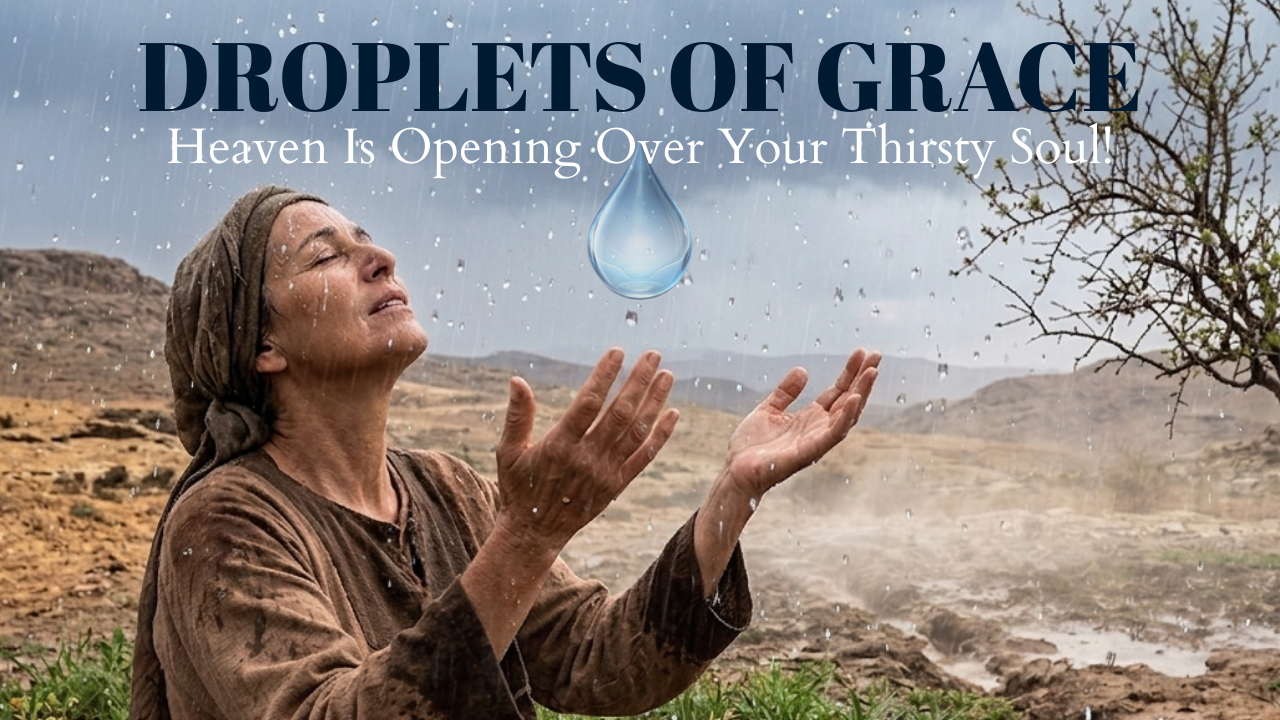
A Devotional on Joel 2:23 & Acts 2:17
"Rejoice, you people of Jerusalem! Rejoice in the LORD your God! For the rains He sends are an expression of His grace. Once more the autumn rains will come, as well as the rains of spring. — Joel 2:23 (NLT, 1996)
A Parched Land
Close your eyes for a moment and travel back with me.
It is the ninth century before Christ. The land of Israel — that beloved stretch of earth God called His own, the land promised to flow with milk and honey — is barely recognizable. The sky above is a hard, pale white. The ground beneath your feet is cracked, parched, and powdery, split into jagged fissures by the relentless sun. The grapevines are withered sticks. The fig trees have been stripped to bare bark. The fields that should be shimmering gold with grain are gray, brittle, and silent.
And then you notice something — or rather, you notice the absence of something. No birdsong. Even the animals have gone quiet. Because when the land dies, everything that depends on the land begins to die with it.
This is the world the prophet Joel walked into. And the devastation had a name — four names, actually. Joel 1:4 records them in terrifying sequence: the cutting locust, the swarming locust, the hopping locust, and the destroying locust. Wave after wave. Species after species. Until nothing remained.
But Joel is doing something more than filing a weather report. He is holding up a mirror.
Because the condition of the land was a perfect reflection of the condition of the people's hearts. The same drought that split the soil had split their hope. The same silence that blanketed the stripped fields had settled over their prayers. The priests wept at the altar (Joel 1:13). The joy of worship had dried up like the vine (Joel 1:12). The people of God were not merely hungry — they were hollow. Not only was the land parched and pale — the people were too. Not merely thirsty — they were desperate. The outer landscape and the inner landscape had become one: desolate, scorched, and aching for something they could not produce on their own.
Friend, perhaps that description is not entirely foreign to you. Maybe your fields look fine on the outside, but something inside has gone quiet. Faith feels routine. Prayer feels like words bouncing off a brass ceiling. The fire that once made worship come easily has become a fading ember. If that is where you are today, I need you to stay with me — because it was precisely into that kind of desolation that God spoke His most breathtaking promise.
The Promise of Rain
Right in the middle of the rubble, the voice of God broke through like the first rumble of thunder after a long, silent summer.
"Fear not, O land; be glad and rejoice, for the LORD has done great things!" (Joel 2:21).
"Fear not"(Al-tiri ): This is the first command of restoration — issued before the rain arrives. God commands us to stop fearing while the drought is still visible. Faith is the decision to obey the "fear not" before we see the rain.
And then, like rain beginning to fall on parched ground, the promise poured out: "He has given you the former rain moderately, and He will cause to come down for you the rain, the former rain, and the latter rain in the first month" (KJV) or, as the NLT words it: “Once more the autumn rains will come, as well as the rains of spring.” (Joel 2:23).
Every farmer in Joel's audience understood this language immediately. The agricultural calendar of ancient Israel depended on two distinct rains. The yoreh — the former rain — arrived in Autumn. It broke the summer drought, softened the iron-hard soil, and made planting possible. The malkosh — the latter rain, the spring rain — came in Spring, just before the harvest, swelling the grain with the weight and fullness it needed to ripen completely. Both rains were not optional. Without the former, you could not plant. Without the latter, you could never harvest.
Now here is the detail I do not want you to miss, because it is hidden like a jewel in the Hebrew text. The word for "former rain" — moreh — carries a stunning double meaning. It means early rain, yes. But it also means Teacher. God was not merely forecasting the weather. He was announcing an arrival. He was saying, in effect: I am sending you a Teacher of Righteousness — and when He comes, He will do what no natural rain has ever done. He will not just soften the surface of your life. He will saturate your soul.
That Teacher was coming. And the world would never be the same.
Why would God do all this? “For the rains He sends are an expression of His GRACE” (Joel 2:23, NLT)
Hallelujah!
Pentecost — The Day It Poured
Fast-forward nearly eight hundred years.
Jerusalem is alive with pilgrims. It is Shavuot — the Feast of Weeks, the festival the New Testament calls Pentecost — fifty days after Passover. It is a harvest celebration, and that timing is no accident. God never wastes a moment on His calendar.
One hundred and twenty men and women are gathered in an upper room. They are waiting — Jesus Himself had told them to (Acts 1:4). And then, without warning, heaven moves. Acts 2:2 says a sound came like a mighty, rushing wind and filled the entire house. Tongues of fire appeared and rested on each person. And they were all filled with the Holy Spirit.
When the stunned crowd demanded an explanation, the Apostle Peter stood to his feet, opened the ancient Scriptures, and turned straight to Joel chapter 2. And he declared eight words that ought to make every believer's heart leap: "This is that which was spoken by the prophet Joel" (Acts 2:16).
This is that. Joel 2 and Acts 2. The ancient word and its thundering fulfillment. Eight centuries of waiting, compressed into one Shavuot morning. This is the great "2 and 2" of Scripture — Joel's promise and Peter's proclamation locked together like two pieces of a puzzle the Holy Spirit had been holding since before either man was born. What Joel called "the former rain and the latter rain," Peter declared was the Holy Spirit Himself. What Joel said God would pour out on all flesh, Acts 2 records as an actual, irreversible, history-splitting downpour.
The Greek word Peter uses for "pour out" in Acts 2:17 is exechu — it means to empty a vessel completely, to hold nothing back. This was not heaven being cautious. This was not a light mist or a polite sprinkle. This was the floodgates of God, open wide, drenching everything beneath them.
Droplets of God’s Grace were showering parched souls!
Three thousand people came to faith that very day (Acts 2:41). The harvest festival had become the greatest spiritual harvest the world had ever seen. The locust years — the years of silence, of exile, of spiritual poverty — had begun, in a single morning, to be redeemed.
Joel had seen it coming. Peter saw it LIVE!
The Promise Is for YOU — and Your Children
Now I want to speak directly to you, because what happened on Pentecost morning was not the end of the story. It was the beginning of yours.
Listen to what Peter said next, right there in Acts 2:38–39: "Repent, and be baptized every one of you in the name of Jesus Christ for the remission of sins, and you shall receive the gift of the Holy Ghost. For the promise is for you, and for your children, and to all that are far off."
The promise is for you. Not just to the one hundred and twenty in the upper room. Not just to first-century Jerusalem. To you — reading these words today — and to your children, and to your children's children. The rain of God's Spirit has not stopped falling. It is falling right now.
Here is what I want you to grasp with both hands: if you have given your life to Jesus Christ, the Holy Spirit does not visit you from time to time like a welcome guest. He lives in you (1 Corinthians 6:19). He is not waiting to be poured out on you someday from a great distance. He is already inside you, already moving, already working — raining His grace into you from the inside out. Not just once, but droplets of rain-grace every single day.
Think about what that means. Those droplets of grace you feel in a quiet moment of prayer? That is the Spirit at work. That nudge toward forgiveness when everything in you wants to hold a grudge? That is the Spirit at work. That unexpected surge of hope on a morning when you had every reason to despair? That is the Spirit — your moreh, your Teacher of Righteousness — raining righteousness, peace, and joy into the deep places of your heart, one grace droplet at a time.
You do not have to manufacture revival. You do not have to work yourself into a spiritual frenzy to get God's attention. The rain is already falling on you. The Spirit is already within you. Your only assignment is to open up — to let the cracked, dry places of your soul receive what He is already pouring out.
Joel 2:25 promises that God will restore the years the locusts have eaten. Not some of them. All of them. In God's economy, not one drought season is wasted, not one dry year is lost. He redeems the whole story — and He does it by rain. By grace. By the steady, faithful, daily downpour of His Spirit into every parched corner of your life.
The former rain has fallen. The latter rain (the rains of Spring) are falling still.
Open up, beloved. The season of refreshing has come.
A Prayer: Rain Down on Me, Holy Spirit
Lord, I come to You today as thirsty ground. I open every dry place, every cracked and silent corner of my heart, to the rain (and reign) of Your Spirit. Abba Father, Pour out the rains of Spring on me through Your Holy Spirit — not a sprinkle, not a mist, but the fullness of Your presence, Your power, and Your love.
Restore the years I have lost. Redeem the seasons that felt wasted. Let every grace droplet You have been raining into my life awaken something I thought was gone forever.
You are my moreh — my Teacher of Righteousness. Rain Your truth into me until my roots run deep and my life bears fruit that remains, not only for me, but for my church and for our nation!
This is my prayer, and I receive Your promise: the rain is for me, and for my children, and for all who call on Your name.
Rain down on me, Holy Spirit. This is my season of refreshing. In the mighty name of Jesus, I ask for it ALL — Amen.