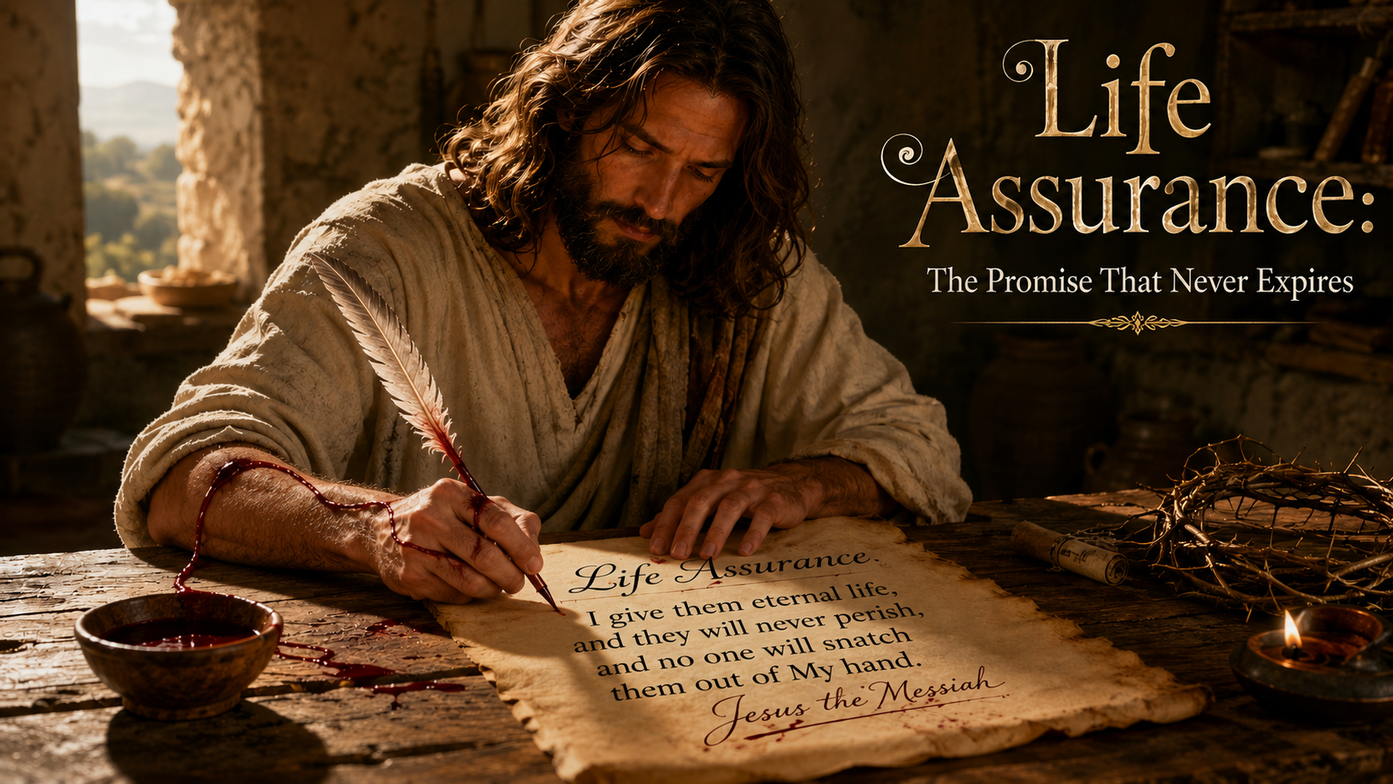
Life Assurance
The Promise That Never Expires

John Di Giorgio
August 27, 2026
What happens the moment you die?
It is not a morbid question. It is the most practical question a human being can ask, because it is the one question every single one of us will answer personally — no exceptions, no postponements, no substitutes.
On August 26, 2026, the world was reminded of this in the most sobering way. A glacier gave way high in the Himalayas along the Nepal–Tibet border, triggering a catastrophic debris flow that thundered down the Bhote Koshi and Trishuli river valleys. Water levels reportedly rose nine meters in thirty minutes. Villages, a border crossing, hydroelectric infrastructure — gone almost before anyone could react. Hundreds are confirmed dead. Well over a thousand remain missing, among them hundreds of foreign tourists who had woken that morning with no idea it would be their last.
No warning. No negotiation. No extra time.
That is the truth Scripture has been telling us all along: our lives are "like a vapor that appears for a little while and then vanishes away" (James 4:14, NASB). We build homes, make plans, set alarms for tomorrow — and tomorrow is a gift, not a guarantee.
This is precisely why people buy life insurance. It's wise. It's responsible. It provides for the people we love after we're gone.
But here is the deeper question this devotional wants to press on your heart: do you have life assurance? Not a policy that pays out when you die — but a certainty about where you go the instant you do.
There is exactly one place in all of history where that question was answered with total, unshakable clarity. It happened on a hill outside Jerusalem called Golgotha — "the Place of the Skull" — and it happened in a conversation that lasted somewhere in the range of a few minutes.
Two Crosses, Two Destinies
Luke tells us that Jesus was crucified between two criminals — literal "evildoers" (Luke 23:32–33). Both men shared the exact same circumstances. Both were guilty. Both were dying in agony. Both were within arm's reach of Jesus. Both witnessed Jesus’ reaction, heard the gracious words that fell from His lips, and the prayers He offered for His persecutors. Both heard the same mockery in the air, saw the same sign nailed above His head — THE KING OF THE JEWS — and watched the same innocent Man refuse to save Himself.
At first, both thieves joined the crowd in hurling insults at Jesus (Matthew 27:44). The verb there is in the imperfect tense — describing ongoing, repeated action. This wasn't one snide remark. Both men kept on reviling Him.
Then something shifts in one of them.
By the time we reach Luke 23:39–43, one criminal is still mocking: "Are You not the Christ? Save Yourself and us!" (v.39). His demand is the oldest temptation in the book: prove Yourself by escaping the cross. Yet Jesus could have come down. That was never the question. The real answer is far more staggering: He stayed because coming down would have saved Himself — and left the very man mocking Him lost forever.
But the other man does something remarkable. He turns and rebukes his fellow criminal — the very mouth that had joined the mockery now defends the Man being mocked. That reversal, all by itself, is the shape of repentance: the tongue that once cursed Christ is now used for Him.
"Do you not even fear God," he says, "since you are under the same sentence of condemnation? And we indeed are suffering justly, for we are receiving what we deserve for our deeds; but this man has done nothing wrong" (vv. 40–41, NASB). No blaming Rome. No blaming circumstance. Just: we did this. That is confession, stripped bare.
He has nothing left to offer. No time to make things right. No religious ritual he can perform while nailed to a beam of wood. No time to join a church, get baptized, and perform many wonderful works. He has only one thing left in the entire universe to bring to Jesus: himself, as he is, a sinner.
"JESUS, REMEMBER ME"
Then he says the words that changed his eternity: "Jesus, remember me when You come into Your kingdom!" (v. 42).
Notice what he's really asking. In Hebrew thought, to "remember" (zakar, pronounced zah-KAHR) is never mere mental recollection. When God remembers Noah, or Rachel, or His covenant, He doesn't simply recall a fact — He acts. The thief isn't asking Jesus to keep him in mind. He's pleading: when Your reign begins, don't leave me behind — act on my behalf. That is an extraordinary thing to ask of a man who, by every visible measure, is losing.
This is the moment the passage stops being just a story that moves you and becomes a foundation you can build your life — and your death — on.
THE LANGUAGE OF CERTAINTY
Jesus answers: "Truly I say to you, today you shall be with Me in Paradise" (Luke 23:43).
Every word here is load-bearing.
"Truly" — Amēn (pronounced ah-MAYN), from the Hebrew āmēn, meaning firmness, reliability, unshakable truth. Jesus is not offering a hopeful guess. He is issuing a royal decree. “I assure you,” (NLT). "I can guarantee this truth…” (GWT). "I promise that today you will be with Me in paradise." (CEV)
"Today" — sēmeron (pronounced SAY-meh-ron). This is one of Luke's favorite theological words: "today a Savior has been born" (2:11); "today this Scripture is fulfilled" (4:21); "today salvation has come to this house" (19:9). Salvation, in Luke's Gospel, keeps breaking into the present tense. The thief doesn't wait for a probation period. He doesn't need to be baptized, join a congregation, or spend years proving himself. He is dying today — and Jesus meets him today.
"You shall be" — esē (pronounced eh-SAY), a future indicative. Not subjunctive. Not "might be" or "could be" or "if you've done enough." Will be. This is grammar built for certainty — a statement of fact about something that has not yet happened but is as fixed as if it already had.
"With Me" — met' emou (pronounced met eh-MOO). Not merely "in heaven." Not merely "away from suffering." With Jesus Himself. The dying man had spent his final hours physically beside Christ on a cross. Jesus promises he will spend his first eternal moments consciously with Him in Paradise — paradeisos (pronounced pah-RAH-day-sos), the very word the Greek Old Testament used for the Garden of Eden. Hallelujah! The first Adam was driven out of paradise for his sin. This repentant sinner, beside the second Adam, is welcomed back in. That is the gospel in a single sentence.
Put it together, and Jesus gave this dying criminal four things in one breath: a certain declaration (Amēn), an immediate timeline (today), a guaranteed future (you will be), and an eternal Person to be with (with Me). That is not hope. That is assurance.
WHAT THIS MEANS FOR YOU
You may not be on a cross. But you are, if you do not already know Jesus personally, in every meaningful sense, in the same position that thief was in: guilty, unable to fix your own record, running out of time you cannot see the edges of. The people caught in that Himalayan valley on August 26th were, hours earlier, as certain of their tomorrow as you are of yours.
Here is the good news, and it is not a slogan — it is a legal, historical, grammatical fact recorded in Luke's Gospel: the same Jesus who spoke to that thief is the same Jesus you can speak to right now. He does not require your resume. He did not ask the thief for one. He asked for one thing only — a heart that stops defending itself and simply turns and says, Jesus, remember me.
That is not a formula. It's the posture of a soul that has stopped pretending. And to everyone who comes to Him this way — not someday, but today — Jesus does not offer probability. He offers promise: you will be with Me.
Herbert Lockyer, in his well-known study of the last words of the dying, observed a striking pattern across history: those who die trusting Christ tend to die in peace; those who die rejecting Him often die afraid, or defiant, or silent. The difference was never their circumstances. Both thieves hung on crosses. Both were seconds from death. The difference was who they trusted with what remained of their lives.
So — do you have life assurance? Not a policy. A Person. Not a probability. A promise, spoken in the future indicative, sealed by the One who has already conquered the grave He was hanging on.
If you have never turned to Him, you can do it in the same handful of words the thief used — no liturgy required, no waiting room, no today-doesn't-count. Jesus, remember me. And He will answer you exactly as He answered him.
Don’t delay. Don’t make excuses. God is asking for your heart right now! For God says, “At just the right time, I heard you. On the day of salvation, I helped you.” Indeed, the “right time” is now. TODAY is the day of salvation.” (2 Corinthians 6:2, NLT)
Truly. Today. You will be. With Him.
That is not insurance. That is assurance.
Do you have it?
Endnotes
-
James 4:14; Luke 23:32–43 — Scripture quotations from the New American Standard Bible (NASB), Lockman Foundation.
-
Greek grammatical analysis (tense, voice, mood of eblasphēmei, epetima, epraxamen, esē, ōneidizon) drawn from standard Koine Greek parsing of Luke 23:39–43 and Matthew 27:44.
-
Background on paradeisos and its Septuagint usage for Gan-Eden, and on the Lukan "today" motif, referenced in devotional and exegetical commentary consistent with the Precept Austin Luke 23 commentary series.
-
Herbert Lockyer, Last Words of Saints and Sinners — referenced thematically regarding the contrast in how the dying face death with or without faith in Christ.
-
Nepal–Tibet debris flow, August 26, 2026: casualty and displacement figures per Reuters, Al Jazeera, ABC News, and CNN reporting as of August 27, 2026; figures were still developing at time of writing.