Shalom Sunday

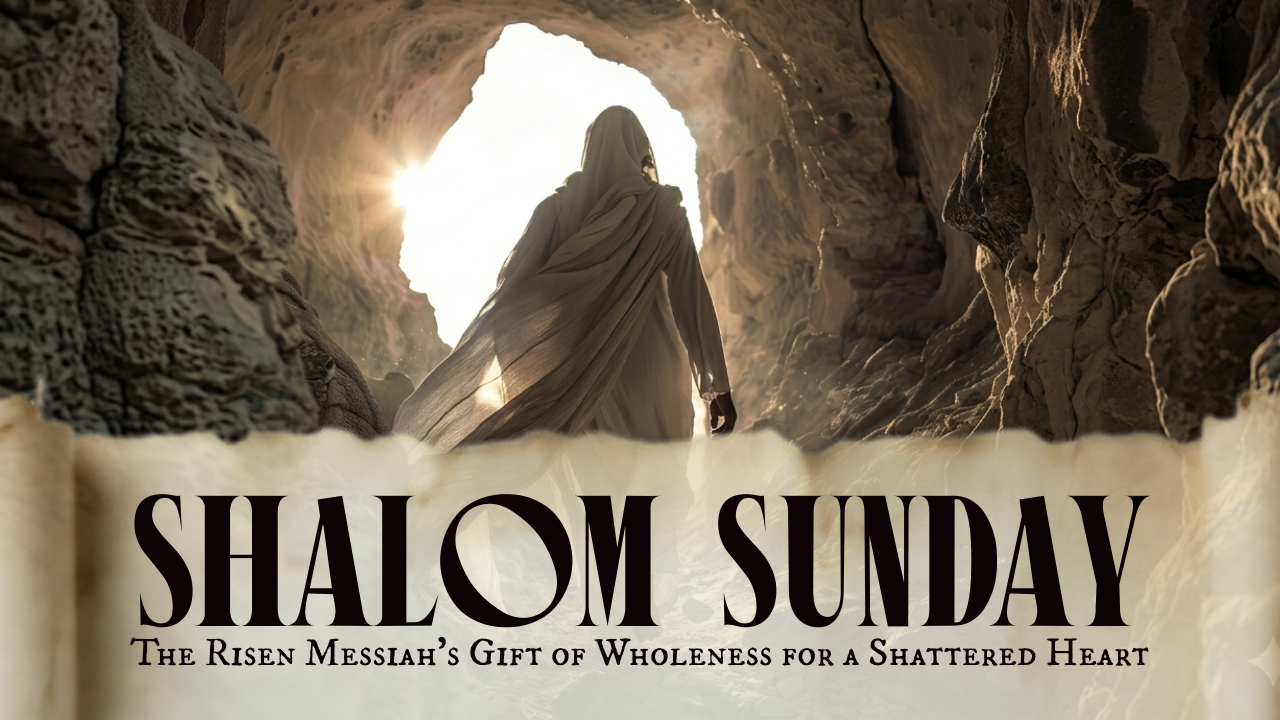
I want you to close your eyes for just a moment and transport yourself back two thousand years. It is Sunday evening in Jerusalem. The narrow streets are still. The city is locked down in a tense, uneasy quiet — the kind of quiet that follows catastrophe. And somewhere behind a bolted door, a small group of trembling men and women are sitting in the dark, wondering if tonight will be their last night on earth.
To truly understand this scene — to feel the weight of what happens next — we must first understand where these people have been. We must trace the road of their anguish, step by painful step.
Part One: Thursday and Friday — The Onset of Acute Trauma
While tradition has long pointed to a Friday crucifixion, a growing number of scholars — drawing from the remarkable prophetic framework of Daniel 9 — suggest that the cross may have come on a Thursday, in the midst of the week. The Hebrew word chatsi in Daniel 9:27 means "in the middle," implying that the Messiah would be "cut off" not at the end of the week, but at its very center.
If this is the case, then the disciples did not endure one long Sabbath of silence. They endured two.
But let us not get lost in the theological debate. Whether Thursday or Friday, the horror was the same. In one violent afternoon, everything these men and women had staked their lives upon was stripped away.
For three years, they had followed Jesus of Nazareth — the One they believed to be the long-awaited Redeemer of Israel. He was not simply their Teacher. He was their anchor. Their identity, their purpose, their future — all of it was bound up in Him. And then the soldiers came.
Consider what they were facing in those darkest hours.
The Shame of Desertion. The man they called "the Rock" — Simon Peter — was sitting somewhere with the crushing weight of three denials pressing down on his chest like a millstone. A few hours earlier, he had been the bold, sword-drawing protector. Now he was a broken man who had looked a servant girl in the eye and said, "I do not know Him." Three times [1]. The shame of that was not a small thing. It was the kind of shame that reshapes a man's entire understanding of himself.
The Fear of Purge. Throughout the ancient world, when Rome executed a rebel leader, the leader's followers were generally next. The disciples knew this. Every creak of a floorboard, every distant sound of sandals on cobblestone — it could be soldiers. The Scripture tells us plainly that the doors were locked because they were afraid [2]. This was not a casual precaution. This was the paralyzing, breath-stealing fear of men who believed their arrest was imminent.
Part Two: The Two-Sabbath Theory — The Silent Void
If the crucifixion occurred on Thursday, the disciples now faced what I call "the Great Silence" — a full 48 hours of psychological and spiritual paralysis. A High Sabbath, the first day of the Feast of Unleavened Bread, followed immediately by the regular weekly Sabbath. They could not move. They could not travel. They could not mourn publicly. They could only sit with it.
And what were they sitting with?
Cognitive Dissonance. Their minds were imprisoned between two irreconcilable truths. On one hand, they had heard Jesus teach. They had seen the miracles. They had walked with the Son of God. On the other hand, He was dead — crucified, which according to the Law of Moses meant He was cursed [3]. A crucified Messiah was, to the first-century Jewish mind, a complete and utter impossibility. The very manner of His death seemed to disqualify Him. And their minds simply could not hold those two realities at once.
Grief and Hopelessness. Underneath all of this was something even darker — the devastating feeling that God had failed them. They were not merely mourning a friend. They were mourning the apparent collapse of God's redemptive plan. And the longer the silence stretched, the deeper that despair cut. The psalmist once described a season like this as being "shut up so that I cannot come forth" [4]. That is exactly where these disciples were — shut up, locked down, unable to see any way out.
Part Three: Sunday Morning — Confusion and Skepticism
When the dawn of the first day of the week finally arrived, the women went to the tomb with their spices — not because they expected a resurrection, but because they expected a body. What they found instead was an empty grave and a blinding announcement from angels that Jesus was alive.
They ran back to tell the others. And what happened next reveals the depth of the disciples' trauma.
Emotional Blunting. The men did not throw open the doors and rejoice. Luke tells us plainly that the women's words appeared to them as "idle tales" — the Greek word leros, which carries the sense of delirious nonsense or medical babbling [5]. When a person has endured extreme grief, they often build an emotional wall to protect themselves from further pain. They cannot allow themselves to hope again because hope, in their experience, has only led to devastation. So they rejected the good news. Not because they were wicked, but because they were wounded.
The Emmaus Walk. Two disciples were so broken that they had literally turned their backs on Jerusalem and were walking away from it all. As they walked, their conversation was heavy with grief. They spoke of Jesus in the past tense. The amplified text of Luke 24:21 captures the raw sorrow of their words beautifully: "We were hoping that it was He who was going to redeem Israel and set our nation free" [6]. "We were hoping." Past tense. Extinguished. Gone.
Part Four: Sunday Evening — The Locked Room of Terror
By the time evening fell on that first Sunday, the disciples were gathered together behind locked doors. The Greek word in John 20:19 is kekleismenōn — a perfect passive participle suggesting that those doors were not merely closed, but securely barred and bolted [2]. They were not just being cautious. They were trapped in a prison of their own making — a tomb with walls built from fear, shame, grief, and hopelessness.
Can you picture it? The room is dim. The air is stale. Men who were once bold fishermen and passionate patriots are huddled in the shadows, whispering, flinching at every sound. This is what trauma does to people. It reduces even the bravest among us to the most frightened.
Part Five: The Supernatural "Standing"
And then — without warning, without the sound of a door opening or footsteps on the stairs — the Risen Christ is simply there.
John 20:19 tells us that Jesus "came and stood" in their midst. The Greek word is estē, from the verb histēmi [7]. This is not the word for casually walking into a room. The lexical weight of this word carries the idea of suddenly, definitively, authoritatively taking one's stand. Luke's account in chapter 24:36 confirms it with even greater emphasis: He "Himself stood" in their midst [8].
He did not knock. He did not apologize for interrupting their despair. He simply planted Himself — the Risen, nail-scarred, glorified Son of God — as the solid, unmovable center of their shattered world.
Part Six: Shalom Sunday — The Grand Finale
And when He opened His mouth, He did not say, "I told you so." He did not rebuke their doubt or shame their unbelief. He looked at these traumatized, terrified men — men who had failed Him, fled from Him, denied Him — and He spoke just two words.
"Peace be with you."
But here is something I want you to understand. Here is something that ought to make this moment come alive for you in a fresh way.
Jesus did not speak English.
I know that may seem like an obvious statement. But think about it. We have read those words so many times in our English Bibles — "Peace be with you" — that we may have missed the thunderous weight of what was actually said in that room. Jesus was a Jewish rabbi. He spoke to Jewish disciples. He worshiped in a Jewish synagogue. He celebrated the Jewish feasts. His mother sang Hebrew psalms over His cradle, and the scrolls He read in Nazareth were written in Hebrew. When He opened His mouth in that locked room on the first day of the week, He did not reach for a Greek word, and He certainly did not reach for an English one.
He used the ancient Hebrew word that every one of those disciples had known since childhood.
He said, "Shalom."
And the moment He said it, those men knew — in the deep places of their hearts — that they were not merely receiving a pleasantry.
What Is Shalom?
Our English word "peace" is a pale shadow of what the Hebrew word shalom (שָׁלוֹם) contains. When we say "peace," we typically mean an absence — the absence of conflict, the absence of noise, the absence of trouble. Shalom is something far more magnificent than an absence. It is a presence.
The Hebrew root of shalom (the Sh-L-M root) carries the meaning of wholeness, completeness, and fullness [9]. It was used in ancient commerce to describe a debt that had been "paid in full" — nothing owed, nothing lacking, the account settled completely [10]. When the word appears in the writings of the Hebrew prophets, it describes a state where every part of life is in right order — nothing is missing, nothing is broken [11]. It encompasses health, safety, flourishing, harmony, and restoration [12].
This is not merely a feeling of calm. Shalom is the condition of a person or a community in which everything is functioning as God designed it to function — body, soul, and spirit all aligned under His sovereign care [13].
The great prophets used this word to describe the peace that would characterize the coming Messianic Kingdom. Isaiah declared that the government would rest on the shoulders of the coming Child, and that of the increase of His government and shalom there would be no end [14]. The angel's announcement to the shepherds of Bethlehem echoed this ancient hope: "Glory to God in the highest, and on earth peace" — the very peace, the very shalom, that the prophets had promised for centuries [15].
And now the Messiah Himself — risen, triumphant, death-conquering — was walking into a locked room and speaking that word personally over the ones He loved.
This was not a greeting. This was a declaration. This was a gift. This was a divine physician standing over His wounded patients and pronouncing them healed.
Today Is Your Shalom Sunday
Friend, I want to bring this home to you today. Because I believe with all my heart that the same Risen Christ who stood in that locked room two thousand years ago is standing in your room right now.
Maybe you have been living through your own version of those dark, silent Sabbaths. Maybe your "Friday" came years ago — a loss, a betrayal, a failure so devastating that it reshaped your entire sense of who you are. Maybe you have been sitting behind locked doors ever since — not physical doors, but the doors of a heart that has been hurt too many times to risk hoping again.
Perhaps you carry something of Peter's shame — the memory of a moment when you failed, when you denied what you knew to be true, when you ran instead of stood. Perhaps you have something of Thomas's skepticism — a reluctance to believe that good things can still happen to you, because the evidence of your own experience has been so discouraging.
Or perhaps, like those two disciples on the Emmaus road, you have been walking away — quietly abandoning the expectations you once had for your life, your faith, your future, speaking of your dreams only in the past tense.
If any of that describes where you are today, then I want you to hear this clearly: the length of the burial does not diminish the power of the Resurrection.
It took only one moment for the Risen Christ to transform the atmosphere of that locked room. It required no elaborate ceremony, no extended preparation. He simply stood — and everything changed.
He is standing in your midst right now.
And the word He is speaking over you today is not "peace" in the thin, insufficient English sense of that word. He is speaking Shalom over you — the deep, comprehensive, Hebrew wholeness that covers every dimension of what has been broken in your life.
To your confusion, He brings the right ordering of your mind. To your shame, He brings the declaration that the debt has been "paid in full." To your fear, He brings the safety of His presiding, authoritative presence. To your grief, He brings the certainty that nothing — nothing — that He has promised has been canceled.
Nothing missing. Nothing broken. Everything restored.
Shalom Aleichem! Peace be upon you!
Today is your Shalom Sunday. Receive it now.
Study References
[1] Matthew 26:75. Peter's bitter weeping reflects a profound psychological rupture from his previous identity as a bold protector and leader.
[2] John 20:19. The Greek kekleismenōn (perfect passive participle) indicates the doors were not merely closed but securely and intentionally barred — a manifestation of prolonged, paralyzing fear.
[3] Deuteronomy 21:23. The Mosaic law declared that one who was "hung on a tree" was under the curse of God, making a crucified Messiah a profound theological and psychological stumbling block for first-century Jewish disciples.
[4] Psalm 88:8. The psalmist captures the spiritual and psychological experience of being "shut up" with no visible way of escape — a fitting description of the disciples' internal condition during the silence of those Sabbaths.
[5] Luke 24:11. The Greek word leros (translated "idle tales") carried in antiquity the connotation of medical delirium or nonsensical babbling, suggesting the men dismissed the resurrection report as the product of hysteria or grief-induced hallucination.
[6] Luke 24:21 (AMP). The use of the imperfect tense in the Greek — "we were hoping" — communicates not just disappointment but the past tense finality of a hope that has been extinguished.
[7] John 20:19. The Greek estē (aorist of histēmi) carries the lexical nuance of suddenly and definitively "taking one's stand," suggesting not a casual arrival but a sovereign, authoritative self-presentation.
[8] Luke 24:36. The emphatic pronoun autos ("Himself") combined with estē underscores the bodily, physical, undeniable nature of the risen Christ's appearance among them.
[9] Theological Wordbook of the Old Testament, R. Laird Harris, Gleason Archer, and Bruce Waltke (Moody Press, 1980). The root sh-l-m carries the foundational semantic range of wholeness, completeness, and being in a state of full and proper order.
[10] Brown-Driver-Briggs Hebrew and English Lexicon (Hendrickson Publishers, 1906, repr. 1996). The verb shillem (from the same root as shalom) is used in commercial contexts to mean "to pay," "to repay," or "to make restitution in full."
[11] A Hebrew and English Lexicon of the Old Testament, Francis Brown, S.R. Driver, and Charles Briggs. Shalom in prophetic literature describes the positive condition of welfare, safety, and soundness — not merely the absence of hostility.
[12] The New International Dictionary of Old Testament Theology and Exegesis, ed. Willem VanGemeren (Zondervan, 1997). Shalom encompasses health, prosperity, safety, harmony, and the absence of disorder across all dimensions of individual and communal life.
[13] Isaiah 26:3; Jeremiah 29:11. The peace God promises is explicitly tied to wholeness of relationship with Him — a complete restoration of alignment between the human soul and its Creator.
[14] Isaiah 9:6–7. The prophetic declaration of Messiah's coming kingdom is inseparably linked to the shalom that will characterize His reign — an increase of divine wholeness and order with no end.
[15] Luke 2:14. The angelic proclamation of "peace on earth" at the birth of the Messiah directly echoes the prophetic shalom tradition, signaling that the long-awaited Messianic restoration had begun.