The Mystery of Antioch
How Two Unsung Jews Gave Us the Name "Christian"

John Di Giorgio
August 30, 2026
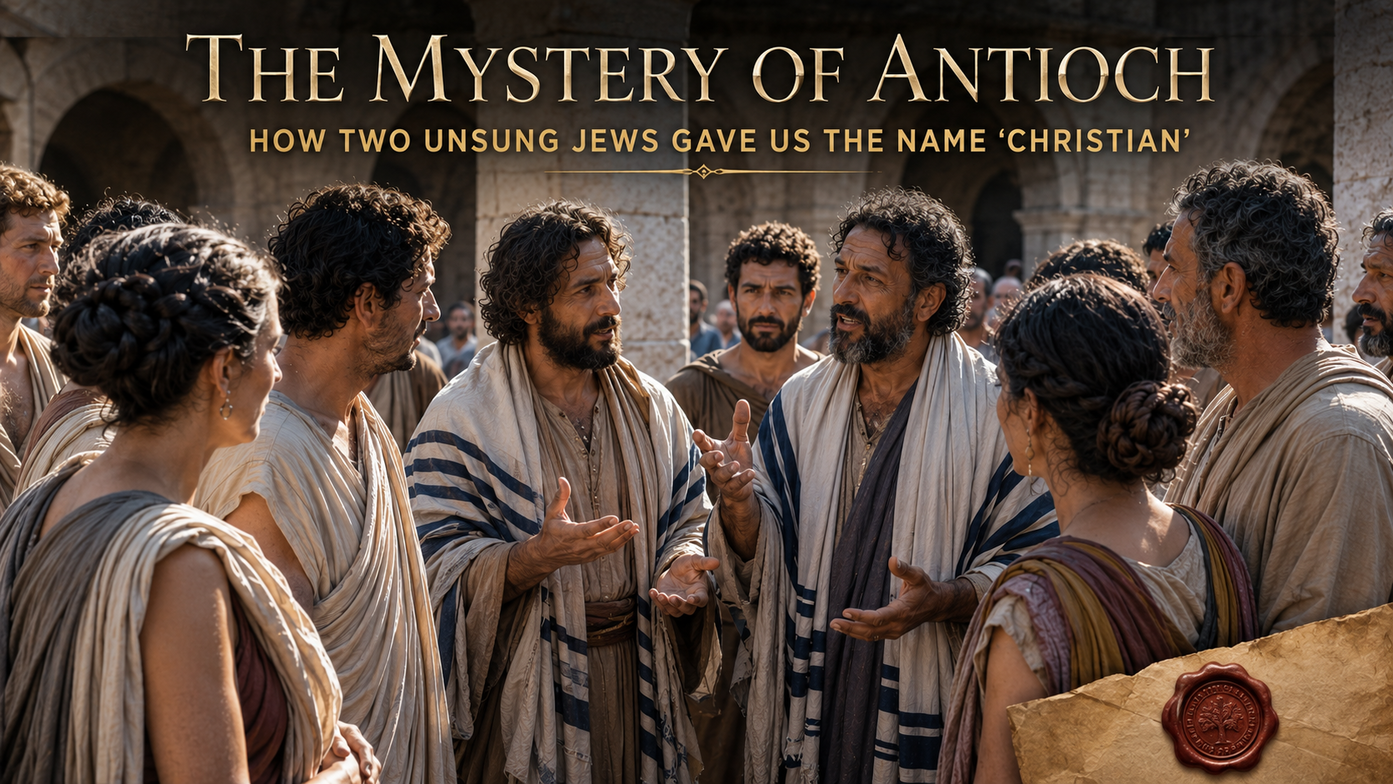
There is a mystery buried in the book of Acts. It is hiding in plain sight, tucked between two verses most of us read past without a second glance. Long before Antioch became the turning point of the early church, two ordinary, unnamed men stepped into an extraordinary assignment. When persecution scattered the believers out of Jerusalem, these unsung Jewish evangelists dared to cross a cultural line no one else would cross—sharing Jesus with the Gentile world and sparking a revival that shook the Roman Empire. When we uncover their quiet obedience, we not only rediscover the rich Jewish foundation of our faith, but we discover the powerful, sacred story behind the very name we carry today—Christian.
Let's walk the road together.
The Sacred Foundation (Pentecost and the Jewish Roots)
Every great work of God begins exactly where you'd expect the God of Israel to begin it — in Jerusalem, on a Jewish feast, among a Jewish people.
Acts chapter 2 opens on the Feast of Pentecost — what our Messianic brothers and sisters rightly call Shavuot (Acts 2:1, TLV). That day, the church was not "invented." She was born. And notice who was in the room: roughly one hundred twenty men and women, gathered in an upper room — every one of them Jewish (Acts 1:14–15, TLV).¹
When Peter stood and preached, three thousand souls were added in a single day (Acts 2:41, TLV) — a harvest that was, in that moment, overwhelmingly Jewish. The church kept growing in Jerusalem. Even a great number of priests — men trained in the Temple, men who had spent their lives guarding the Law — began to obey the faith (Acts 6:7, TLV). A minority of Greek-speaking Jews is mentioned in Acts 6 as well, but let the record stand: *this was, at its root, a Jewish movement, planted in Jewish soil, watered by Jewish hands.*²
1. The Sovereign Provocation (Persecution as Divine Setup)
Roughly two to five years later, we arrive at Acts chapters 6 and 7, and a man named Stephen becomes the first martyr of the Church (Ekklesia) — the called-out ones. His blood was spilled not in Rome, not in Athens, but in Israel.
Now remember — Jesus had already told His disciples in Acts 1:8 that they would receive power when the Holy Spirit came upon them, and that they would be His witnesses "in Jerusalem, and in all Judea and Samaria, and to the ends of the earth" (Acts 1:8, TLV). And yet — they did a wonderful work in Jerusalem, but Judea, Samaria, and the ends of the earth never came. They stayed put. As we noted, they remained in Jerusalem for two to five years. The prophecy was still going to come to pass — but not by obedience. It would come to pass through persecution. Acts 1:8 gave them a calling; Acts 8:1 is what it took to fulfill it: "On that day a great persecution broke out against the community... and they were all scattered...” Where? “ …throughout the region of Judea and Samaria," (Acts 8:1, TLV).³
Here is the first thread of the mystery: what the enemy meant to scatter the church, God meant to scatter the seed. This was no accident. It was prophesied. It was purposed. Jewish evangelists, driven from their homes, carried the Good News through Judea and Samaria like sparks carried on the wind (Acts 8:4, TLV).
2. The Courageous Proclamation (Unnamed Believers Breaking Barriers)
But then — Acts chapter 11. And here the mystery deepens.
We are introduced to two unnamed evangelists. Scripture does not give us their names. But it does give us their identity: they were Jews from Cyprus and Cyrene — men of the Diaspora, Jews who had grown up outside the borders of the Land (Acts 11:19–20, TLV).⁴
Watch them closely, because I am about to say something that may unsettle you: if it had not been for these two unnamed, unheralded Jewish evangelists, you and I — as Gentiles — may never have received the gospel at all.
Ridiculous? Let's look at the text.
At first, these men "spoke the message to no one except Jewish people" (Acts 11:19, TLV). That was the pattern. That was the boundary everyone assumed. But then something in these two men broke loose from the mold — a holy boldness, a divine nudge — and they turned and began speaking to the Hellenists, the Greeks, in the city of Antioch (Acts 11:20, TLV).⁵
What happened next was staggering: "The hand of the LORD (Adonai) was with them, and a great number who believed turned to the Lord" (Acts 11:21, TLV).⁶ That’s revival, friend!
For the first time in redemptive history, Jew and Gentile became one in Messiah. Not merely side by side — one.
3. The Gracious Affirmation (Barnabas & Paul’s Discipleship)
Word of this massive revival reached Jerusalem, and the apostles dispatched a man named Barnabas to investigate. When he arrived, "he saw the grace of God, and he rejoiced" (Acts 11:23, TLV).⁷ He did not find confusion. He did not find compromise. He found grace, on display, in living color — Jew and Gentile, standing shoulder to shoulder in the love of Messiah.
The revival was so great that Barnabas left Antioch to search for a man who was, at that time, in a kind of quiet hiatus — studying, waiting, patiently being prepared. That man's name was Saul of Tarsus, whom we know as Paul (Acts 11:25, TLV).
Think of the irony. This was a man who, prior to his Damascus Road encounter, had hated the very idea of Gentile inclusion. Now Barnabas brings him to Antioch, and he sees with his own eyes the very people he once despised, wrapped in the grace of the Messiah he now served.
4. The Cultural Identification (The Birth of the Name "Christian")
And here is where the mystery reaches its climax.
For two thousand years, followers of Jesus (Yeshua) have carried a single word as their identity: Christian. But few stop to ask where that word was born — or why.
"...and it was in Antioch that the disciples were first called Christians" (Acts 11:26, TLV).⁸
Many believe the Antiochenes coined the term as mockery. Perhaps. But I hold — though I cannot prove it, I believe it with my whole heart — that it may well have been Paul and Barnabas themselves who gave this community its name. Consider: here stood a man who had seen the light of Messiah on the Damascus road (Acts 9:3–5, TLV), a man who no longer saw people merely as Jew or Gentile, but saw beyond them — to the Messiah within them.
The name "Christian" was not born in isolation. It was born in Antioch — in the crucible of Jewish and Gentile believers, worshiping as one. Do you understand the importance of that?
The Charge
Friends, if you do not see the Jewish-Gentile connection at the very birthplace of your name, I urge you — pastor, teacher, believer — to return to the Scriptures and see it afresh. You and I, as Gentile believers, owe an incalculable debt to two Jewish evangelists whose names history never recorded, but whose obedience Heaven never forgot!
They broke the mold. They carried the gospel across a line no one else dared to cross. And because they did — we have a name, a hope, and a Savior.
Carry this truth with you. Share it boldly — especially in an age when antisemitism rises again in plain sight. Let the church remember where she was born, and whom God used to bring her into the world He so loved.
Shalom, and the Love and grace of Yeshua our Messiah be with you all.
Pastor/Evangelist John Di Giorgio
Our Father’s House (Beit Avinu)
www.ofHim.org
Endnotes (Scripture References, Tree of Life Version)
-
Acts 1:14–15, TLV
-
Acts 6:1, 7, TLV
-
Acts 8:1, TLV
-
Acts 11:19–20, TLV
-
Acts 11:20, TLV
-
Acts 11:21, TLV
-
Acts 11:23, TLV
-
Acts 11:26, TLV; see also Acts 9:3–5, TLV (Paul's Damascus road encounter)