WOVEN IN THE WAITING ROOM

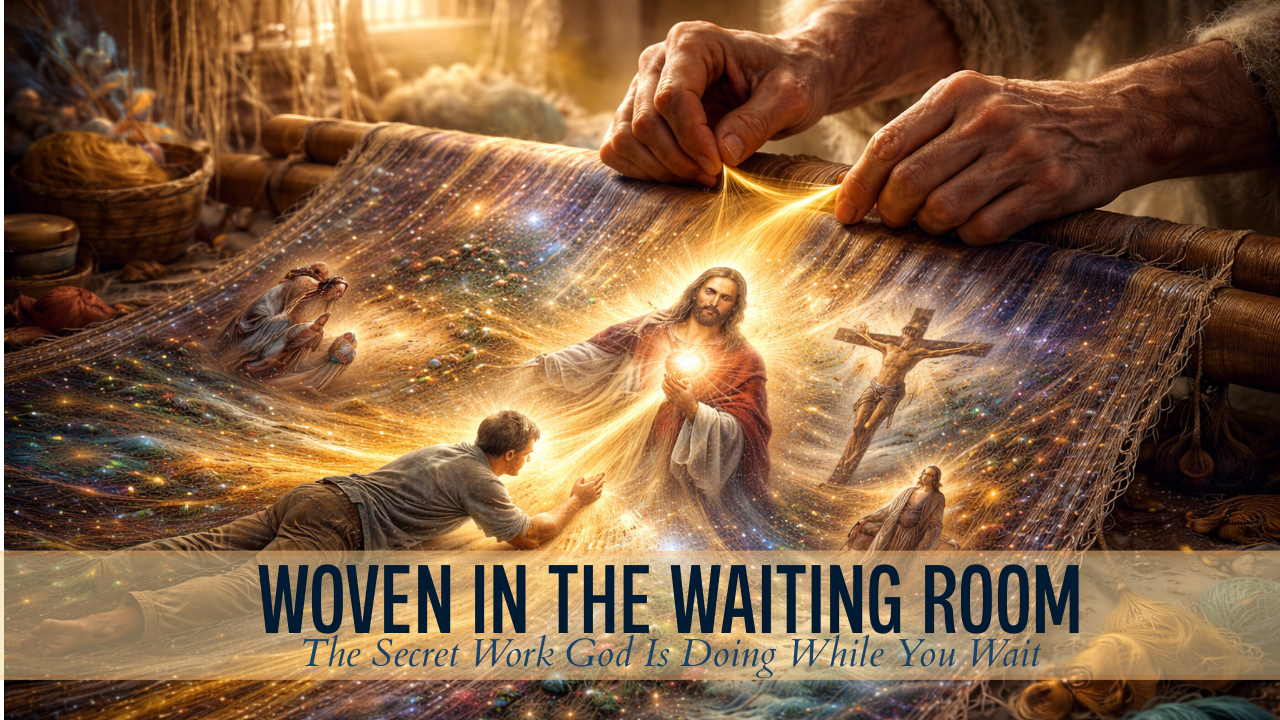
Primary Texts: Psalm 139:13–15 | Isaiah 40:31 | Jeremiah 29:11 Additional References: Job 23:10 | Romans 8:28 | Exodus 28:6 | Habakkuk 2:3 Scripture Version: New American Standard Bible (NASB)
✦ ✦ ✦
THE ROOM WHERE EVERYTHING BEGINS
There is no moment quite like it in all of human experience.
The hospital corridor is hushed. The clock on the wall moves with an almost unbearable slowness. A father paces. Perhaps he grips a cup of coffee that has long since gone cold. Perhaps he bows his head and prays the same prayer he has been praying for hours, for weeks, for months — Lord, let everything be all right. And somewhere beyond those doors, a mother labors. She breathes through the pain. She pushes through the exhaustion. She endures what no description can fully honor — the sacred, shattering, glorious agony of bringing a new life into the world.
And then — finally — that cry.
The cry that breaks through every wall and fills every corridor and turns a waiting father's knees to water and makes a mother forget, in one luminous instant, every hour of suffering that preceded it. A new life has arrived. A new soul has entered the world. And it is, without question, one of the most breathtaking moments a human being will ever witness.
But here is what I want you to notice today.
That baby did not simply arrive. That child was formed — quietly, secretly, in darkness and in hiddenness, over long months of waiting and mystery and imperceptible, ongoing, miraculous work. Before the cry. Before the joy. Before the world ever laid eyes on that new life — God was already at work. In the unseen. In the quiet. In the womb.
And I want to suggest to you today that the very same thing is true of every promise God has ever made to you. Every dream He has placed in your heart. Every season of your life that feels too dark, too long, too confusing, too painful to endure.
God is not absent in your waiting room.
He is weaving.
✦ ✦ ✦
I. THE ARTISAN'S HAND & THE MYSTERY OF THE WEAVING — PSALM 139
The great poet-king David, sitting with his harp and his wonder before the majesty of God, gave us one of the most intimate and staggering declarations in all of Holy Scripture:
"For You formed my inward parts; You WOVE me in my mother's womb. I will give thanks to You, for I am fearfully and wonderfully made." — Psalm 139:13–14, NASB
The Hebrew word rendered "wove" in Psalm 139:13 (NASB) is sakak, pronounced saw-KAHK. Its usage here in Psalm 139:13 means to weave together — to intertwine, to interlace, to knit constituent parts into a unified, coherent whole.
But here is what I want you to feel in that image.
A weaver does not work randomly. A weaver does not throw threads together and hope for the best. A master weaver begins with a pattern — a design conceived in the mind before a single thread is placed on the loom. Every thread has a color that was chosen deliberately. Every thread has a position that was determined intentionally. Every thread intersects with the others at precisely the right moment, in precisely the right way, to produce precisely the right image.
And David wants you to understand something that will change the way you see yourself forever — God brought that same painstaking, thread-by-thread intentionality to the making of you.
You were hand-woven — thread by thread, detail by detail, purpose by purpose — by the master Artisan of the universe, in the darkness of a womb, before you ever took a single breath or opened a single eye. Not haphazardly. Not generically. Not as one more undifferentiated unit rolling off a cosmic assembly line. But as a weaver works — with design, with deliberateness, with the unhurried, meticulous, loving attention of a master craftsman who knows exactly what He is making and why.
The Passion Translation renders this verse with breathtaking tenderness: *"You formed my innermost being, shaping my delicate inside and my intricate outside, and wove them all together in my mother's womb."*³
Shaping my delicate inside and my intricate outside. Every fiber. Every nerve pathway. Every chamber of the heart and corridor of the mind. Woven. Deliberately. By Him. For a purpose that He conceived before you drew your first breath.
And here is the truth that must go with you: if God was weaving you in the darkness of your mother's womb — working with divine precision and eternal intention in a place where no human eye could see and no human hand could reach — then what makes you think He has stopped weaving now? What makes you think that the darkness you are in today, the confining and difficult and disorienting season you are presently enduring, is somehow beyond the reach of His loom?
The womb is dark. But the weaving NEVER stops.
✦ ✦ ✦
II. THE SECRET OF THE WAITING — ISAIAH 40:31
How can we know this for sure? Let’s go back to one of the most beloved and most frequently quoted verses in all of the Bible. And I want to show you something in it that may be entirely new to you.
"Yet those who wait for the Lord will gain new strength; they will mount up with wings like eagles, they will run and not get tired, they will walk and not become weary." — Isaiah 40:31, NASB
Most of us have heard this verse preached as an encouragement to simply hold on during difficult times. And it is that. But the Hebrew word translated wait here is doing something so much richer than our English can carry.
The word is qavah — קָוָה. And its root meaning is not merely to sit still and endure. At its most foundational level, qavah means to bind together — to twist and intertwine, as multiple threads are twisted together to form a strong and unified cord.³
Do you see it?
When Isaiah says "those who wait for the Lord," he is not describing passive, resigned endurance. He is describing a binding together — a progressive, active, intimate intertwining of your life with the life of God. As you wait on Him, you are being wound into Him and His purposes. Your weakness is being twisted together with His strength. Your confusion is being woven together with His calmness. Your finite thread is being braided into the infinite purposes of the Almighty — until what emerges is something that no single thread could have produced on its own.
This is why people who have walked through the deepest valleys with God emerge not broken, but stronger. Not thinner, but thicker — fortified by the very suffering that seemed designed to destroy them. Because the waiting was not wasted. The waiting was weaving.
The mother who labors through the long hours of the night does not experience those hours as purposeless suffering. She knows — even in the pain — that something is coming. That every contraction, every wave of anguish, every moment of exhausted endurance is moving her and her child toward an arrival that will make every moment worth it.
✦ ✦ ✦
III. GOD'S PLANS FOR YOU ARE BEING WOVEN — JEREMIAH 29:11
Perhaps no verse in the entire Bible is more frequently printed on greeting cards, embroidered on pillows, and recited at graduation ceremonies than this one:
"'For I know the plans that I have for you,' declares the Lord, 'plans for welfare and not for calamity to give you a future and a hope.'" — Jeremiah 29:11, NASB
It is a beautiful promise. But I want to take you beneath the surface of it — because the Hebrew is carrying something that most of our translations cannot fully convey.
The word translated plans is machashavoth — מַחֲשָׁבוֹת — from the root chashav.⁴ And this is where the devotional heart of everything we have been exploring today comes together in one magnificent moment.
Chashav does mean to think or to plan. But in its oldest and most concrete usage, it is a weaver's term. It is the word used in Exodus 28 to describe the skilled, intentional, artistic work of the master craftsman who wove the priestly garments — the choshev, the master weaver, who worked with gold and blue and purple and scarlet, creating something of surpassing beauty, thread by deliberate thread.⁵
Messianic teacher Rabbi Jonathan Cahn has illuminated this connection powerfully, pointing out that when God says "I know the machashavoth I have for you," He is not speaking as a mere strategist drawing up an organizational chart. He is speaking as a master weaver standing before His loom — and you are the tapestry He is making.⁶ Every thread of your life — the golden threads of your joys, yes, but also the dark threads of your sorrows, the rough threads of your failures, the thin threads of your uncertainties — He is weaving all of it together into a pattern of surpassing beauty and eternal purpose that you cannot yet see from your vantage point on the underside of the loom.
The underside of a tapestry, you see, looks like chaos. Knots and loose ends and tangled threads going in every direction without apparent rhyme or reason. But turn it over — and there is a masterpiece.
You are living on the underside right now. But God is working from the topside. And He has not lost a single thread.
✦ ✦ ✦
IV. THE WOMB, THE WAITING, AND THE GOLD
Now let me bring all of these threads together in one final, glorious image.
Think again of that child in the womb.
It is dark in there. Confined. The world the child inhabits is nothing like the world that is coming. There is pressure. There is the rhythmic drumming of a heartbeat that is not its own. There is discomfort. There is the strange, muffled reality of a life being lived in a space that was never meant to be permanent — because it is not a destination. It is a preparation. It is not where the child is going to live. It is where the child is being made ready to live.
And the mother — oh, the mother. Let us never minimize what she endures. The nausea of the early months. The exhaustion that settles into her bones. The physical transformation she did not fully anticipate. The sleepless nights. The anxious questions. The aching and the waiting and the wondering. Every day is a new exercise in surrendering control over something she loves more than her own life — and trusting that the One who designed this process knows exactly what He is doing.
She endures it all. Because she knows that on the other side of the waiting — there is life.
Beloved, that is YOU! That is YOUR season. And this is what the suffering patriarch Job knew from the ash heap — broken, bewildered, stripped of everything he had ever loved or built or called his own — when he lifted his ravaged face to heaven and declared with astonishing, undefeated faith:
"But He knows the way I take; when He has tried me, I shall come forth as gold." — Job 23:10, NASB
Come forth as gold.
Gold, as any metallurgist will tell you, does not become pure in comfortable conditions. It becomes pure in fire. In the intense, sustained, refining heat of the furnace — where every impurity is burned away and what remains is precisely what was always there, underneath everything else, waiting to be revealed.⁷
The womb is dark. The waiting is long. The process is painful. But what is being formed in you — through every seemingly unanswered prayer, every delayed promise, every season of confusion and suffering and holy endurance — is not something cheap or ordinary or disposable.
It is gold.
It is the gold of God's eternal purposes, woven by His sovereign hand, into a tapestry of glory that will reflect His beauty and declare His faithfulness to a watching world. You are not merely surviving your waiting room. You are being made in it — thread by thread, day by day, into the masterpiece He declared you to be before you drew your first breath. You are being created to look more and more like JESUS (Romans 8:29)!
✦ ✦ ✦
HOLD ON — THE WEAVER IS NOT FINISHED
So today, if you find yourself in a season of waiting — if the room feels too small and the silence feels too long and you are tempted to conclude that God has forgotten the plans He made for you — I want you to remember three things.
He is weaving you while in His waiting room! Every dark thread has a purpose. Every painful detail has a place in the pattern.
He is binding you to Himself. Your waiting is not separation from God — it is the intertwining of your life with His. You are being made stronger with every twist of the cord.
And His weaver's plans, (machashavoth), His craftsman's purposes — for your life have not been revised, abandoned, or delayed beyond recovery. They are being worked out, with the precision and artistry of the Master who has NEVER once dropped a thread, into a golden and glorious tapestry for His eternal glory.
Spiritual birth is coming.
The gold is being refined.
The tapestry is being finished.
Hold on, beloved. The Weaver has not finished His glorious tapestry yet. In the end, you will come forth as GOLD for His GLORY! Hallelujah!
✦ ✦ ✦
FOOTNOTES
¹ The Hebrew verb raqam (רָקַם, Strong's H7551) carries the primary meaning of "to weave in colors, to embroider." The Brown-Driver-Briggs Hebrew Lexicon defines it specifically as the work of a "weaver in colors" or "embroiderer," denoting the skilled, intentional, multicolored craftsmanship of an artisan. David's use of this word in Psalm 139:15 is a deliberate and theologically loaded choice, imaging God not as a factory but as a master craftsman working with intimate, painstaking care.
² The same root raqam appears in Exodus 26:36, 27:16, 28:39, and 36:37 in connection with the skilled weaving of the Tabernacle's curtains and the priestly garments — some of the most sacred objects in all of Hebrew religion. By using this word for the formation of a human being, David is placing the making of a person in the same category of divine artistry as the construction of God's own dwelling place. See The Expositor's Bible Commentary, Vol. 5 (Grand Rapids: Zondervan, 1991), p. 846.
³ Qavah (קָוָה, Strong's H6960) derives from a root meaning "to bind" or "to twist together," as strands are twisted to form a rope. The Theological Wordbook of the Old Testament (TWOT, Chicago: Moody Press, 1980), entry 1994, notes this concrete background and connects it to the idea that waiting on the Lord is not passive but involves an active, progressive bonding of the human soul to its divine source of strength. The "new strength" of Isaiah 40:31 is not self-generated; it flows directly from this act of binding.
⁴ Machashavoth (מַחֲשָׁבוֹת) is the plural form of machashabah (מַחֲשָׁבָה), from the root chashav (חָשַׁב, Strong's H2803). BDB identifies among its meanings "to think, plan, esteem" but also "to weave, to work with the hands of a craftsman." The related noun choshev refers specifically to the skilled weaver or embroiderer who worked on the Tabernacle (Exodus 26:1, 31; 28:6, 15). The semantic range of chashav thus encompasses both cognitive planning and artistic craftsmanship — a richness that the single English word "plans" cannot carry.
⁵ In Exodus 28:6 (NASB), the ephod — the most sacred garment of the High Priest — is described as the work of the choshev (חֹשֵׁב), the "skillful workman" or master weaver, who worked with gold and blue and purple and scarlet threads and fine twisted linen. The same root chashav underlies both this craftsman's title and the divine "plans" of Jeremiah 29:11 — a connection that reveals God's self-disclosure as not merely a planner but a weaver of sacred garments out of human lives.
⁶ Rabbi Jonathan Cahn has addressed the weaving imagery embedded in chashav and Jeremiah 29:11 in multiple teaching contexts, including his work The Book of Mysteries (Lake Mary, FL: FrontLine/Charisma Media, 2016), where he explores the pattern of God as cosmic craftsman whose plans for His people are not merely strategic but artistic — crafted with the care of One who is making something of surpassing and eternal beauty out of the raw material of human experience.
⁷ Job 23:10 employs the image of the tzaraph (צָרַף) — the refiner or smelter — whose work involves intense sustained heat applied to ore in order to separate precious metal from dross. The same metallurgical image appears in Malachi 3:3, where God is described as a refiner of silver who sits over the process — not standing at a distance, but watching closely, personally present — until He sees His own reflection in the surface of the refined metal. The goal of the refining process, in both passages, is not the destruction of the ore but the revelation of the gold that was always within it. See The New International Commentary on the Old Testament: Job, by John Hartley (Grand Rapids: Eerdmans, 1988), p. 344.